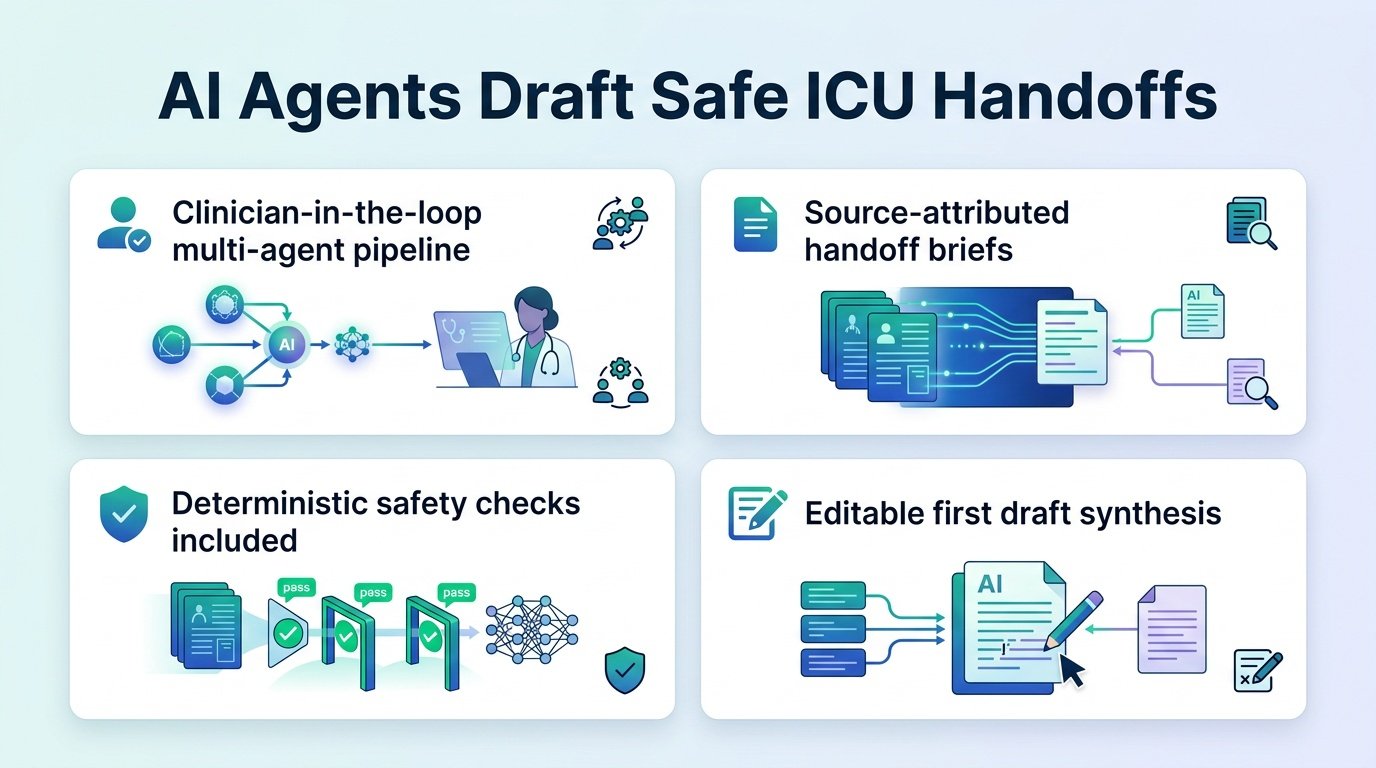
A new multi-agent AI pipeline proves that the safest way to use language models in hospitals is to stop treating them as autonomous writers and start using them as structured conflict detectors.
When a patient moves from the ICU to a general ward, the transition is notoriously dangerous. Crucial medical details frequently vanish in the administrative gap, leading to preventable medical errors. While many developers try to solve this by building autonomous AI scribes to write handoff notes, this approach misses the point. The real value of AI in high-stakes transitions is not its ability to write a smooth narrative, but its ability to spot contradictions in the medical record before a patient is moved.
A new preprint details PAUSE-Agents, a system designed to mirror the structure of an ICU team. It routes patient data through a scribe extractor, six specialized AI agents, and a series of safety checks. Instead of generating a final, unverified note, the pipeline creates an editable draft. This design choice shifts the AI’s role from an independent actor to a clinical assistant.
How the system performed
To test the system, researchers conducted a study in a single-center medical ICU. A group of 5 physicians completed 100 reviews of 84 agent-drafted briefs. The results suggest that structured, multi-agent pipelines can achieve clinical-grade accuracy without human intervention during the drafting phase.
- Physicians verified 98.8% of the claims made in the drafts, while only 1.2% were incorrect.
- A total of 88% of the briefs contained no pertinent omissions of clinical data.
- The drafts earned a mean quality score of 4.20 out of 5 on the PDSQI-9 scale.
- The system successfully flagged 118 conflict warnings and 421 safety flags during the drafting process.
Why this design matters
This performance challenges the current industry push toward fully autonomous clinical AI. By surfacing hundreds of conflict warnings, the tool forces clinicians to resolve discrepancies in the chart rather than blindly signing off on a generated summary. The AI acts as a digital safety net that makes documentation inconsistencies visible before the handoff occurs.
However, the study also highlights clear boundaries for the technology. The researchers tested an o4-mini model as an automated judge to grade the drafts. It showed limited case-level discrimination, meaning humans are still required to catch subtle errors. AI can monitor aggregate quality, but it cannot yet replace human oversight at the individual patient level.
Hospital administrators should take note. Do not buy AI tools that promise to take clinicians entirely out of the loop. Instead, invest in pipelines that highlight data conflicts and leave the final clinical decisions to human experts.
Read the full study on medRxiv.