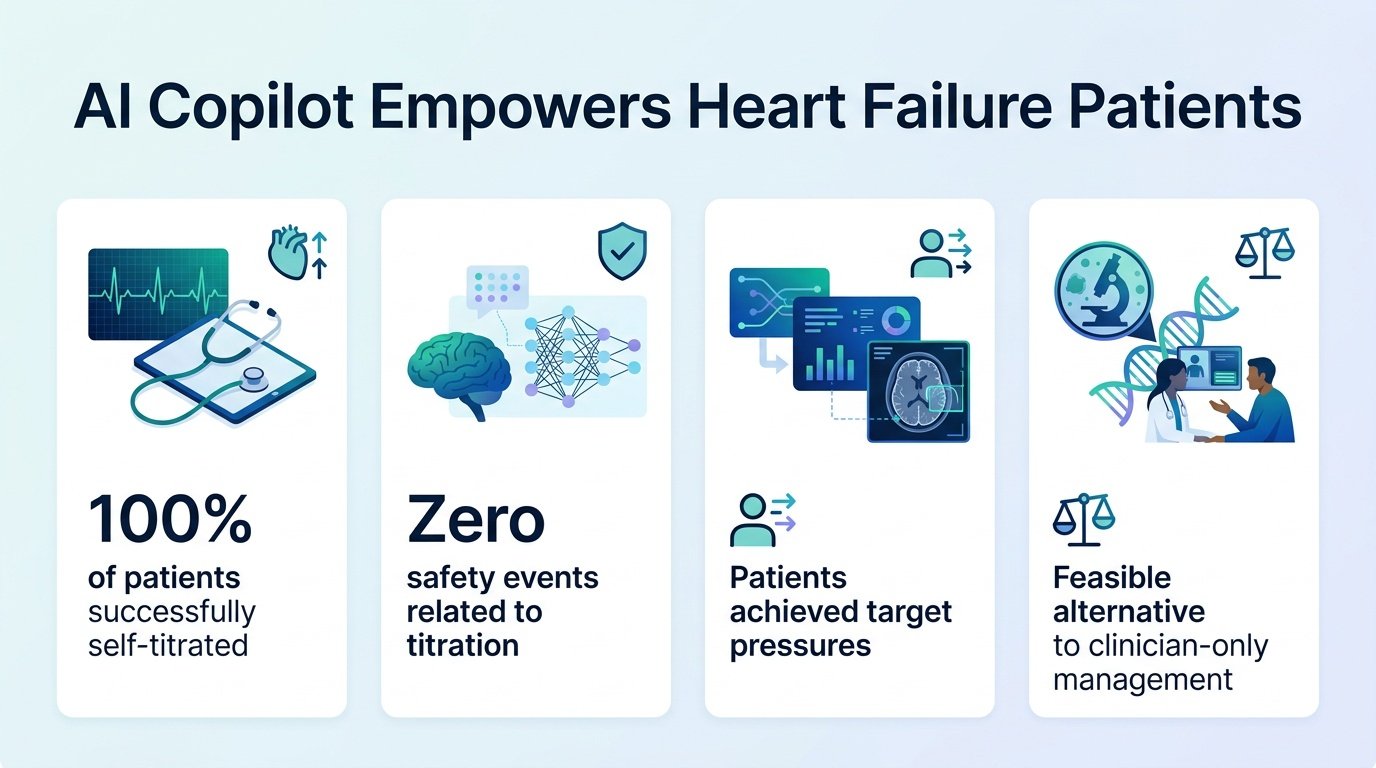
A new pilot study suggests heart failure patients can safely adjust their own daily diuretic doses using AI-guided sensor readings, shifting the burden away from overloaded clinical teams.
Why do we trust diabetics to inject insulin based on a finger-prick test, yet force heart failure patients to wait for a doctor’s phone call before changing a single pill? The current model of managing implantable pulmonary artery sensors does not scale. A single clinical team cannot manually review daily pressure readings for hundreds of patients without hitting a bottleneck. This trial challenges the assumption that hemodynamic data is too complex for patient-led care. It suggests we have been treating heart failure patients with too much fragility, keeping them passive rather than active partners in their own therapy.
By combining a deterministic medication algorithm with a domain-trained AI assistant named ARTHUR, researchers tested whether patients could run their own care loops. The AI prepared pre-determined dose adjustments based on sensor readings, which clinicians quickly confirmed before patients executed them. This shifts the clinical role from active manager to passive supervisor.
The safety trade-offs
The 90-day feasibility study tracked 21 adults with a mean age of 69 years (52% women) who had implanted sensors. Out of these, 19 completed the full protocol. While the study reported 0 pre-specified safety events like acute kidney injury or severe potassium imbalances, this finding comes with a major caveat. Only 5 out of 21 patients underwent post-adjustment lab draws, totaling just 8 blood tests. Because laboratory monitoring was so sparse, a meaningful harm rate cannot be ruled out.
Furthermore, the cohort was already highly stable at baseline. The mean baseline pressure was 14.8 mmHg, and the average pressure change was a negligible -0.89 mmHg. The AI did not have to rescue unstable patients; it merely kept stable ones on track. Whether this system can safely manage highly volatile, decompensating patients remains unproven.
Why this matters
This approach moves beyond traditional cardiac monitoring. Landmark trials like GUIDE-HF and MONITOR-HF established that tracking pulmonary pressures keeps patients out of the hospital. However, those trials relied on heavy clinical oversight. If AI can safely automate the triaging and preparation of these dose changes, cardiology clinics can dramatically scale their patient panels without adding staff.
- 92.1% reading adherence achieved by patients over the 90-day period.
- 88.4% of patient-months spent within the optimal target pressure range.
- 53 provider alerts generated, with zero clinician overrides.
- 89% of patients required no protocol-triggered escalations.
Ultimately, this pilot proves that patient-led, AI-assisted titration is logistically viable. The next step must be a randomized trial comparing this co-pilot model directly against standard provider-led care to prove it is just as safe as it is efficient.
Read the full study in medRxiv.