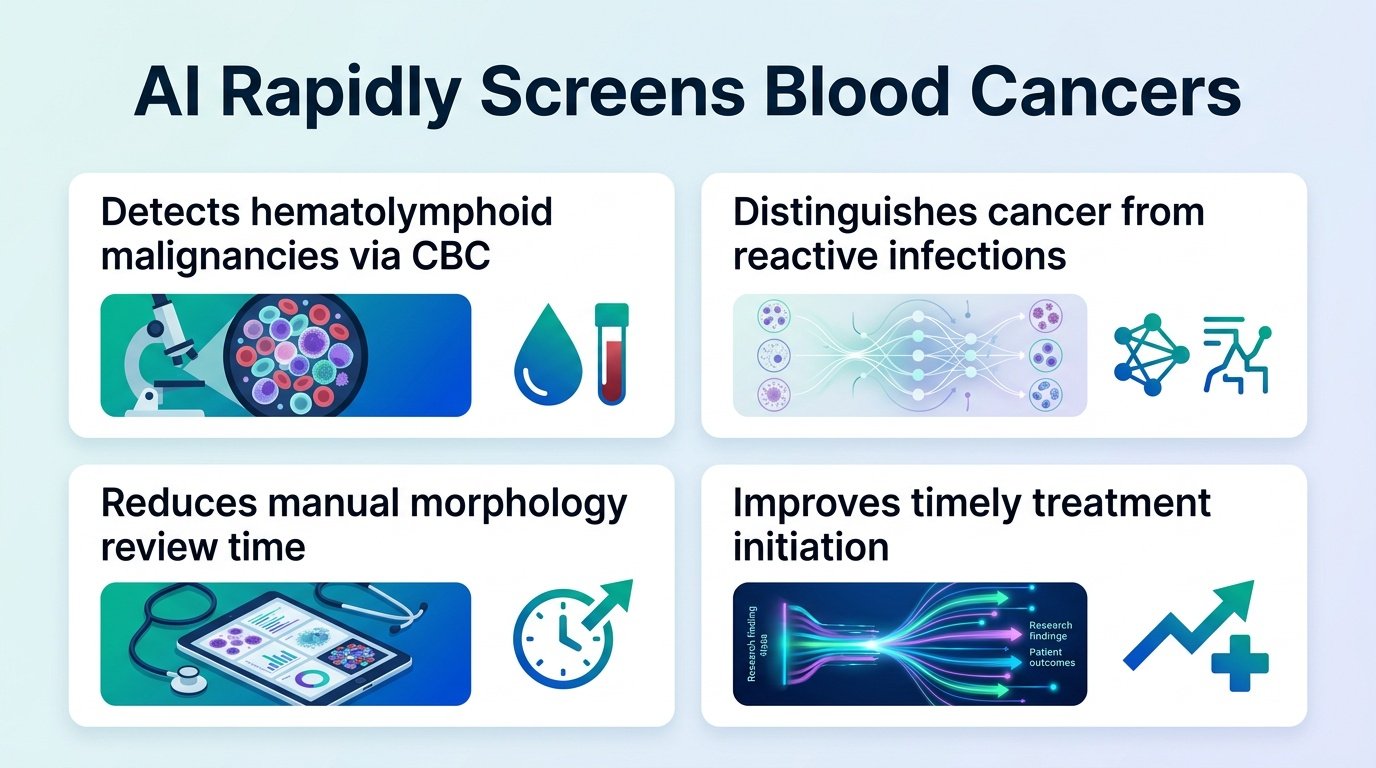
A new AI model turns the standard complete blood count into an instant classifier for leukemia and severe infections, bypassing the slow manual slide review that delays critical care.
When a patient presents with a dangerously high white blood cell count, doctors face a high-stakes guessing game. Is it a severe but common bacterial infection, or is it a rapidly progressing leukemia? Distinguishing between them usually requires a specialist to manually review blood smears under a microscope. This bottleneck costs precious hours when a patient’s life hangs in the balance.
This study challenges the assumption that we need complex, expensive genomic tests for early, highly accurate cancer triage. By squeezing hidden patterns out of the humble complete blood count (CBC), the AI proves that our most basic diagnostic tools are vastly underutilized. It shifts the diagnostic bottleneck from laboratory staffing to computational processing.
To build the model, researchers gathered a multicenter dataset of 4,996 CBC records from patients presenting with leukocytosis. These patients were ultimately diagnosed with either one of six prevalent hematolymphoid malignancies or acute bacterial and viral infections. The resulting multimodal model, named mDNN-cHM, fuses numerical CBC data with visual white blood cell scattergrams from a single test.
A Leap in Accuracy
The model’s performance metrics show a significant leap over traditional manual screening methods. By combining numbers and scattergram images, the system achieves near-perfect classification.
- The multimodal system achieved an internal AUC-ROC of 0.98 to 1.00.
- In external validation across different hospitals, it maintained an AUC-ROC of 0.95 to 1.00.
- It outperformed standard CBC review flag rules and both unimodal models (p < 0.05).
- The entire classification process takes less than 0.5 hours from sample receipt.
The Clinical Reality
This is not just about speed. In conditions like acute promyelocytic leukemia, starting treatment hours earlier can prevent fatal bleeding. By delivering an eight-way classification in thirty minutes, the tool acts as an automated triaging assistant.
However, we must look closely at the limitations. The model was trained on patients who already had confirmed diagnoses of either specific cancers or acute infections. Real-world emergency departments are messier. They are filled with patients suffering from chronic inflammatory conditions, multiple co-existing diseases, or rare hematological anomalies not represented in the 4,996 cohort. Before clinical adoption, we need to see how the algorithm handles these gray areas without generating false alarms.
Ultimately, this research confirms that the raw data generated by modern lab hardware contains far more diagnostic signal than human eyes can extract. The future of triage is not necessarily cheaper hardware. It is smarter software running on the machines we already own.
Read the full study in BMC Medicine.