A new AI agent named Biomni can design and run its own lab experiments, shifting the bottleneck of medical discovery from human labor to machine execution.
For decades, drug discovery has stalled because of the physical friction of lab work. What happens when an AI stops just suggesting ideas and starts running the actual instruments? That transition is the real story of modern biotechnology.
A new system called Biomni bypasses the usual human bottleneck. Instead of waiting for programmers to write custom code for every new experiment, this agent builds its own laboratory workflows on the fly. This shifts the AI healthcare debate from passive prediction to active, closed-loop execution.
While earlier efforts focused on augmenting large language models with chemistry tools, this new architecture maps the entire biomedical action space to run complex, multi-step projects alone. It represents a fundamental shift in how we design scientific workflows.
How the agent works
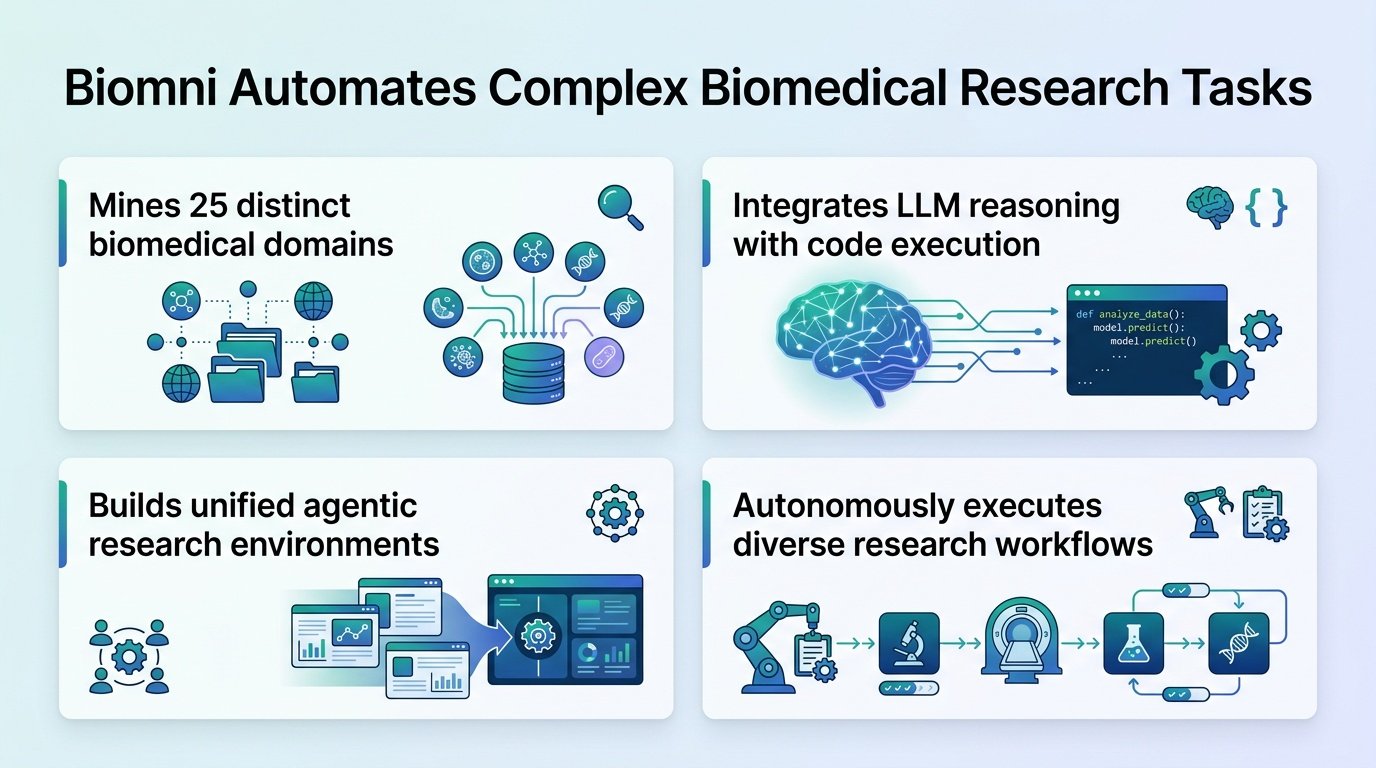
The system does not rely on rigid templates. Instead, its action-discovery agent mined databases, tools, and protocols from thousands of papers across 25 domains to build a unified environment. This allows the software to adapt to entirely new scientific challenges without manual reconfiguration.
By combining language model reasoning with code-based execution, the agent dynamically plans its next steps. It can interpret multi-modal datasets, optimize protein stability, and orchestrate physical wet-lab instruments without human intervention. This capability bridges the gap between digital computation and physical chemistry.
This integration is crucial. For years, biology has struggled with fragmented data silos. By unifying these tools into a single agentic environment, the system can jump from analyzing a microbiome dataset to writing a molecular cloning protocol in seconds.
Key performance areas
Researchers tested the agent across several complex scientific tasks. It demonstrated strong generalization across heterogeneous tasks without any task-specific tuning.
- Causal gene prioritization and rare-disease diagnosis.
- Drug repurposing and microbiome analysis.
- Molecular cloning and generating testable lab protocols.
This versatility is highly unusual. Most biomedical software is specialized, requiring constant retraining for new tasks. By mastering multiple domains at once, this agent proves that general-purpose AI can handle highly technical scientific workflows.
The limits of autonomy
The implications are massive, but we must look at the limits. An autonomous agent is only as good as the physical instruments it controls and the data it digests. If the underlying literature contains flawed protocols, the AI will execute those flaws with perfect efficiency.
Furthermore, real-world labs are messy. While the agent can orchestrate instruments, physical errors like clogged pipettes or temperature drifts still require human oversight. We are not looking at empty labs yet, but rather a future where scientists act as supervisors to machine fleets.
This transition mirrors the broader shift detailed in recent reviews of autonomous AI agents. The bottleneck is no longer the intelligence of the software, but the reliability of the physical interface. Scientists must now learn to manage these agents rather than perform the manual labor themselves.
This research was published in Science. Read the full study here.