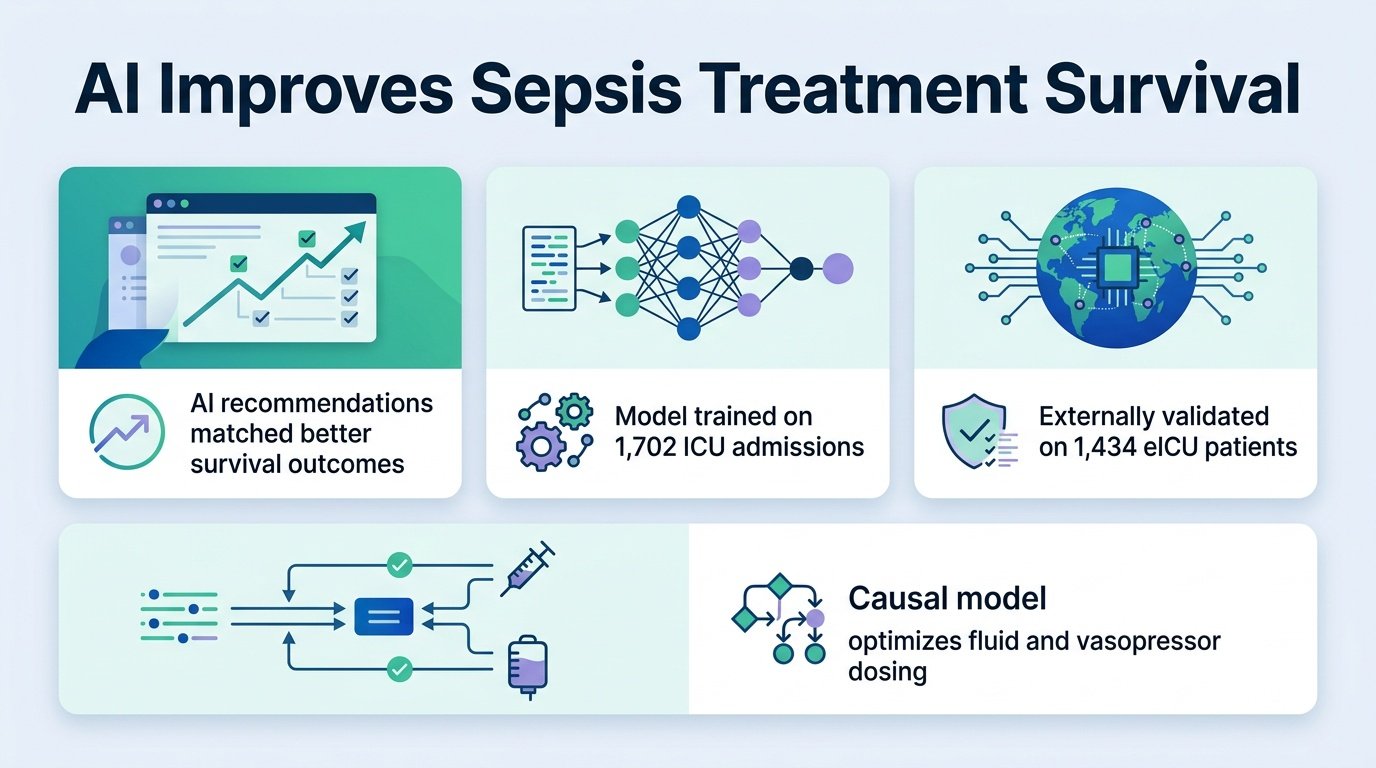
A new causal AI model shows that straying from its vasopressor dosing recommendations is tied to a fivefold increase in hospital mortality for septic shock patients.
How much fluid or blood-pressure medication does a dying sepsis patient actually need? Clinicians usually rely on gut instinct and broad guidelines to balance these fast-moving cases. This new study suggests that ignoring algorithmic advice on these tight margins carries a steep, quantifiable cost.
This challenges the traditional reliance on pure clinical intuition in the intensive care unit. It suggests that causal AI—which models cause and effect rather than just finding patterns—can map the messy reality of septic shock. Specifically, the data highlights that vasopressor timing is incredibly unforgiving compared to fluid volume, shifting how we should prioritize clinical decision support.
Mapping the clinical data
Researchers built a graphical causal inference model using clinical data from 3,136 ICU patients. The training set included 1,702 admissions from the MIMIC database, while 1,434 eICU admissions served as the external validation group. The cohort had a median age of 65 years, and 42.7% of the participants were female. The model focused on the first six hours of ICU admission, targeting survival and a 24-hour clinical improvement defined as a SOFA score reduction of two points or more.
Where the model succeeded
The study revealed a stark divide between fluid management and vasopressor dosing. The penalties for ignoring the AI’s recommendations were not distributed equally across treatments.
- Straying from vasopressor recommendations was linked to a median odds ratio of 5.61 for in-hospital mortality and 6.33 for failed clinical improvement.
- Fluid deviations had a much smaller impact, yielding a median odds ratio of 1.02 for mortality and 1.14 for failed improvement.
- In external validation, the model achieved a median survival AUROC of 0.73 and a clinical improvement AUROC of 0.69.
- Optimal fluids increased survival by up to 4% in low-severity patients, while vasopressor responses varied from 0.5% to 17% across different acute severity levels.
The limits of causal modeling
This finding forces us to rethink how we evaluate ICU decision support. The massive difference in mortality risk between fluid deviation and vasopressor deviation shows where the real clinical tightrope is. Doctors have more leeway with fluids, but vasopressor dosing is a high-stakes, narrow-window decision where algorithmic guardrails are desperately needed.
We must remain realistic about the limitations of this approach. While sensitivity analyses across 36 scenarios confirmed the primary associations in 91.7% of cases, this remains a retrospective analysis of database records. A predictive survival AUROC of 0.73 is respectable but not flawless, meaning the model still struggles with the extreme outliers of septic shock. Real-world prospective trials are required before software dictates the infusion pumps.
Read the full preprint in medRxiv.