A new AI model drafts emergency head CT reports that radiologists cannot tell apart from human work.
Can an AI safely decide who gets brain surgery first? In a crowded emergency department, doctors do not need a long-winded summary of chronic brain aging. They need to know, instantly, if there is an active bleed. This high-pressure environment is where general medical AI usually stumbles.
This study challenges the current push toward all-purpose medical models. Instead, it suggests that emergency medicine requires highly specialized, triage-first systems to be truly useful. By focusing purely on acute risks, the researchers created a tool that actually fits the chaotic workflow of an emergency room.
A specialized emergency tool
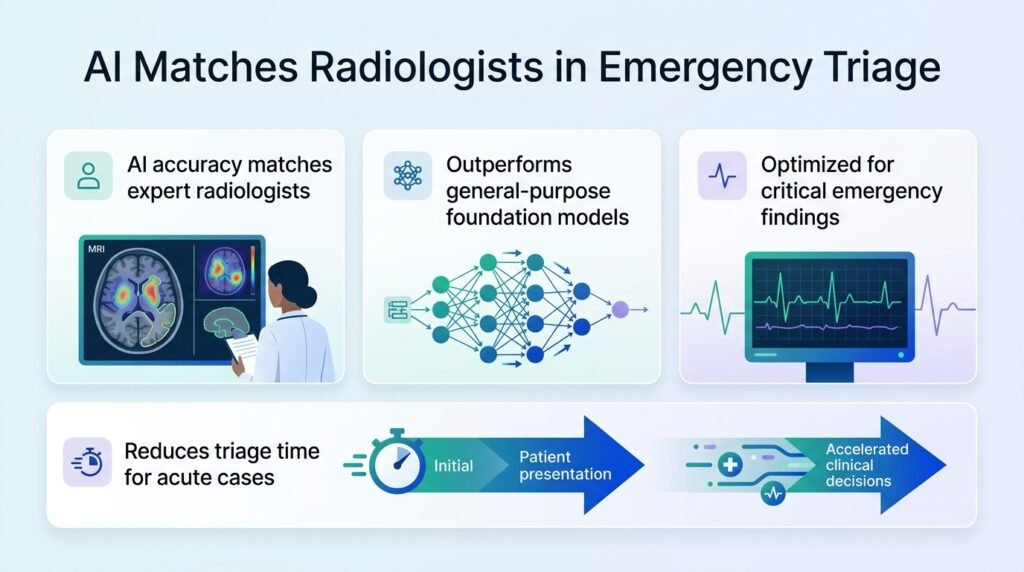
The researchers developed CHIEF, a Chinese-language foundation model trained specifically on emergency head CT volumes and paired reports. Unlike general models, CHIEF uses contrastive and generative objectives to prioritize risk-relevant findings. This means it ignores minor, chronic issues to highlight immediate threats like hemorrhages or strokes.
To test its real-world viability, the team gathered a large, diverse dataset. They trained and evaluated the model on 16,563 examinations sourced from seven different hospitals. This multi-center approach helps ensure the AI can handle scans from different machines and patient groups without losing accuracy.
What the data shows
The results show that a narrow focus yields much higher clinical utility than a broad, generalist approach.
- CHIEF achieved an AUROC of 0.9646 for emergency triage.
- It successfully supported image-to-text retrieval for reference cases and zero-shot abnormality recognition.
- In a blinded Turing test, radiologists could not reliably tell CHIEF’s reports apart from human-written ones.
- The model generated reports of substantially higher quality than those from commercial multimodal large language models.
The clinical reality check
This finding matters because emergency radiology is a constant bottleneck. If an AI can draft highly accurate, triage-ready reports, it cuts down the time a critical patient waits for a specialist to open their file. It turns the AI into an active clinical safety net rather than just a passive dictation tool.
However, we must be honest about the limitations. Because CHIEF was trained on Chinese-language reports, its language generation capabilities cannot be easily deployed in English-speaking health systems without extensive retraining. It also still requires a radiologist in the loop, meaning it is a decision-support tool, not a replacement for human judgment.
Ultimately, this work proves that the future of clinical AI lies in specialization. Trying to build one AI that does everything is a distraction when lives depend on models that do one urgent thing exceptionally well.
Read the full study in medRxiv.