Your calendar age says you are fifty, but a quick heart scan might prove your cardiovascular system is already running on borrowed time.
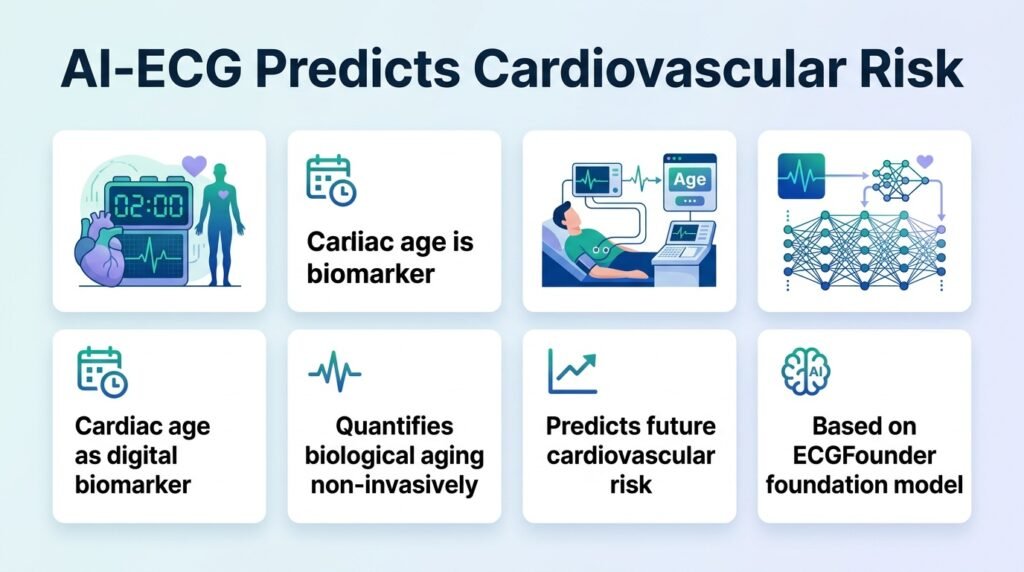
Doctors have long relied on cholesterol levels and blood pressure to guess when a heart might fail. But these static metrics often miss the silent, accelerated aging happening inside the cardiac muscle itself. By turning a standard electrocardiogram into a biological clock, researchers are shifting the focus from managing symptoms to measuring systemic decay.
This builds on previous attempts to use the 12-lead electrocardiogram as a biomarker of biological age. The real shift here is the scale of validation, proving that an AI-derived “age gap” is not just a statistical quirk but a highly sensitive warning light.
Testing the biological clock
To prove the model’s worth, researchers built an AI framework called ECGFounder. They trained it on a development cohort of 26,871 healthy individuals, where it matched calendar age with a mean absolute error of 5.12 years and a correlation of 0.55. The team then tested the tool on a clinical evaluation cohort of 40,953 UK Biobank participants, drawing from a total pool of 67,824 ECGs from 63,512 people.
They did not stop there. The researchers pushed the model through rigorous external validation using 55,860 hospital patients from Tianjin Medical University and 27,065 community members from the Kailuan cohort. Grouping these massive, diverse populations makes the findings hard to dismiss as a localized fluke.
The cost of older hearts
The clinical implications of an accelerated heart age are stark. When the AI calculates a heart age that exceeds a patient’s actual calendar age, the risk of major adverse cardiovascular and cerebrovascular events (MACCE) climbs rapidly.
The statistical breakdown reveals a clear, escalating scale of risk:
- Each single-year increase in the cardiac age gap correlates with a 13% higher risk of major cardiovascular events.
- Patients with an overestimated age gap of more than 6 years face a massive 4.51 hazard ratio for MACCE.
- Conversely, those with a younger heart (an age gap under -6 years) enjoy a protective effect, with a hazard ratio of just 0.46.
Rethinking preventative care
This finding challenges the traditional, reactive model of cardiology. Instead of waiting for a patient to develop high blood pressure, clinicians could use this digital biomarker to catch occult accelerated aging years before physical symptoms appear. It turns a cheap, ubiquitous test into a sophisticated prognostic tool.
However, we must remain realistic about the limitations. While the correlation in healthy individuals is solid, a mean absolute error of over five years means the model still has a wide margin of uncertainty for individual patients. Clinicians cannot treat the AI’s age estimate as an absolute truth, but rather as a highly sensitive flag for closer monitoring.
Read the full study on medRxiv.