
A new analysis of wearable data shows that tracking how we move during sleep can flag Parkinson’s risk a decade before clinical symptoms appear.
Can a cheap wristband do what expensive neurological workups often miss? For years, doctors have known that REM sleep behavior disorder (RBD)—where people physically act out dreams—is a major warning sign for Parkinson’s disease. But diagnosing this sleep disorder usually requires overnight sleep lab testing, which is too expensive and rare for mass screening.
This preprint challenges the idea that we need clinical-grade sleep labs to find high-risk patients. By turning raw movement data into a digital biomarker, researchers are bypassing the clinic entirely. It suggests that passive, continuous monitoring in the home is actually superior to active medical screening.
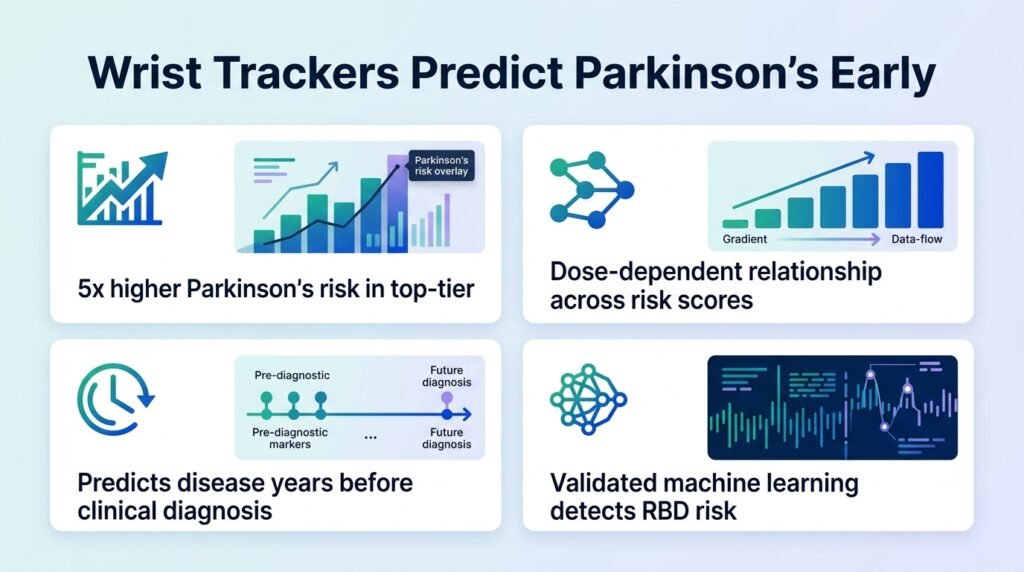
Researchers analyzed 7-day wrist accelerometry data from 87,975 UK Biobank participants who were followed for 10 years. They used a machine learning classifier to score RBD risk from these movement patterns. Participants in the highest risk group, representing the top 1% of scores, had an approximately fivefold increased hazard of developing Parkinson’s compared to the lowest-risk group.
The power of passive data
The real value here is how this digital marker interacts with genetics. The risk prediction remained independent of a patient’s Parkinson’s polygenic risk score. When researchers combined the high RBD score with genetic risk, the positive likelihood ratio jumped to 7.91, which is approximately threefold higher than traditional questionnaire-based screening.
Questionnaires rely on patient recall or a partner’s complaints, both of which are notoriously unreliable. A tracker does not forget. Even for participants who did not develop Parkinson’s during the study, a high RBD score was not a false alarm. These individuals showed baseline cognitive deficits and a steady buildup of autonomic and psychiatric symptoms over the decade.
- The algorithm identified a fivefold increased hazard of Parkinson’s in the highest-risk percentile.
- High RBD risk scores correlated with baseline cognitive deficits and worsening psychiatric symptoms over time.
- Combining movement data with genetics yielded a 7.91 positive likelihood ratio.
The limits of prediction
We must treat these findings with caution. This is a preprint, meaning it has not yet completed peer review. The UK Biobank cohort also skews healthier and wealthier than the general population, which can bias the algorithm’s real-world accuracy.
Even with these caveats, the implications are clear. We are moving away from reactive neurology. If a week of passive wrist tracking can outperform standard clinical questionnaires, then consumer wearables are no longer just fitness toys. They are the new frontline of neurodegenerative triage.
Read the full study in medRxiv.