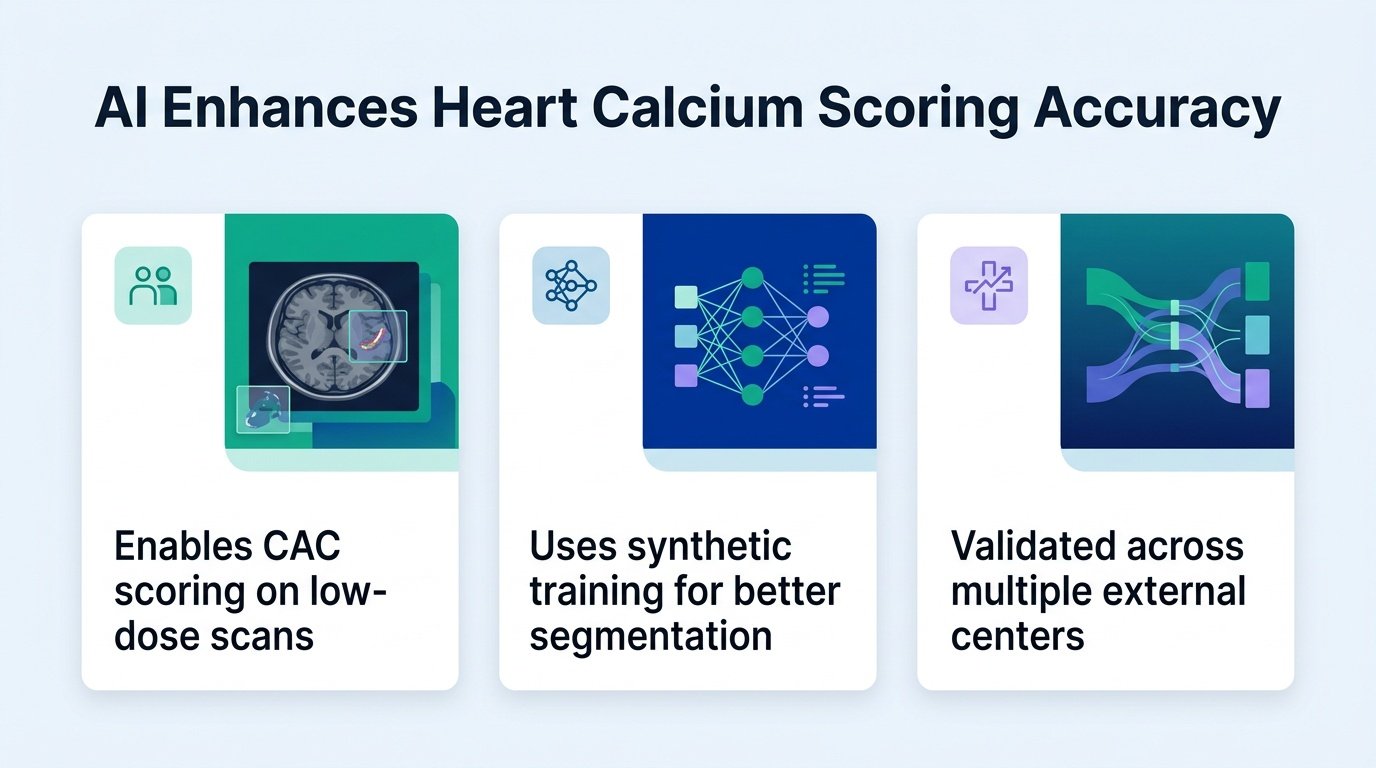
A new machine learning method extracts high-quality heart disease risk data from low-dose scans that doctors usually ignore for calcium scoring.
Why do we waste valuable clinical data just because an image is blurry? Every year, millions of patients undergo low-dose CT scans for various medical reasons. These scans capture the heart, but because they are not synced to the heartbeat, the motion makes coronary calcium look like a smear. Doctors typically ignore these scans for calcium scoring, forcing patients to get a second, more expensive gated scan.
This study challenges the assumption that we need expensive, dedicated hardware to get precise clinical metrics. By using synthetic data to bridge the gap between high-quality and low-quality images, researchers showed that AI can salvage clinical utility from noisy, cheap scans. This shifts the bottleneck of cardiac risk assessment from hardware availability to software intelligence.
Testing the AI model
The researchers developed a method called KAD-CAC. It generates synthetic, ungated CT scans from high-quality gated scans, allowing the AI to learn from expert annotations without losing alignment. This allows the model to accurately spot calcium in blurry, ultra-low-dose attenuation correction scans.
To prove the model works in the real world, the team tested it externally across multiple centers. The external test cohort included 5,969 patients with a median age of 64 years, and 50.2% of the participants were male. The KAD-CAC model achieved a Cohen’s kappa of 0.86 for agreement with expert readers, significantly outperforming previous methods.
The key results show a clear step forward in diagnostic accuracy:
- The model achieved a high agreement score of 0.86 against expert human readers.
- It outperformed traditional deep learning models trained only on gated images, which scored 0.81 (p<0.01).
- It beat a previous convolutional LSTM model, which scored 0.78 (p<0.01).
- It provided the greatest net reclassification improvement for predicting death or myocardial infarction over standard clinical risk factors.
The clinical implications
This is not just about a higher statistical correlation. It means patients undergoing routine nuclear medicine scans can now get an accurate coronary calcium score for free. It turns a throwaway calibration scan into a powerful tool for predicting heart attacks without extra radiation or cost.
This approach aligns with broader trends in cardiovascular medicine. Researchers are increasingly looking at how advanced computational models can extract hidden risk factors from routine clinical data, as discussed in a recent review on Large Language Models in Cardiovascular Imaging.
Remaining clinical hurdles
However, synthetic data is not a perfect substitute for physical reality. While the model performed well across different centers, synthetic training can sometimes introduce subtle biases if the source gated scans do not represent diverse patient populations. Furthermore, clinical workflows must adapt to handle these opportunistic findings without causing unnecessary patient anxiety or over-treatment.
Read the full study in medRxiv.