A new digital twin model shows that one-third of heart failure patients fail cardiac therapy because surgeons are aiming at the wrong target.
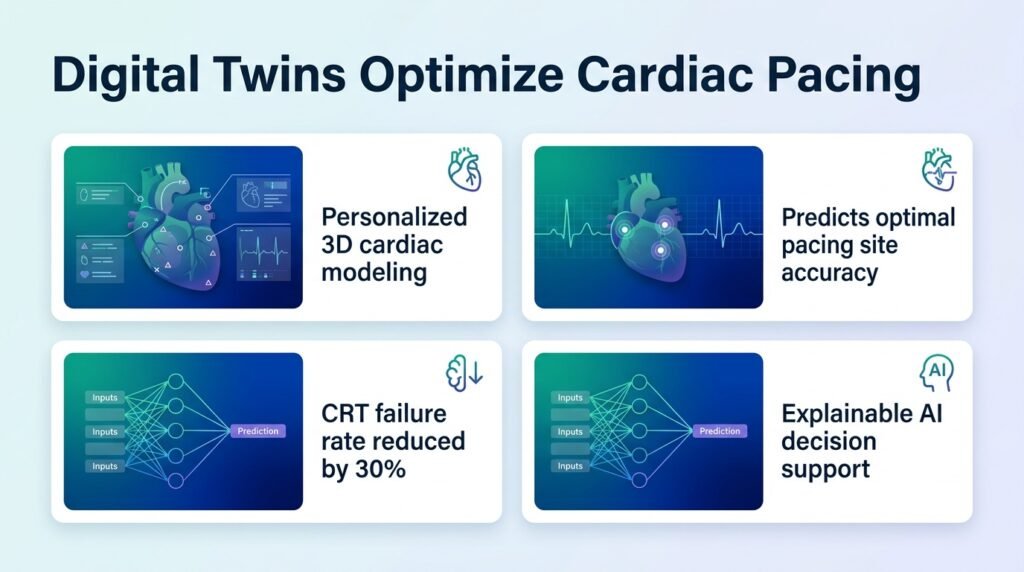
Why does a standard $30,000 heart implant fail in nearly 30% of patients? For decades, cardiologists have threaded pacing leads into the coronary sinus using standardized guidelines. They are essentially guessing the best spot to deliver electrical pulses.
This high failure rate is not an inevitable biological dead end. Instead, it is a spatial design flaw that we can now simulate and correct before the first incision. By combining 3D digital twins with machine learning, this framework shifts the clinical question from whether a patient will respond to exactly where we must pace them to guarantee success.
Mapping the target zone
Researchers built personalized 3D cardiac models for 74 patients using CT scans and MRI data. They simulated electrical activity across the ventricles and trained a machine learning classifier to predict therapy response. The model achieved an accuracy of 0.78 and an F1-score of 0.75, easily outperforming the standard Feeny clinical calculator, which managed just 0.58 accuracy and a 0.43 F1-score.
This approach builds on previous attempts to classify cardiac patients, such as earlier research on characterizing CRT response through machine learning and personalized models. However, this new framework goes a step further by mapping the physical anatomy of the coronary sinus to find viable implant pathways.
The team tested this spatial mapping on a pilot cohort of 19 patients. The results suggest that current surgical practice is blind to anatomical realities.
- The model revealed that 8 of 13 clinical non-responders had zero accessible pacing sites that could yield a positive response, meaning they should have skipped this surgery entirely.
- For the remaining 5 non-responders, the algorithm identified alternative implantable sites that had a high probability of success.
- The system achieved a sensitivity of 0.80 and a specificity of 0.77 during validation, with a bootstrap mean AUC of 0.85.
The end of guesswork
This matters because it provides a clear exit ramp for patients destined to fail. Instead of subjecting a patient to an ineffective, invasive procedure, clinicians can immediately pivot to alternative pacing strategies. For the others, it turns a blind procedure into a targeted strike.
But the workflow is not ready for prime time. Creating these digital twins requires high-resolution CT and MRI imaging, which adds cost and clinical complexity. The pilot cohort of 19 patients is also far too small to justify a shift in surgical guidelines. We need prospective clinical trials to prove that software-guided lead placement actually translates to longer patient survival.
Read the full study in medRxiv.