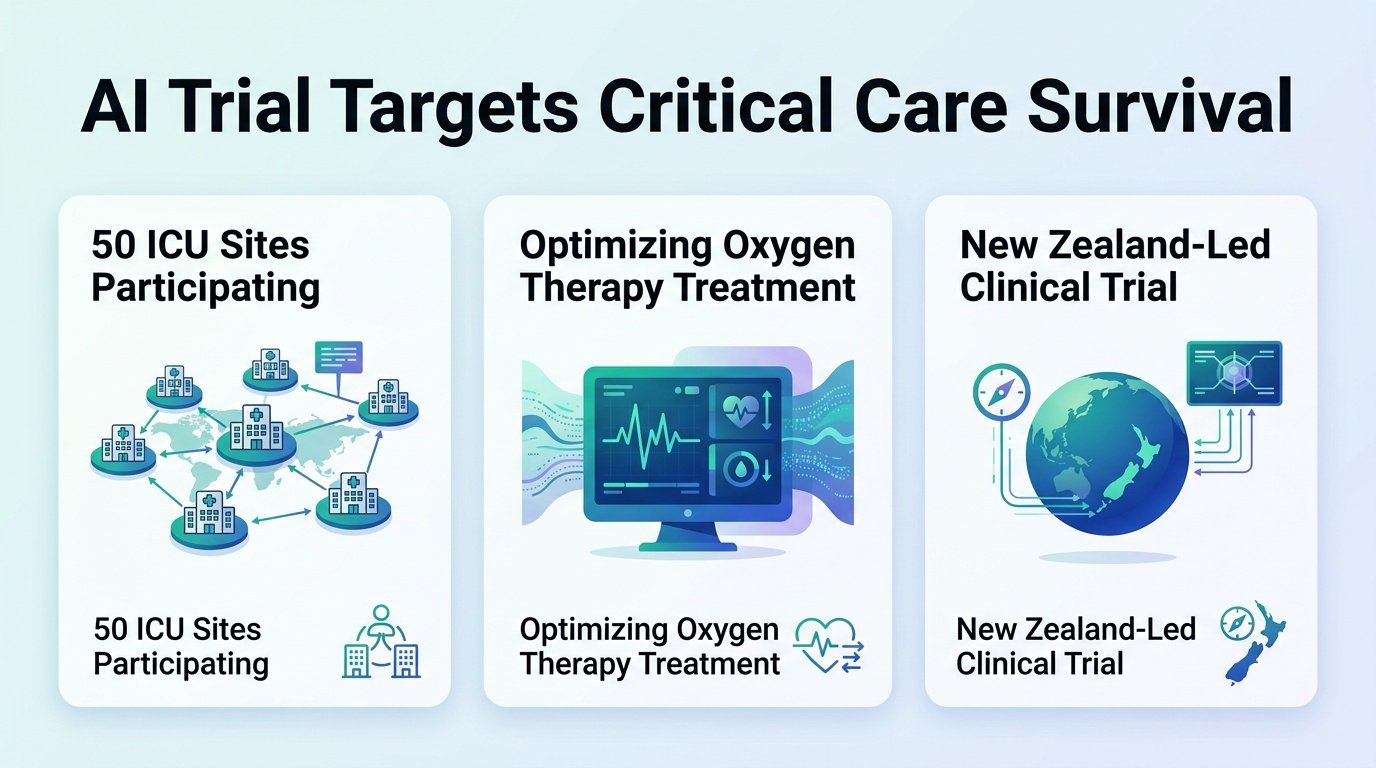
An ambitious clinical trial across Australasia is about to test whether machine learning can make split-second decisions to save critically ill patients.
For decades, intensive care units have relied on standardized protocols to keep patients alive. Oxygen therapy is a prime example. Clinicians typically apply a one-size-fits-all target, even though every human body responds differently to critical stress.
Now, a major trial across 50 intensive care units in New Zealand and Australia is challenging this baseline. Researchers are deploying machine learning models to predict how individual patients will respond to oxygen therapy in real time.
The shift to active algorithms
This is not just another passive diagnostic tool. The trial represents a shift toward active bedside algorithmic decisions. Using data from a previous 40,000-patient trial, the model will guide treatment dynamically.
The $5 million initiative, funded by the Health Research Council of New Zealand, highlights a broader regional strategy. The country is quietly positioning itself as a testbed for clinical AI, running projects from stroke imaging to smart monitoring.
The clinical trust barrier
But the true test of this technology is not the math. It is the human element.
For bedside AI to succeed, it must overcome deep-seated trust barriers. ICU doctors are trained to rely on clinical intuition and established guidelines. Asking them to defer to an algorithm during a crisis is a massive cultural shift.
If this trial succeeds, it proves that machine learning can safely handle the chaotic environment of intensive care. If it fails to win over clinicians, it may push back the adoption of active bedside AI for years.