AI Flags High Risk Pregnancy in Tanzania Clinics
A new algorithm catches every high-risk pregnancy case in Tanzania, but its high false-alarm rate will test the limits of busy clinics.
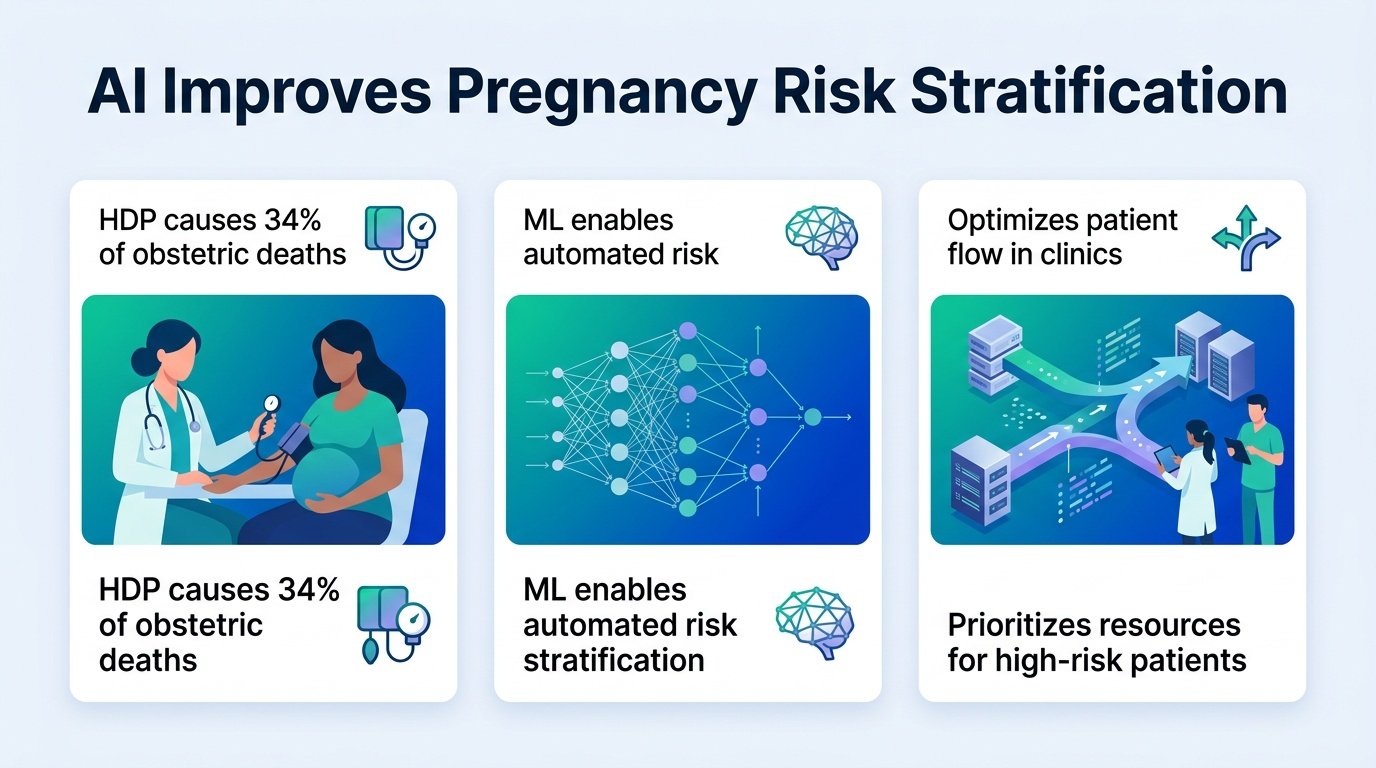
How do you save pregnant mothers when a single blood pressure check is the only tool available? In Tanzania, hypertensive disorders of pregnancy cause 34% of direct obstetric deaths. Overburdened government clinics face massive patient volumes, meaning doctors often miss the warning signs until it is too late.
This reality challenges how we define clinical utility for machine learning. Standard AI models chase high precision to avoid annoying doctors with false alarms. This new research flips that logic, prioritizing perfect safety over clinician convenience. It suggests we must rethink what makes an algorithm “good” in a crisis zone.
The data behind the triage
Researchers analyzed 337,027 routine records from Tanzania’s Unified Community System spanning 2023 to 2024. They aggregated these into 187,438 unique client records, defining hypertension at the standard threshold of 140/90 mmHg. The team then validated their top algorithm on an independent dataset of over 120,000 records.
The resulting XGBoost model delivered striking performance metrics:
- Achieved 90.1% overall accuracy and an AUC of 0.95.
- Maintained 100% sensitivity, successfully flagging 12,603 high-risk clients.
- Registered a low precision of 14%, which translates to 6.3 false positives for every true case.
The cost of perfect safety
A 14% precision rate means clinicians will spend time reassessing six healthy women for every one true patient they find. In a congested clinic, this could trigger alarm fatigue. Yet, in areas where missing a single patient can be fatal, this trade-off is entirely rational. This contrasts with traditional approaches that rely on complex biomarkers, as discussed in a review of AI in Hypertensive Disorders of Pregnancy.
This shifts the goal of AI from diagnostic perfection to operational triage. Instead of replacing doctors, the tool acts as a wide net to catch patients before they deteriorate. This aligns with broader efforts to improve maternal outcomes in resource-limited settings, such as those highlighted in Frugality to Functionality.
However, the model relies entirely on the quality of routine digital data. If clinic staff enter poor data into the Unified Community System, the triage system falls apart. The Tanzanian Ministry of Health must invest in data integration before this tool can run safely in primary care.
This analysis is based on a study published in PLOS Digital Health.