The shift from chatbots that answer questions to autonomous agents that execute medical tasks is happening faster than our safety guardrails can adapt.
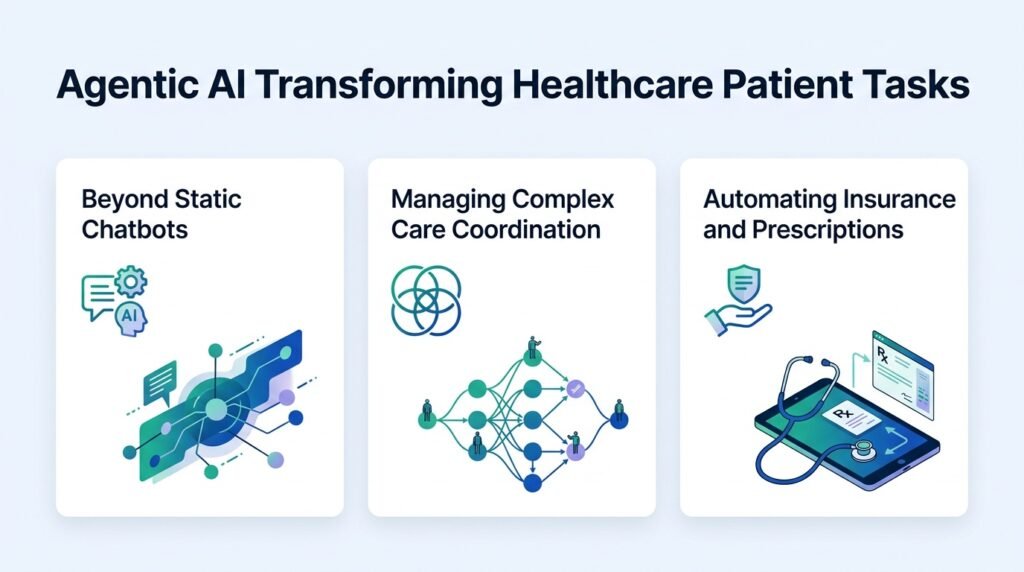
We are moving past the era of passive healthcare chatbots. Instead of merely transcribing doctor-patient conversations or answering basic health queries, a new wave of “agentic” AI is taking control of actual clinical and administrative operations. Industry giants like Epic, Google Cloud, and GE HealthCare are deploying multi-agent systems designed to automate scheduling, manage prescriptions, and handle complex prior authorizations.
The Bot-to-Bot Trap
The immediate risk of this automation push is a total loss of human oversight. Industry analysts are already warning of a future dominated by autonomous “bot-to-bot” communication. In this scenario, insurance company bots negotiate directly with hospital provider bots to approve or deny patient care. When algorithms talk only to algorithms, the patient is left entirely out of the loop.
This rush toward delegation is colliding with a harsh reality. Recent evaluations show that nearly half of AI-generated medical responses remain inaccurate or incomplete. Despite these errors, desperate patients are increasingly turning to AI over human professionals for quick medical advice. Handing operational keys to agents that still fail to get the facts right fifty percent of the time is a massive gamble.
The Real Cost
If an AI agent books the wrong specialist or fails to secure a critical insurance approval, the clinical consequences are real. Healthcare systems cannot treat autonomous agents like simple software upgrades. Until these systems can prove their accuracy, delegating tasks without strict human-in-the-loop oversight is a major liability.