Dermatology algorithms are quietly biased against gender, but forcing them to look at actual skin lesions instead of demographic noise might finally fix the problem.
Why does a computer vision tool need to know a patient’s gender to spot skin cancer? It does not. Yet deep learning models routinely pick up on hidden gender cues in medical images. This leads to unequal diagnostic accuracy across different demographic groups.
This disconnect is the real story. For years, developers assumed that feeding more diverse images into a neural network would automatically solve bias. This study challenges that passive approach. It suggests that raw data diversity is not enough. To make algorithms fair, we must actively restrict what the machine is allowed to see.
How the model works
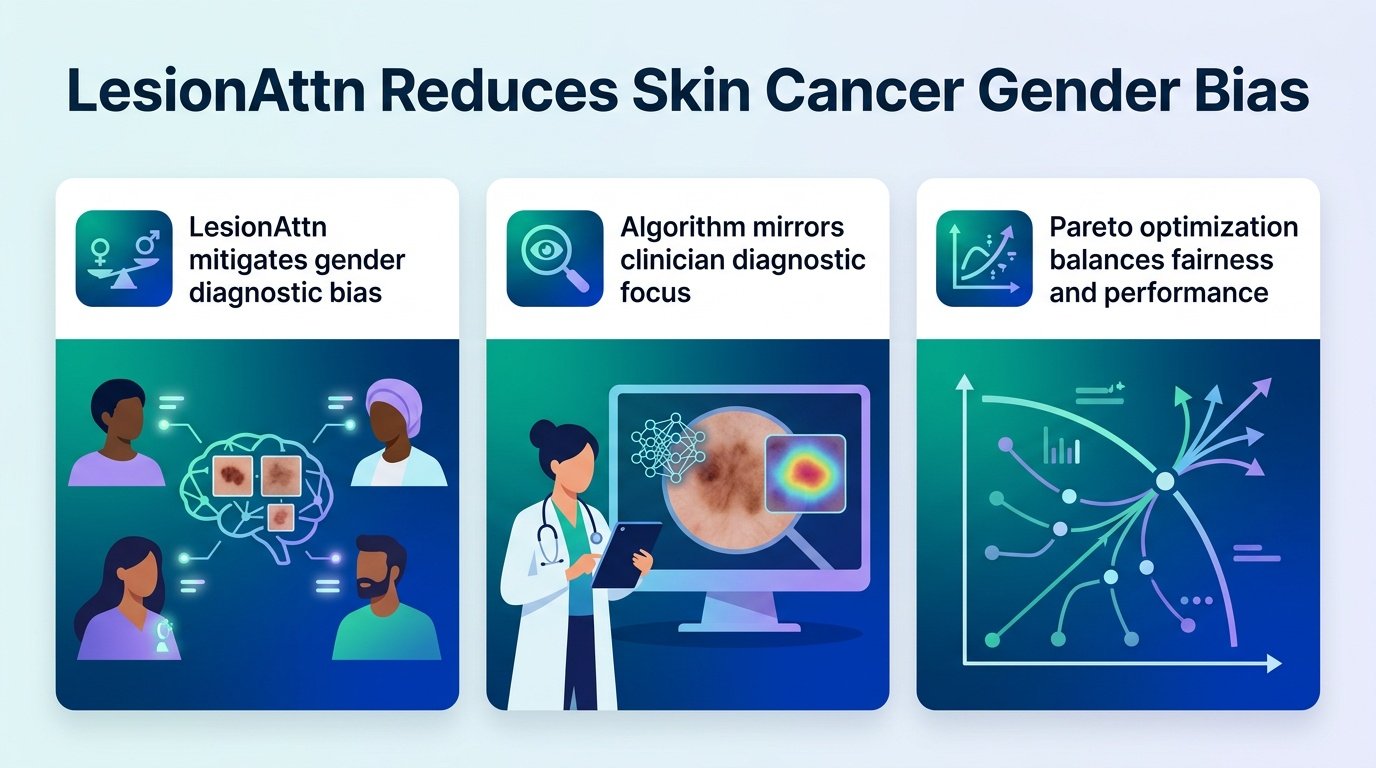
A new study introduces LesionAttn, an algorithm designed to force AI to focus only on the physical lesion. By directing the model’s attention away from surrounding skin and background noise, researchers targeted a major blind spot in dermatological AI. They wanted the model to mimic the diagnostic focus of a human clinician.
The team combined this attention-guiding mechanism with Pareto Frontier optimization. This mathematical approach balances two competing goals. It keeps diagnostic accuracy high while minimizing the fairness gap between genders. The researchers validated their model using two large-scale dermatologic datasets for binary malignancy classification.
The results showed that LesionAttn successfully reduced gender bias without sacrificing overall diagnostic performance. It proved that clinical guardrails can make software both fair and highly accurate.
Why this finding matters
This matters because it moves bias mitigation away from lazy statistical patching. Instead of trying to mathematically balance biased outputs after the fact, this approach builds clinical logic directly into the neural network’s vision. It proves that “black box” learning is a liability in medicine.
If an AI must mimic human clinical priors to be fair, then unguided machine learning is fundamentally flawed. True fairness in medical AI requires strict, top-down rules. We must design systems that are intentionally blind to non-medical features.
Key study outcomes
- The algorithm significantly mitigated gender bias across both large-scale validation datasets.
- It maintained high diagnostic performance for binary malignancy classification, proving fairness does not require sacrificing accuracy.
- The model outperformed existing bias-mitigation algorithms by focusing on clinical priors rather than raw statistical adjustments.
The remaining hurdles
We must be honest about the limitations. While the study proves the concept on retrospective datasets, we still do not know how LesionAttn performs in messy, real-world clinical workflows. Different lighting, camera types, and varied skin tones could still throw off the attention maps. True validation will require prospective clinical trials.
Ultimately, this study proves that medical AI cannot be left to find its own patterns. To make algorithms safe for everyone, developers must actively teach them what to ignore.
Read the full analysis in npj Digital Medicine.