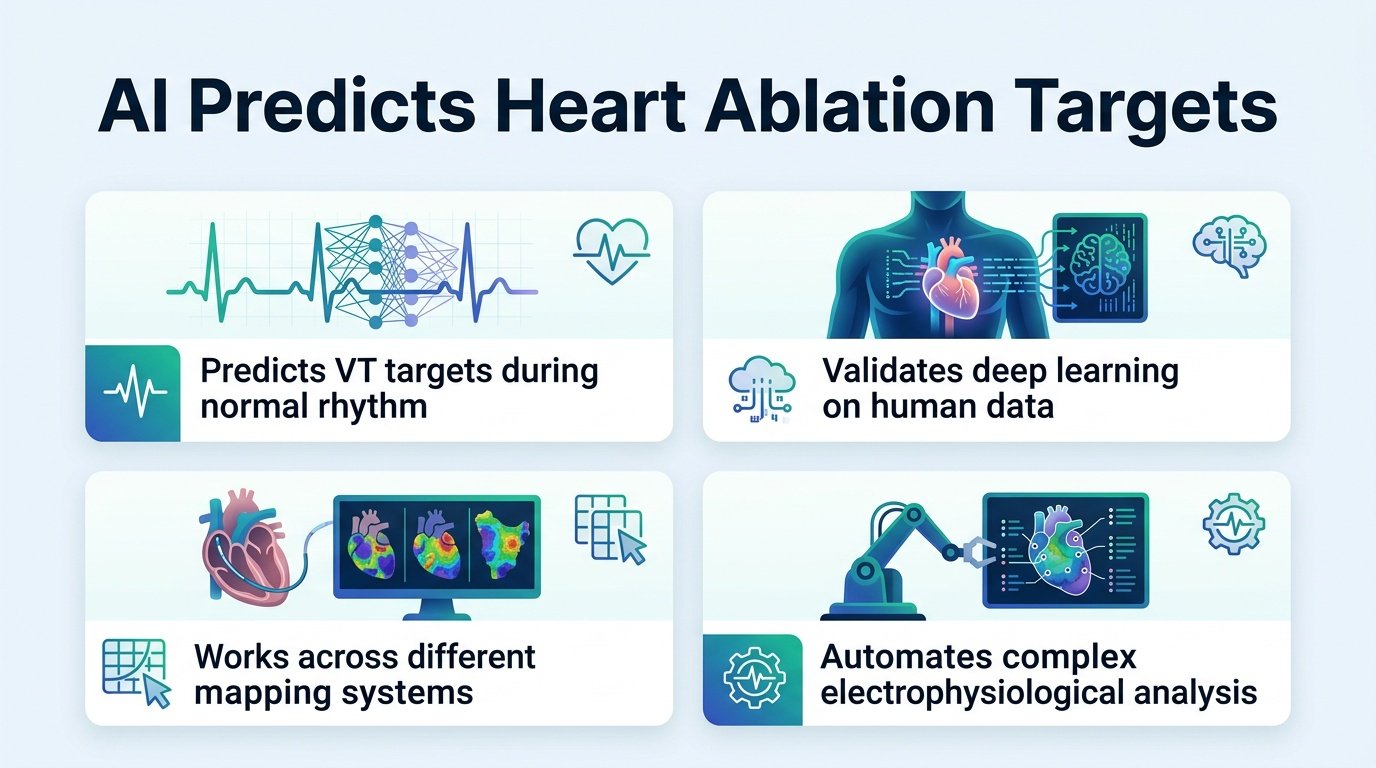
A new deep learning model can locate dangerous heart arrhythmia targets without needing to trigger the life-threatening rhythm first.
To fix a racing heart, doctors usually have to trigger the very chaos they want to stop. They induce ventricular tachycardia (VT) in a vulnerable patient to map the short circuit. It is a risky, high-stress game of chicken.
A new preprint challenges this paradigm. By analyzing the heart’s quiet moments instead of its chaotic ones, researchers showed that artificial intelligence can map these targets during normal sinus rhythm. This shifts the clinical burden from patient endurance to computational power.
How the AI maps
The study evaluated a deep learning approach using data from 34 patients with structural VT undergoing catheter ablation. The researchers trained three machine learning models using cardiac mapping data acquired during normal sinus rhythm and ventricular pacing. The top performer was a graph convolutional network (GCN) that merges electrical signal waveforms with three-dimensional heart geometry.
This geometric integration is the critical step. Instead of treating the heart as a flat grid, the GCN analyzes the electrical signals as they flow through the physical curves of the heart tissue. The development dataset included 21 patients mapped with the Advisor HD grid, while the validation dataset used 13 patients mapped with different clinical systems.
The key numbers
The model performed best when analyzing unipolar electrograms during normal sinus rhythm. This success likely stems from two factors: unipolar signals capture repolarization dynamics, and normal rhythm maps offer a much higher density of data points.
The system achieved the following metrics in the trial:
- A median area under the curve (AUC) of 0.793 for target discrimination.
- A sensitivity of 83.6% in identifying the critical ablation zones.
- A specificity of 69.0%, helping avoid unnecessary tissue damage.
These results held up during external validation. This consistency suggests the AI is learning actual cardiac physics, not just the quirks of one hospital’s mapping machine. The target was defined as mapping points within 8 mm of VT isthmuses, proving the model can pinpoint targets with high spatial precision.
The clinical reality
Why does this matter? Inducing VT during a procedure can cause a patient’s blood pressure to crash, forcing emergency shocks. Mapping in sinus rhythm makes the procedure safer, faster, and accessible to sicker patients who cannot tolerate induced arrhythmia. It turns a chaotic emergency procedure into a controlled, planned intervention.
However, a specificity of 69.0% means the AI still flags healthy tissue as a target. Over-ablation can weaken the heart muscle, so electrophysiologists cannot blindly trust these predictions yet. The small sample size of 34 patients also means this model needs testing on a much larger scale before it enters the operating room.
Ultimately, this study proves that the signature of a deadly arrhythmia is hidden inside a normal heartbeat. We just needed the right math to see it.
Read the full study in medRxiv.