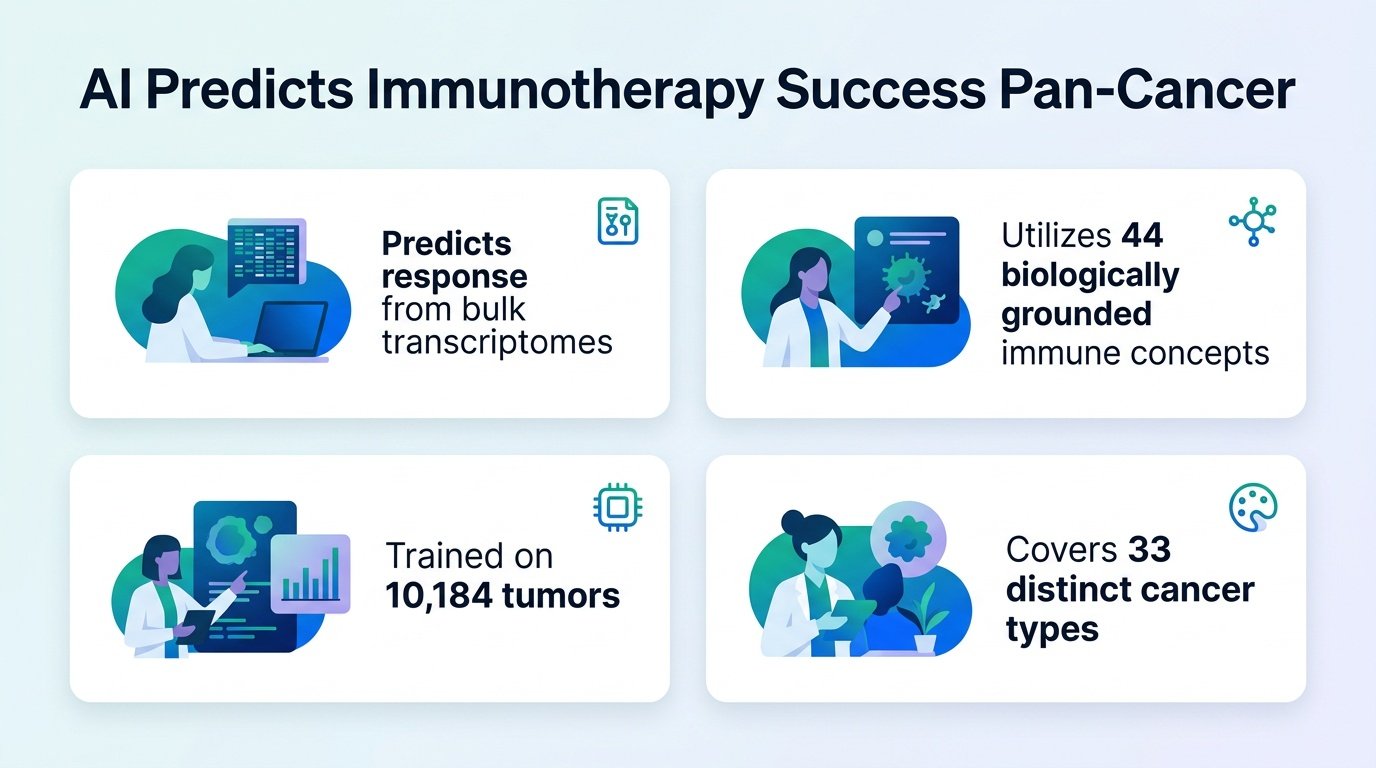
A new AI model predicts immunotherapy success across different cancers by translating complex genetic data into clear biological concepts.
Why do most cancer patients fail immunotherapy when the treatment is hailed as a major medical breakthrough? The problem is not always the drugs, but our inability to predict who they will actually help. Existing biomarkers work well for one specific tumor type but fail when applied to another, leaving doctors to rely on educated guesswork.
This diagnostic gap forces clinicians into a costly game of trial and error. A new foundation model called COMPASS challenges this status quo by proving that AI does not need to be an uninterpretable black box to generalize across different diseases. By mapping raw genetic data to 44 distinct immune concepts, it bridges the gap between raw statistical power and biological reality.
Researchers trained the model on a dataset of 10,184 tumors across 33 cancer types. When tested against 22 existing prediction methods across 16 clinical cohorts, COMPASS consistently came out ahead. The model improved predictive accuracy by an average of 8.5% and boosted the area under the precision-recall curve by 15.7% across cohorts spanning seven cancers and six different drugs.
How the model works
Instead of jumping straight from complex gene expression data to a survival prediction, COMPASS uses a concept-bottleneck transformer. This architecture forces the AI to route its calculations through 44 biologically grounded immune concepts, representing specific cell states and signaling pathways. This design choice makes the model’s reasoning process visible to human researchers.
- Patients classified by the model as responders had significantly longer overall survival, with a hazard ratio of 4.7.
- The system successfully generalized to cancer types and drug treatments that were completely absent during its training phase.
- In patients with inflamed tumors who still failed to improve, the AI identified specific resistance programs, including TGF-beta signaling and CD4+ T cell dysfunction.
The clinical reality check
This biological transparency is the real value of the research. For years, drug developers have struggled to understand why some “hot” tumors with plenty of immune cells still resist therapy. By pointing directly to endothelial exclusion and B cell deficiency, COMPASS moves beyond simple prediction and starts generating testable hypotheses for future clinical trials.
However, some skepticism is warranted. This study relies entirely on retrospective data, and the findings are currently published as a preprint. Before oncologists can trust these predictions at the bedside, the model must prove its accuracy in prospective, real-time clinical trials.
Read the full study in medRxiv.