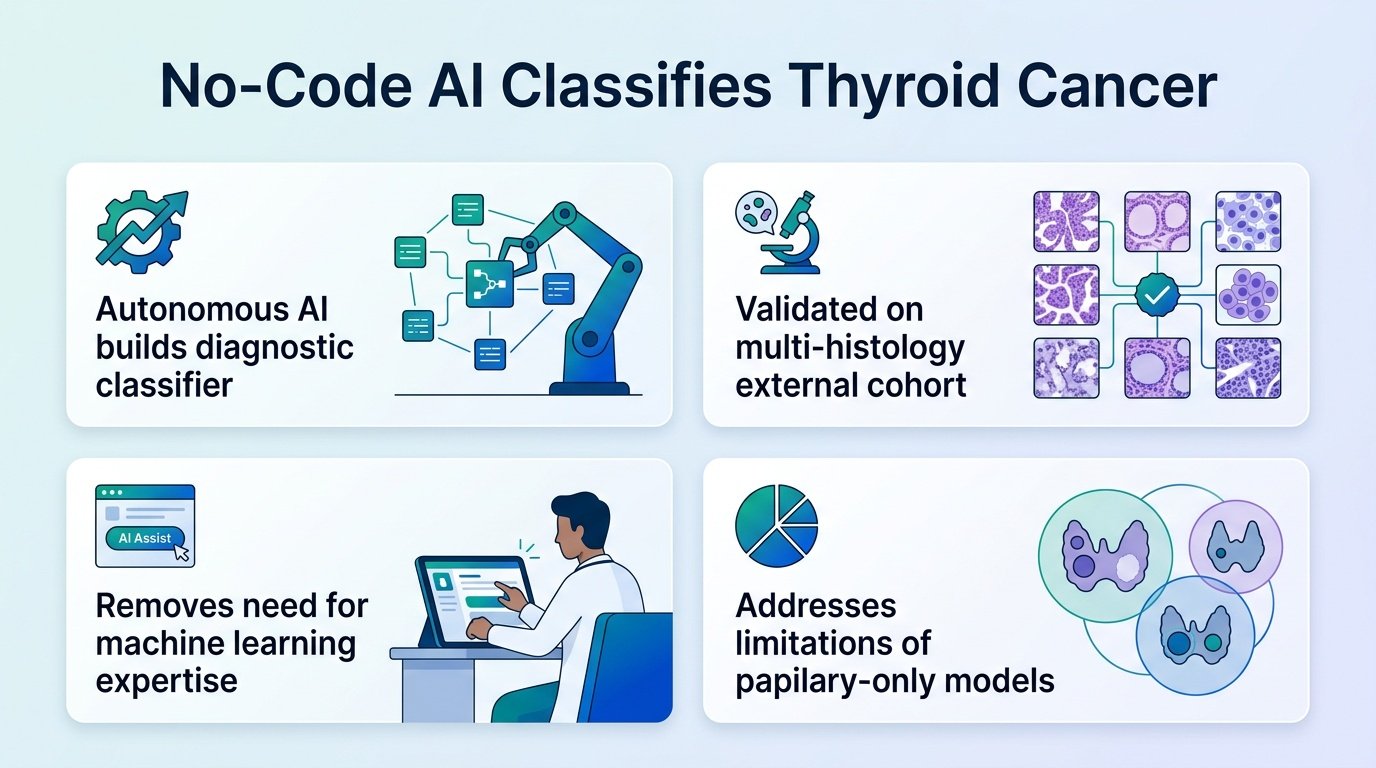
An autonomous AI agent just built a medical imaging tool that outperformed human-engineered models, proving that clinical-grade machine learning no longer requires a team of coders.
For years, hospital IT departments believed that building reliable diagnostic AI required millions of dollars and specialized data scientists. A new study challenges this assumption. An autonomous, no-code AI agent built a highly accurate thyroid cancer classifier entirely on its own.
That shift is where the industry must pay attention.
This development shifts the bottleneck of medical AI from technical coding to clinical validation. If a basic software agent can train a top-tier model, the value of proprietary medical AI algorithms will plummet. The real differentiator is now who has the best data and who can validate the tools safely.
Researchers used an autonomous agent called the Hugging Face ML Intern to build the tool. The agent reviewed the data, selected a ResNet 18 architecture, and calibrated the probabilities. It trained on the open-source TN5000 dataset, which contains **3,500 training images**, **500 validation images**, and **1,000 test images**.
To prove the model could handle real-world complexity, the researchers tested it externally on **232 nodules** from the University of Colorado. This cohort was highly diverse. It included difficult cancer subtypes like follicular, medullary, oncocytic, and follicular variant of papillary carcinomas.
The performance numbers
- On the internal test set, the agentic model achieved an **AUROC of 0.94** (95% CI, 0.920 – 0.953) with a **sensitivity of 0.90** and **specificity of 0.80**.
- On the external cohort, it maintained an **AUROC of 0.90** (95% CI, 0.850 – 0.936), with a **sensitivity of 0.92** and **specificity of 0.68**.
- The external test showed a high negative predictive value of **0.96**, making it highly reliable for ruling out malignancy.
- It easily beat a previously published, human-developed classifier on the same cohort, which only managed an **AUROC of 0.83**.
Why this matters
This performance is remarkable because external validation is where medical AI usually fails. Most models are fragile and do not translate well to other hospitals. Earlier research, such as a study on deep learning on ultrasound images of thyroid nodules, showed the promise of automated classification. Another project on the automatic detection of thyroid nodule characteristics highlighted how hard it is to standardize these measurements. The agentic workflow bypasses these bottlenecks by automating the tedious parts of model selection and probability calibration.
The remaining hurdles
We must be honest about the limitations. A positive predictive value of **0.52** on the external cohort means nearly half of the positive flags were false alarms. This could lead to unnecessary biopsies if clinicians rely on the tool blindly.
The model still needs prospective clinical trials and local recalibration before doctors should trust it in daily practice. However, the technical barrier to entry has officially collapsed.
Read the full study on medRxiv.