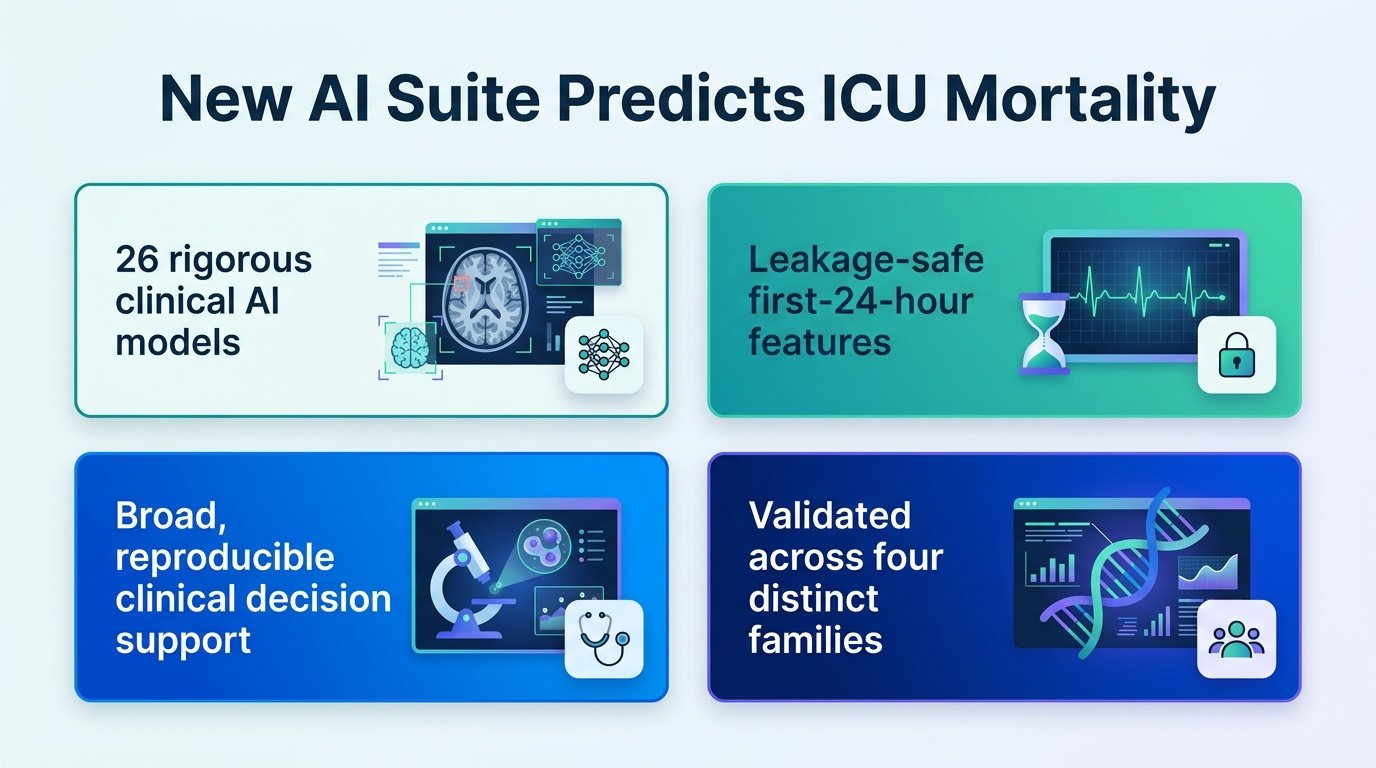
Most clinical AI models fail when they leave their home hospital, but a new 26-model suite proves that reproducible clinical tools can survive the transition to different healthcare systems.
Why do clinical AI models look like geniuses in the lab but fail in the real world? The dirty secret of medical machine learning is “data leakage” and poor generalizability. When an algorithm trained at one hospital is deployed at another, its accuracy usually plummets. This forces health systems to choose between expensive custom-built software or tools that degrade in clinical utility.
This new study challenges the assumption that clinical AI must be custom-made for every single hospital. By building a suite of 26 models on the MIMIC-IV dataset, researchers proved that rigorous, leakage-safe design can create tools that actually travel well. The suite spans four distinct clinical families: intensive-care deterioration, emergency department triage, ECG interpretation, and clinical natural language processing.
This matters because it proves we do not need to retrain models from scratch at every local clinic. The mortality model maintained its predictive power even when tested on an entirely different multi-centre US cohort of 199,133 stays, dropping only 0.044 in AUROC. This level of stability suggests that standardized clinical decision tools are finally ready for multi-center deployment without losing their edge.
High Marks Across Tasks
The suite relies on gradient-boosted trees for tabular data and deep learning for raw signals. Every model uses patient-level data splits, probability calibration, and SHAP explanations to keep predictions transparent and reliable. The performance metrics across the board show high accuracy:
- ICU mortality prediction achieved an AUROC of 0.884.
- Acute kidney injury detection reached 0.830, while prolonged hospital stay prediction hit 0.813.
- Emergency-department-to-ICU triage scored 0.875.
- Cardiologist-labelled ECG diagnosis hit 0.909, with raw-signal deep learning improving myocardial infarction detection by +0.142 AUROC over traditional interval features.
- Full-note diagnostic coding achieved an AUROC of 0.892.
Fighting the Leakage Problem
Many medical algorithms cheat by accidentally training on future patient data. To prevent this, this suite uses patient-level data splits and a shuffled-label leakage gate. This methodological rigor builds on previous efforts to secure clinical models, such as leakage-safe pipelines for incident diabetes prediction and SHAP-driven evidence retrieval for acute kidney injury warning systems.
By forcing every model to use probability calibration and full confusion matrices, the researchers ensure clinicians get realistic probability scores rather than overconfident guesses. The models are already incorporated into the latest version of the zMed Critical Care application.
The Real-World Catch
The main limitation remains the reliance on retrospective data. While the models are integrated into active software, we still lack prospective, randomized controlled trials showing how doctors react to these alerts in real-time. If clinicians suffer from alert fatigue, even a highly accurate model becomes useless noise.
Read the full preprint in medRxiv.