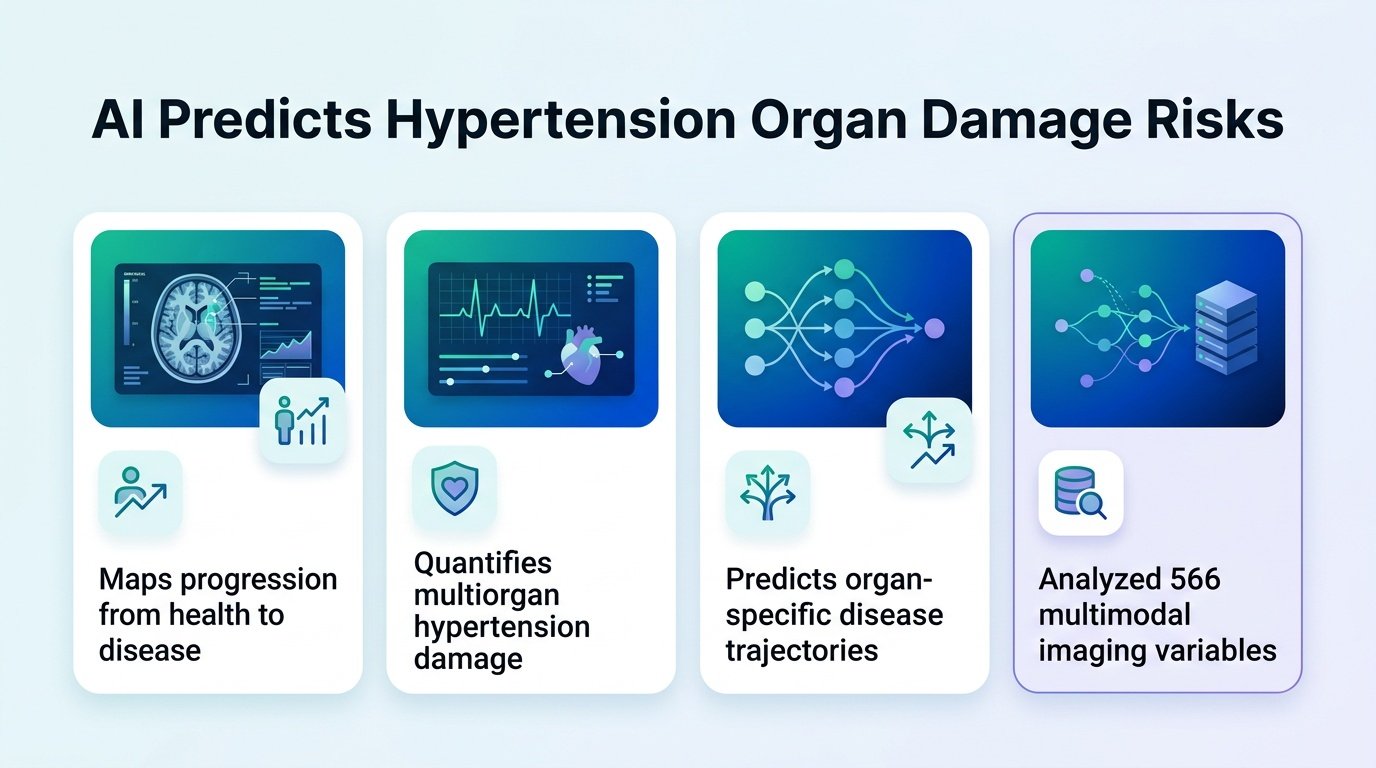
A new machine learning model proves that tracking silent organ damage is far more predictive of survival than standard blood pressure readings.
Why do we still rely on a simple arm-cuff reading to manage a disease that quietly wrecks the entire body? A standard blood pressure measurement tells us the pressure today, but it misses the slow, cumulative destruction happening inside the heart, brain, and kidneys.
This disconnect is the real story.
A study published in *Circulation* challenges the clinical reliance on blood pressure numbers alone. By using machine learning to analyze multiorgan damage, researchers proved that a patient’s physical damage profile predicts death, while blood pressure stratification does not. This means we must stop treating hypertension as a simple pressure problem and start treating it as a systemic, multi-organ disease.
Mapping the silent damage
Researchers analyzed 566 multimodal imaging and nonimaging variables. They used data from 27,099 participants in the UK Biobank imaging substudy, with a mean age of 63.27±7.48 years, of whom 53.4% were women. The team built a contrastive trajectory inference framework to generate a global organ damage score called HyperScore, mapping alterations across the heart, brain, kidneys, vasculature, lungs, liver, and metabolic systems. To prove the AI was not just finding patterns in one specific group, they tested it on an external cohort of 5,507 participants from the Atherosclerosis Risk in Communities (ARIC) study.
The model did not just look at a single organ. It tracked the complex, interconnected ways that high pressure degrades tissue over time. This approach moves us away from isolated specialists and toward a unified view of cardiovascular health.
What the data revealed
The results show that the algorithm successfully mapped how hypertension progresses from early health to advanced disease.
- The HyperScore achieved an area under the curve of 0.964 (0.941–0.987) for identifying individuals with severe end-organ disease.
- The model showed robust stability with a mean root mean square error of 0.104±0.084 in cross-validation.
- Survival odds differed significantly across HyperScore stages with a p-value of P < 0.001, whereas traditional blood pressure stratification was nonsignificant.
- The system identified 6 distinct hypertensive disease phenotypes, characterized by predominant cardiac, lipoprotein, atherothrombosis, brain, cardiorenal, and liver features.
- External testing in the ARIC cohort confirmed stability, showing Jensen-Shannon distances as low as 0.10 for score distributions and no significant deviation in progression patterns (P > 0.05).
The shift in clinical thinking
This finding forces a rewrite of how clinicians should monitor chronic hypertension. If blood pressure readings fail to stratify survival risk but the HyperScore succeeds, then managing hypertension solely by aiming for a target cuff pressure is an incomplete strategy. We are treating the symptom rather than the systemic footprint.
We must rethink our therapeutic targets. A patient might have well-controlled blood pressure on paper, yet their organs could still be on a fast-track trajectory toward failure. Identifying which of the 6 phenotypes a patient fits into allows for personalized therapy, targeting the specific organs most at risk rather than applying a blanket treatment.
However, the study has clear limitations. Gathering 566 variables, including advanced imaging of multiple organs, is currently impossible for the average local clinic. Until health systems can acquire and process this level of multimodal data cheaply, this highly accurate tool remains a luxury for resource-rich research institutions.
This research was published in Circulation.