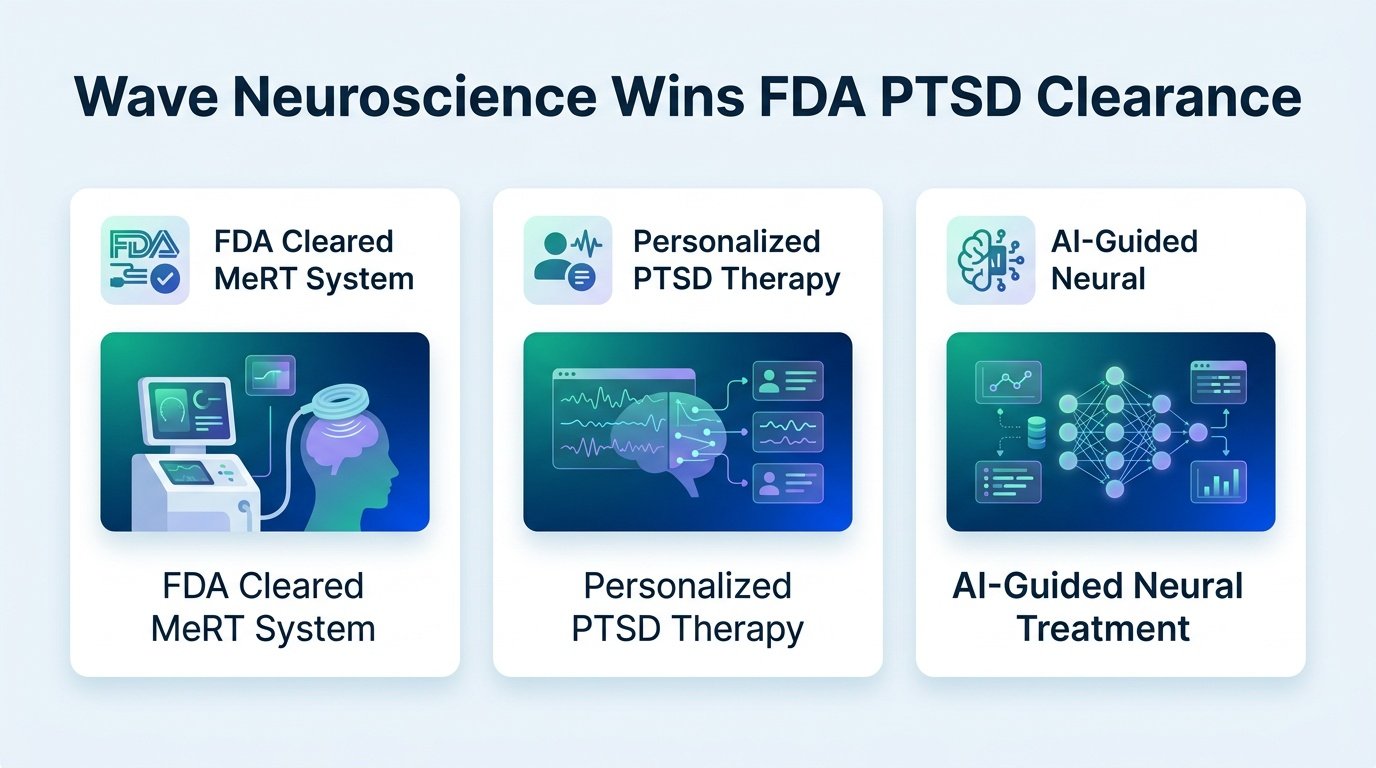
A newly cleared neuromodulation system shifts PTSD treatment from trial-and-error pharmacology to personalized brain mapping.
For decades, treating post-traumatic stress disorder has been an exercise in frustration. Patients cycle through antidepressants and talk therapy, often finding little relief.
The FDA clearance of Wave Neuroscience’s MeRT system signals a shift. By using AI to analyze a patient’s unique brainwaves, the technology customizes magnetic pulses to target specific neural deficits. It moves psychiatric care away from subjective symptom checklists and toward objective, biology-based treatment.
The Precision Shift
Standard transcranial magnetic stimulation (TMS) uses a one-size-fits-all approach. MeRT changes this by integrating electroencephalogram (EEG) data to map individual brain activity before delivering stimulation.
This is a direct challenge to the pharmaceutical status quo for the 13 million Americans living with PTSD, particularly those who do not respond to traditional therapies.
The double-blind clinical trial, conducted with the Texas A&M Health Institute of Biosciences and Technology, validated this personalized approach. By integrating MagVenture’s hardware, the system targets the exact neural pathways associated with trauma.
But scaling this technology faces hurdles.
The Adoption Hurdle
High-tech neuromodulation requires specialized clinical infrastructure. Unlike a pill, patients cannot take this home.
Furthermore, the market is crowding. Wave Neuroscience must compete with other recently cleared systems like GrayMatter Health’s Prism and Neurovalens’ Modius Spero.
Whether insurers will broadly cover these personalized, device-based therapies remains the critical question. Without reimbursement, this tech-driven approach risks remaining a luxury for the few rather than a standard of care for the many.