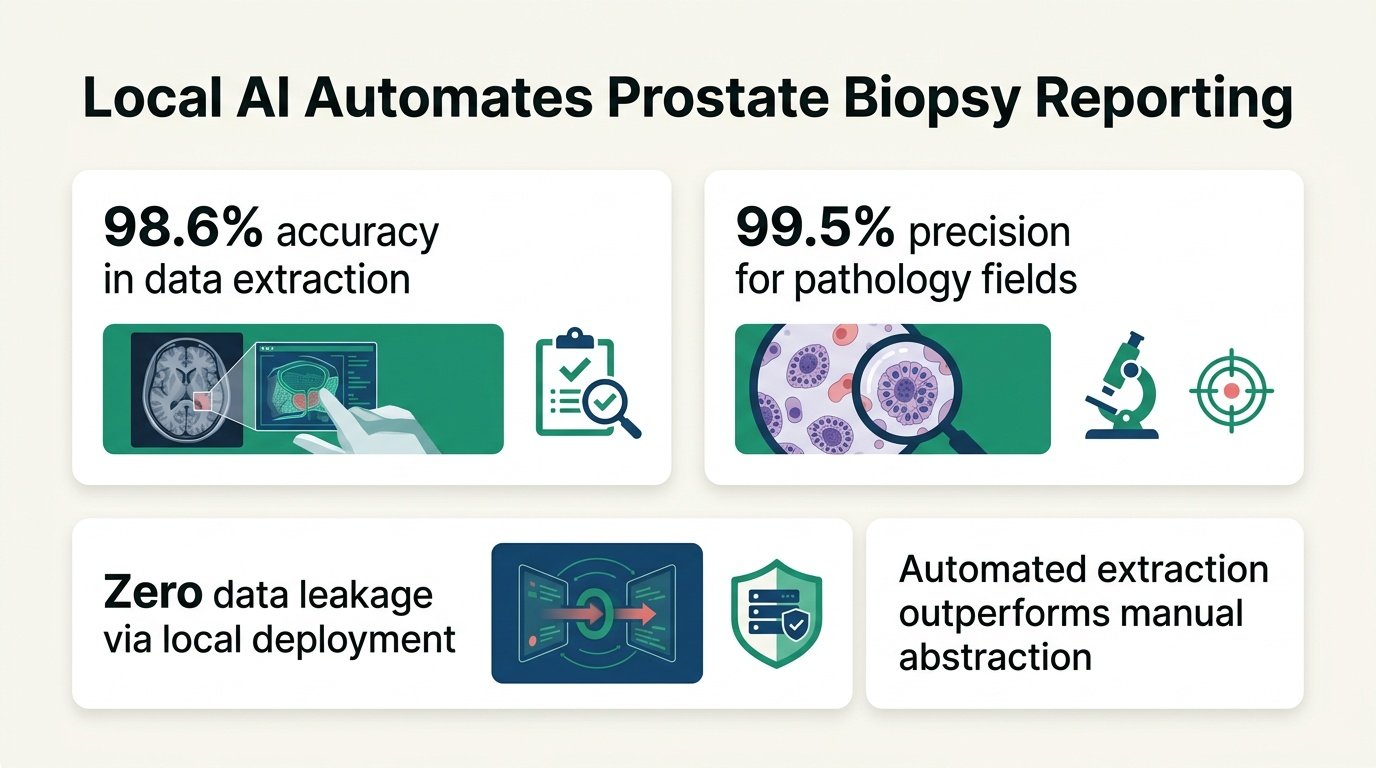
A new study shows that small, locally hosted AI models can clean up messy clinical text better than expected, without risking patient privacy.
How do you turn thousands of free-text medical records into clean data without leaking patient secrets to the cloud? Hospitals sit on goldmines of unstructured biopsy notes, but extracting this data has always required slow, expensive human labor. Sending this sensitive information to external cloud-based models introduces massive compliance and security headaches.
This trial challenges the assumption that hospitals need giant, cloud-dependent models to handle complex medical jargon. By running a compact, open-source model on local servers, researchers proved that privacy and high accuracy do not have to be a trade-off. It suggests clinical data pipelines can be entirely self-contained, shifting how we think about hospital data security.
The power of multistage pipelines
Researchers tested this approach using Mistral 7B, a small open-source model deployed on local hardware. They fed the system 150 transrectal ultrasound-guided biopsy and histopathology reports, reserving 50 for development and 100 for validation. The team compared a simple single-stage prompt against a more complex, multistage workflow that combined the AI with traditional natural language processing and iterative error correction.
The results show that raw AI power is not enough. The architecture of the pipeline itself dictates the success of the data extraction. While a single prompt performed well on simpler reports, the integrated pipeline achieved near-perfect accuracy on highly complex, multi-page pathology documents.
The system’s performance across different tasks highlights this gap:
- Single-stage analysis of procedure reports achieved 95.3% accuracy, getting 991 of 1040 discrete data points right.
- The multistage pipeline raised procedure report accuracy to 98.0%, resolving 1314 of 1341 data points.
- On longer histopathology reports, the integrated approach reached 99.6% accuracy, correctly mapping 9110 of 9150 points across diagnoses, grades, and core locations.
Where the system stumbles
The errors were not random.
Mistakes clustered in ambiguous cases where doctors used vague descriptors or highly localized shorthand that differed from the institution’s standard documentation culture. When humans write poorly, the AI struggles to interpret the intent.
This limitation is the real story for clinical leaders. The bottleneck in medical data engineering is no longer the reasoning capability of the AI, but the lack of standardized writing among physicians. For local AI to succeed at scale, departments must first standardize how clinicians dictate their findings.
This shifts the burden of data quality back to the clinic floor. If doctors write consistently, cheap, offline models can automate clinical registries overnight. This makes large-scale prostate cancer research far more accessible to institutions without massive IT budgets.
Read the full study in Urologic Oncology.