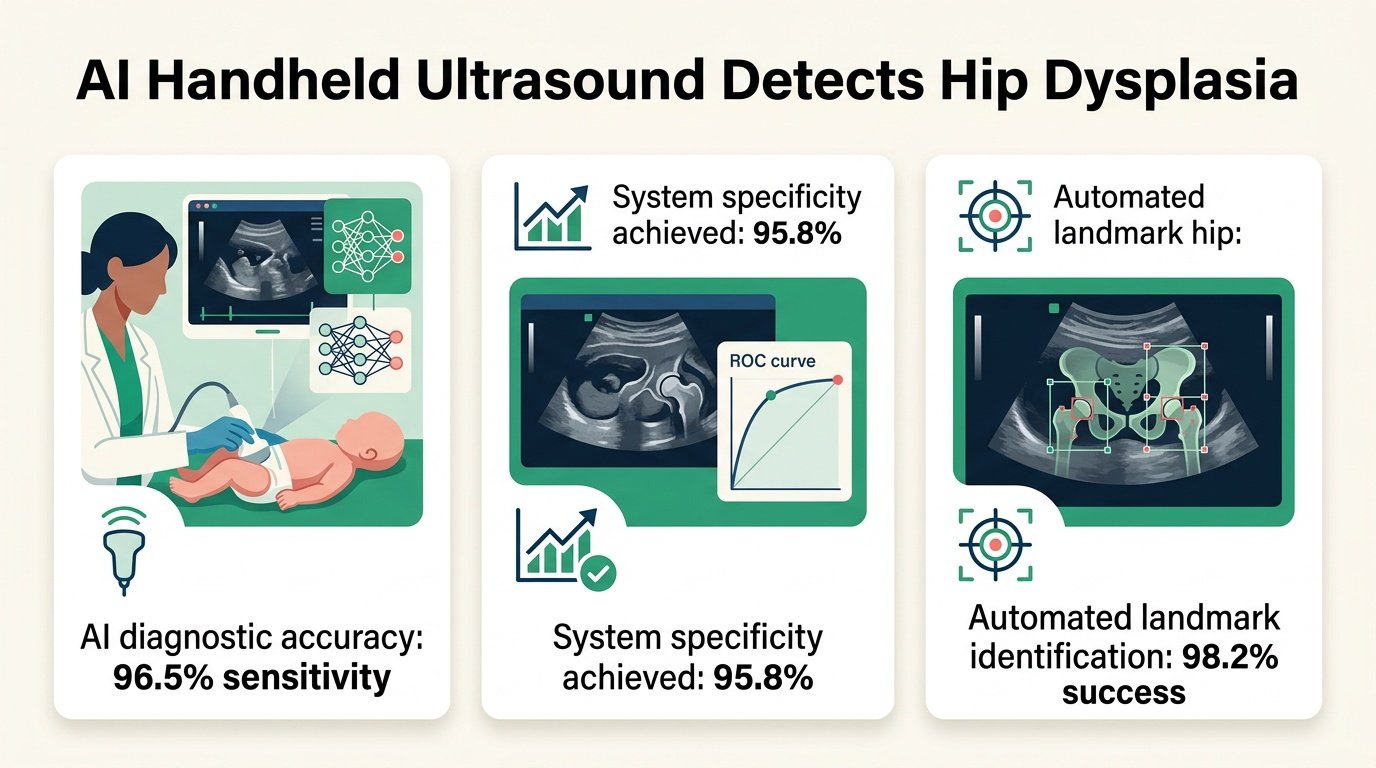
A new wireless handheld AI system allows novice doctors to screen infants for hip dysplasia with expert-level accuracy.
Can a novice physician with a pocket-sized device match the diagnostic accuracy of a veteran ultrasound specialist? For developmental dysplasia of the hip (DDH), the answer has traditionally been no. Standard screening requires bulky cart-based machines and years of specialized training to interpret subtle anatomical angles.
This study challenges the assumption that pediatric imaging must remain tethered to specialist clinics. By putting diagnostic intelligence on a handheld device, the technology shifts the bottleneck of infant screening from specialist availability to simple hardware distribution. It suggests we can democratize complex diagnostics without sacrificing accuracy.
Expert performance in novice hands
Researchers developed the AI wireless handheld ultrasound system (AI-HUDs) using the YOLOv8 model. They trained and tested the system on a dataset of 1192 static ultrasound images and 498 dynamic videos. The software automatically identifies 6 key anatomical landmarks to measure the α and β angles used in the Graf classification method.
To test the system in a real clinical workflow, a resident physician used the handheld device to scan 52 infants, capturing 104 dynamic videos. Experts then manually measured the same hips to establish a baseline. The agreement between the novice-operated AI system and the specialists was remarkably close.
- In static mode, the AI achieved a mean absolute error of just 1.05° for the α angle and 1.65° for the β angle.
- When operated by the resident physician, the system maintained accuracy with mean absolute errors of 1.16° for α and 1.91° for β.
- Bland–Altman analysis showed that 96.15% of α measurements and 95.19% of β measurements fell within the limits of agreement.
The limits of dynamic tracking
The data reveals a clear limitation in dynamic imaging. While static measurements were highly reliable, the intraclass correlation coefficient for the β angle dropped to 0.51 in dynamic mode. This drop indicates that tracking moving hip structures in real time remains a significant hurdle for the algorithm.
This discrepancy matters because dynamic testing is crucial for assessing hip stability. Clinicians cannot yet rely entirely on the automated dynamic readings. The system is highly capable of baseline screening, but human oversight remains essential for borderline cases.
Ultimately, this tool changes how we think about preventative pediatric care. Early detection of DDH prevents invasive surgeries later in childhood. By enabling resident physicians to achieve diagnostic performance comparable to experts, this technology makes universal, low-cost infant hip screening a realistic goal for community clinics and remote regions.