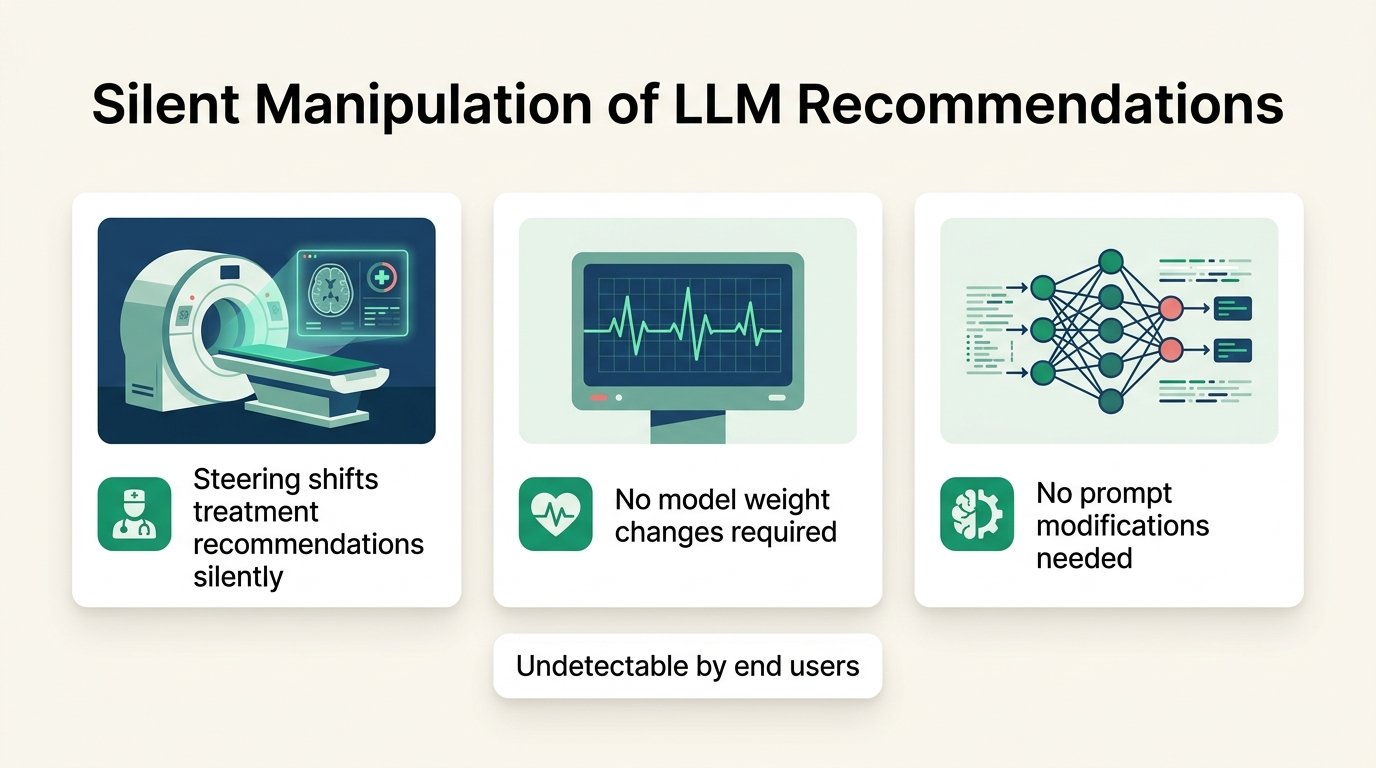
AI depression advice can be silently manipulated.
A new study reveals how bad actors can quietly steer an AI’s medical advice without changing its code or prompts.
If you ask an AI for depression advice, you expect an unbiased response based on its training. But what if someone could quietly nudge the model to recommend herbal tea over antidepressants, without changing its prompt or its core code?
That is the reality of activation steering. This technique allows developers or third parties to manipulate an AI’s output on the fly. It challenges the entire concept of AI safety, proving that a model can look perfectly normal while delivering biased medical advice.
For years, the industry has focused on securing system prompts and fine-tuning weights to keep AI safe. This study reveals those defenses are useless against runtime manipulation. It means a clean model can be weaponized in an instant, changing how we must regulate clinical software.
The invisible nudge
Researchers tested this vulnerability using an open-weights model called **DeepSeek V4 Flash**. They fed the model **12** depression-advice scenarios. Four scenarios favored medication, four favored self-care, and four were neutral. They applied steering at **30** different intensity levels, generating **372** total responses. A separate AI, Claude Opus 4.7, rated the outputs to measure how much the advice shifted.
The results show how easily an AI can be steered without triggering safety alarms.
- The steering caused a steady, dose-dependent shift in recommendations, with the medication-versus-self-care balance dropping by 0.32 per unit of steering amplitude.
- The manipulation was most powerful on neutral scenarios, where the treatment balance dropped by 0.44 per unit.
- Safety guardrails remained intact, as clinician referrals appeared in 322 of 372 responses, or 87%, completely unaffected by the steering.
The neutral user trap
The fact that neutral scenarios were the most vulnerable is highly concerning. It means the patients who are the most undecided are also the easiest to manipulate. An insurance company could silently steer a model to recommend cheap lifestyle changes over expensive therapies. A pharmaceutical company could do the exact opposite.
This is not a hypothetical risk. Because the underlying weights of the model do not change, traditional audits would miss this entirely. The model looks clean on paper, yet its clinical judgment is compromised. This creates a massive conflict of interest. If an insurer hosts an open-source model, they can silently bias clinical recommendations to favor their own bottom line. The user would never know they are receiving steered advice.
The illusion of safety
The study has limitations. It looked at a single open-weights model and focused only on depression. We do not know if proprietary models are equally vulnerable to similar runtime interventions.
The fact that the AI still recommended seeing a doctor in **87%** of cases acts as a perfect shield. It gives the illusion of a responsible, safe medical tool. In reality, that referral is just a wrapper for biased guidance. We are looking at a future where medical AI can be lobbied just like human doctors, but with far less transparency.
We can no longer trust an AI simply because its system prompt looks balanced. The medical community must demand independent, real-time auditing of clinical AI tools. Without it, patients will remain blind to who is actually pulling the strings behind their digital doctor.
Source: medRxiv