
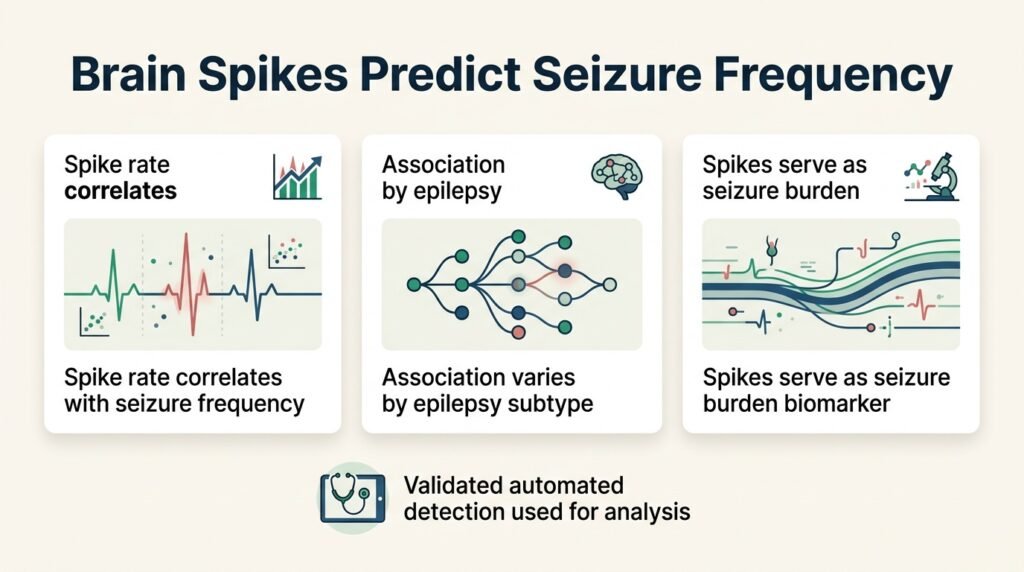
A massive new study reveals that standard brain wave spikes only weakly correlate with actual seizure frequency, challenging how doctors monitor epilepsy.
For decades, neurologists have treated electrical spikes on an EEG as a direct warning sign of epilepsy severity. The assumption was simple. More spikes meant more seizures, and fewer spikes meant a patient was improving.
This study disrupts that comfortable assumption. By analyzing a massive dataset, researchers proved that the link between spike rates and actual seizures is incredibly weak. In some common forms of epilepsy, the connection is virtually nonexistent. This means clinicians relying on routine EEGs to gauge medication success may be reading the wrong signals.
Not all epilepsy is equal
The researchers analyzed 3,614 routine outpatient EEGs from 3,245 patients followed for a median of 2.8 years. They used an automated detector called SpikeNet2 to count spikes, while large language models extracted seizure data from clinical notes. The overall correlation across the entire cohort was a tiny 0.11.
When broken down by epilepsy subtype, the picture becomes even more fragmented. The study revealed distinct differences across three major groups:
- Generalized epilepsy (N = 625) showed the strongest association with a correlation of 0.23.
- Temporal lobe epilepsy (N = 834) showed a much weaker correlation of 0.12.
- Frontal lobe epilepsy (N = 263) showed a correlation of 0.11, which was not statistically significant (p = 0.22).
This variance is the real story.
Treating all epilepsy patients with the same diagnostic yardstick is a mistake. For a patient with frontal lobe epilepsy, tracking spikes on a routine EEG tells doctors almost nothing about their actual seizure burden.
The timing window matters
The study did find one crucial caveat. The association between spikes and seizures was stronger when the EEG and the clinic visit occurred close together in time, with an odds ratio of 0.983.
This suggests that spike rate is a highly volatile, time-varying marker. It is not a permanent baseline. A routine, 30-minute EEG is merely a snapshot of a highly dynamic process.
We must acknowledge the study’s limitations. The data relies on automated spike detection and clinical notes parsed by AI, which can introduce errors. Short, routine EEGs also miss the broader picture of 24-hour brain activity.
Even so, the clinical takeaway is clear. We can no longer treat spike reduction as a universal surrogate endpoint in drug trials or daily care. If a drug stops the spikes but does not stop the seizures, the patient is no better off.
Read the full analysis in medRxiv.