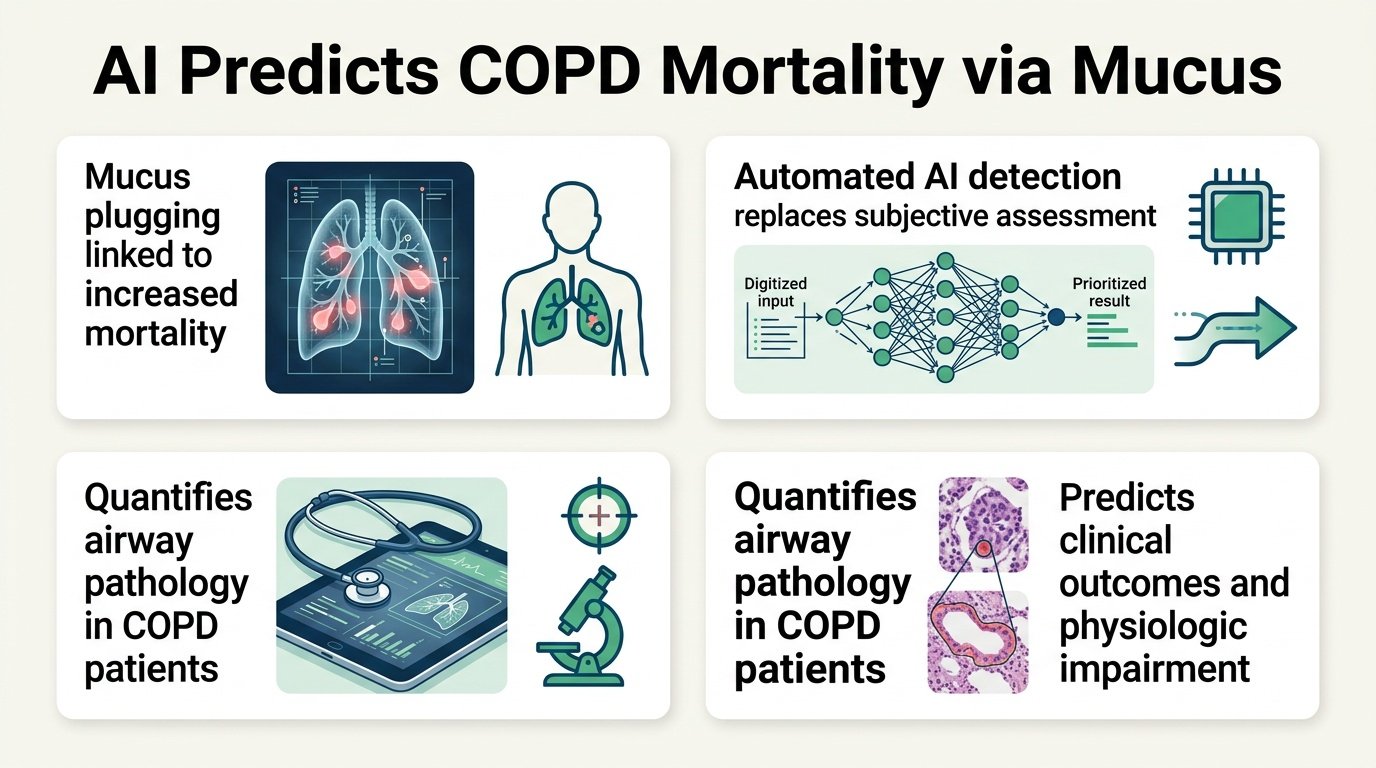
Automating the search for mucus plugs in lung scans reveals a hidden driver of COPD mortality that human eyes routinely miss.
Radiologists have long known that mucus plugs block airways and make breathing miserable. Yet manually counting these tiny blockages across thousands of CT slices is too tedious for busy clinics. Because we cannot easily measure them, we often ignore them, relying instead on simpler lung function tests that miss the structural damage happening deep in the lungs.
This disconnect is where the clinical gap lies.
A new AI tool changes the equation by turning a subjective, labor-intensive chore into an automated metric. The analysis suggests that mucus plugs are not just a late-stage symptom of chronic obstructive pulmonary disease (COPD). Instead, they are an independent, deadly driver of patient decline that clinicians must start tracking early.
A massive imaging trial
Researchers trained an AI framework combining 3D airway segmentation with a convolutional neural network to spot and count airway obstructions. They tested the tool on inspiratory CT scans from 8,971 participants in the COPDGene Phase 1 cohort, which included patients across GOLD stages 0 to 4 and those with preserved ratio impaired spirometry (PRISm). By automating this count, the system established a clear “mucus plug burden” for every patient.
The automated measurements mapped directly to severe clinical decline across multiple physical metrics:
- Higher plug burden strongly correlated with lower post-bronchodilator FEV1% predicted (ρ = -0.41; P < 0.001) and greater air trapping measured at LAA < -856 HU (ρ = 0.33; P < 0.001).
- Patients with more plugs reported worse health status on the St. George’s Respiratory Questionnaire (ρ = 0.31; P < 0.001) and walked shorter distances on the six-minute walk test (ρ = -0.26; P < 0.001).
- Among patients in GOLD stages 1-4, the mere presence of a mucus plug was associated with a 1.28 times higher risk of all-cause mortality and a 1.32 times higher rate of disease exacerbations.
- Plug presence also predicted higher respiratory mortality across all GOLD categories, alongside increased cardiovascular mortality in mild-to-moderate cases (GOLD 1-2).
Rethinking COPD risk
This finding challenges how we stratify COPD severity. Traditionally, medicine relies on spirometry to grade these patients. But spirometry is a blunt instrument that can look normal even when small airways are quietly choking. This AI-driven data proves that structural blockages drive mortality independently of traditional lung function metrics.
The findings build on earlier work tracking the longitudinal evolution of CT-detected mucus plugging over a decade. If these plugs persist and actively worsen patient survival, they should be treated as primary therapeutic targets, not secondary symptoms. Finding them early allows for aggressive airway clearance therapies before irreversible damage occurs.
The hurdles ahead
There are clear limitations to keep in mind. This study relies on retrospective data from a single cohort, and the findings come from a preprint that has not yet completed peer review. We also lack clinical trials proving that clearing these specific AI-detected plugs actually improves survival rates. Until those trials happen, this tool remains a powerful risk-assessment instrument rather than a direct guide for daily treatment decisions.
Read the full study in medRxiv.