Off-the-shelf automated machine learning can flag deadly hospital-acquired infections, but only if hospitals feed them the right clinical data.
Hospitals spend millions on custom AI models to catch ICU infections before they turn fatal. What if cheap, automated software could do the same job right out of the box? It is a question that challenges the entire cottage industry of bespoke healthcare software.
This comparison of automated machine learning (AutoML) tools suggests we may not need custom-built algorithms to protect vulnerable patients. The real bottleneck is not the math, but the data we feed it. If we rely on static admission charts, even the best tools fail to perform.
AutoML goes head to head
Researchers put two popular AutoML frameworks, PyCaret and H2O, to the test. They analyzed data from 20,682 pneumonia patients stored in the eICU Collaborative Research Database. The goal was to see if these automated pipelines could predict hospital-acquired infections early.
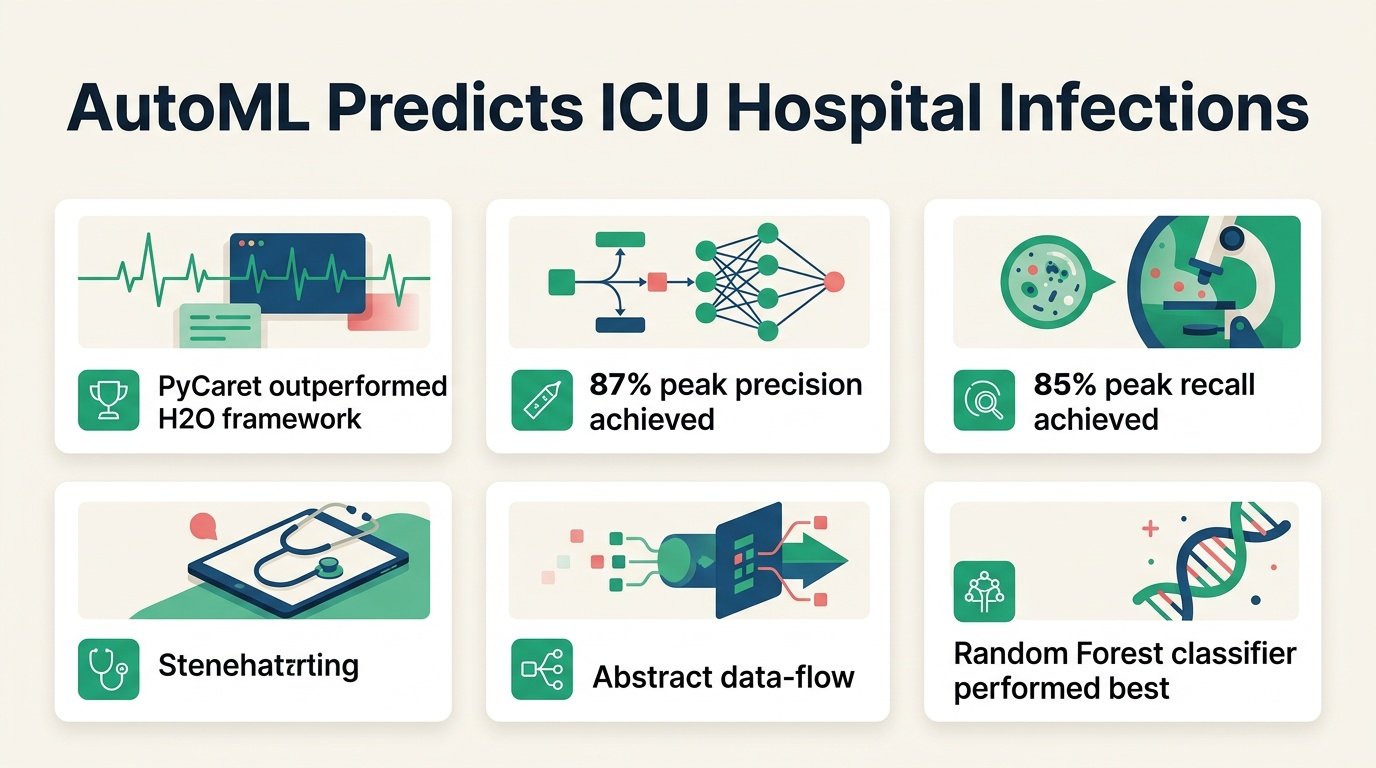
The results revealed a clear winner. PyCaret’s Random Forest classifier consistently beat H2O’s stacked ensemble across every metric. When the model combined baseline admission data with dynamic clinical factors, it reached a peak precision of 87% and a recall of 85%.
This performance is high enough to be clinically useful. It proves that end-to-end AutoML frameworks can provide real-time surveillance tools without requiring a team of elite data scientists to build them from scratch.
- PyCaret’s Random Forest outperformed H2O’s stacked ensemble.
- The system reached 87% precision and 85% recall.
- Length of stay and hematocrit levels were the strongest predictors.
The data quality trap
But the high accuracy numbers hide a deeper truth about clinical AI. The models only achieved these results when researchers integrated dynamic clinical variables. Relying on static baseline demographics is enough for basic triage, but it fails to catch active, developing infections.
Feature importance analysis identified length of stay in the ICU and hospital, alongside hematocrit levels, as the most significant clinical predictors. This means the AI is only as good as the live laboratory updates it receives. If a hospital cannot feed live blood data into the system, the predictive power evaporates.
There are clear limitations to this approach. The study relied on retrospective data from the eICU database, meaning we still do not know how these models handle the messy, real-time data flows of an active ICU. Additionally, the cohort was limited to pneumonia patients, so these specific accuracy rates might not hold for other ICU populations.
For healthcare leaders, the takeaway is clear. Stop worrying about buying the most expensive, bespoke AI model. Focus instead on building the data pipelines that allow basic, automated tools to see how your patients are changing in real time.
Read the full study in the Journal of the Association for Information Systems.