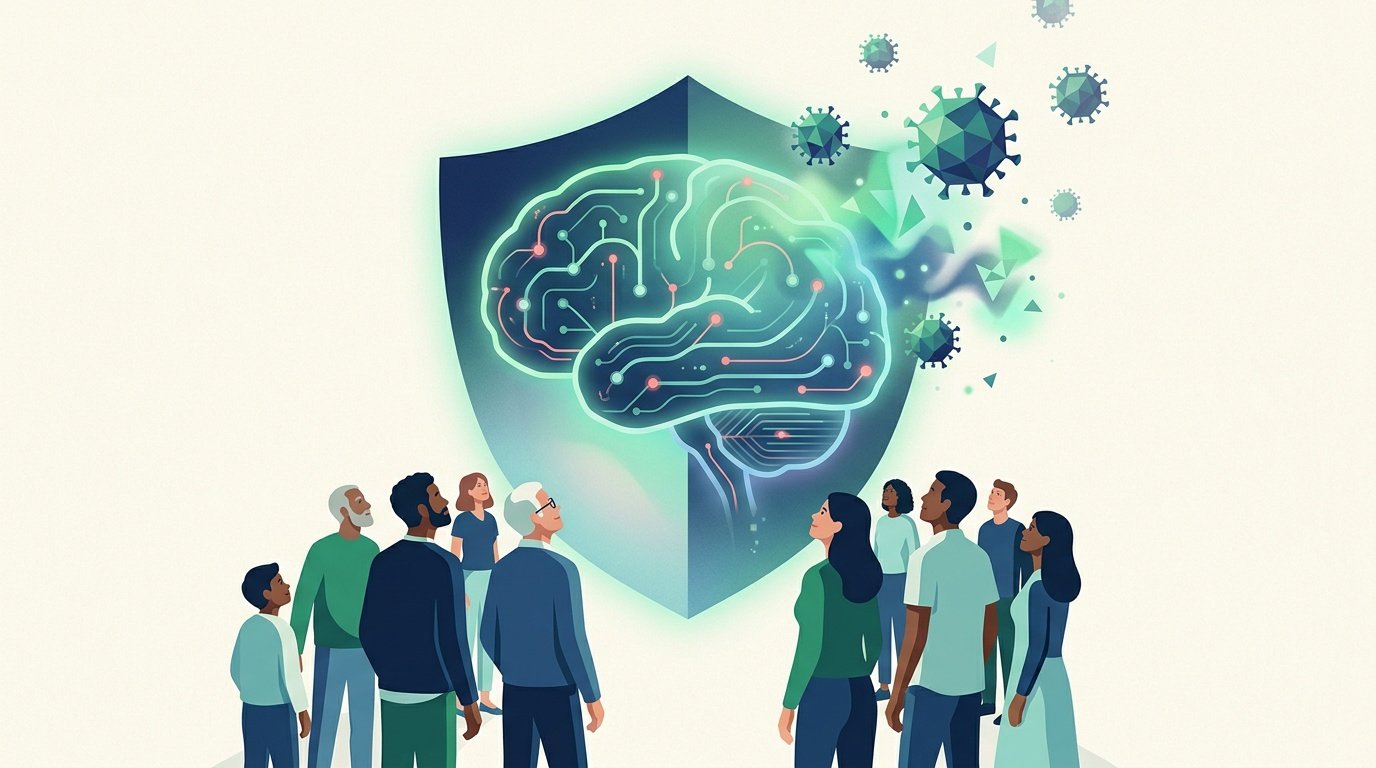
A vaccine designed entirely by computer simulations has proven safe in humans, marking a shift from reactive medicine to predictive defense.
Vaccine development has always been a game of catch-up. By the time manufacturers tweak a shot to target a new variant, the virus has already mutated. We are constantly fighting yesterday’s pathogen.
A new approach aims to end this cycle. Instead of chasing the latest strain, researchers used machine learning to analyze genetic data across the entire Sarbeco coronavirus family. The AI identified highly stable, shared viral features to construct a synthetic “super-antigen” that resists mutation.
Predicting the Mutation
This is the first time a vaccine with an active component designed entirely by computer simulations has been tested in humans. Delivered via a needle-free jet system, the DNA vaccine proved safe, well-tolerated, and capable of provoking immune responses against multiple coronaviruses in its Phase 1 trial.
This is not just about COVID-19. It is a proof of concept for future-proof vaccinology. If we can train algorithms to find the immutable vulnerabilities in highly mutable virus families, we can design defenses before the next spillover event even occurs.
The Limits of Code
However, coding a vaccine is only the first step. While the AI successfully predicted stable targets, Phase 1 trials are small and only measure safety and initial immune markers.
We do not yet know if this computer-generated antigen will translate to robust, real-world protection when a novel virus strikes. But the trial proves that algorithms can generate biologically viable blueprints that the human immune system recognizes and acts upon.