A new AI model uses standard heart scans to calculate your biological age, spotting hidden heart risks even when using cheap wearable devices.
Can a simple wristband sensor predict your risk of sudden death as accurately as a clinical-grade hospital machine? For years, AI cardiology has relied on complex 12-lead ECGs that require patients to strip down in a clinic. This new study challenges that paradigm by proving that “heart age” can be tracked reliably using simplified 6-lead or even single-lead setups. It shifts the focus of cardiac AI from expensive diagnostic suites to continuous, passive monitoring in everyday life.
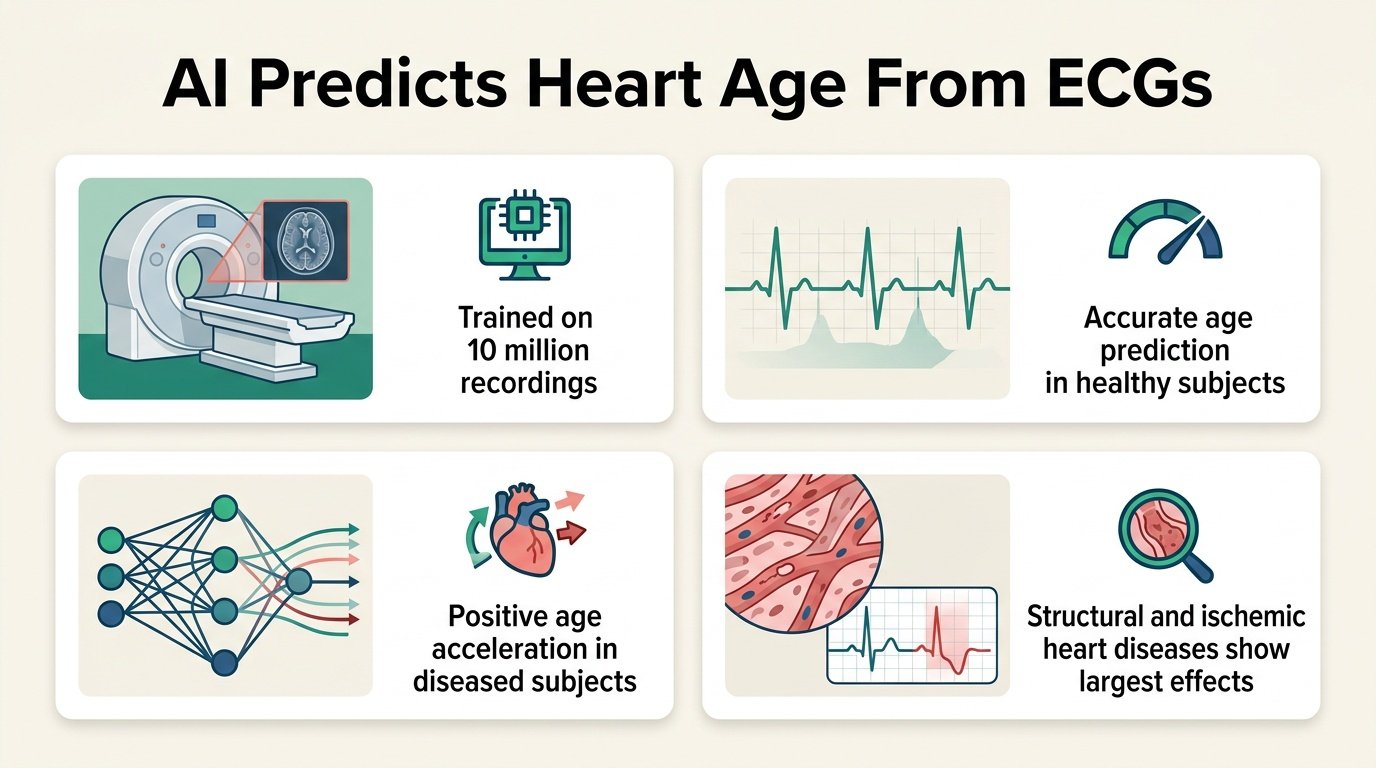
Researchers trained a foundation model on over 10 million ECG recordings. They built an age-prediction tool using only healthy subjects. When tested on diseased patients, the AI flagged significant “age acceleration” — meaning their hearts looked much older than their actual birth certificate. This finding confirms that biological aging of the heart is a measurable physical state, not just a metaphor.
To prove this was not just a statistical fluke, they ran an external validation on a massive hospital cohort of 160,493 patients. The results were stark. This AI-calculated age gap independently predicted all-cause mortality, showing its strongest prognostic power in patients under 65 years old. This builds on previous research, such as a 2025 study in JACC Advances, which showed ECG-derived aging improves risk prediction for incident cardiovascular disease.
What the data shows
- Structural and ischemic heart diseases caused the largest jumps in predicted heart age.
- Mortality prediction remained highly accurate even when downscaling from 12-lead setups to single-lead wearable configurations.
- A major morphological confound was discovered: patients with a complete left bundle branch block threw off the standard age-gap calculation.
This last point is where the researchers show crucial intellectual honesty. A left bundle branch block mimics age acceleration on an ECG, which could lead to false positives. To bypass this biological glitch, the team proposed using “absolute age deviation” rather than simple positive acceleration. This adjustment makes the tool far more robust, but it also highlights a persistent hurdle for AI medicine.
Algorithms are easily fooled by structural electrical blocks. Clinical deployment will still require a safety valve to filter out these specific conduction anomalies before telling a patient their heart is prematurely aging. This caution aligns with findings in the European Heart Journal, which noted that AI-derived ECG age gaps serve as powerful predictors of mortality after major cardiac interventions.
Why this matters
This is not just about making risk calculators slightly more accurate. It proves that consumer smartwatches, which typically use single-lead ECGs, can run clinical-grade longevity algorithms. By shifting the focus to absolute age deviation, the researchers have created a metric stable enough to survive the messy transition from sterile hospital wards to the noisy data stream of consumer wearables. It forces clinicians to rethink what counts as a diagnostic tool, moving cardiology out of the clinic and onto the patient’s wrist.
Read the full preprint on medRxiv.