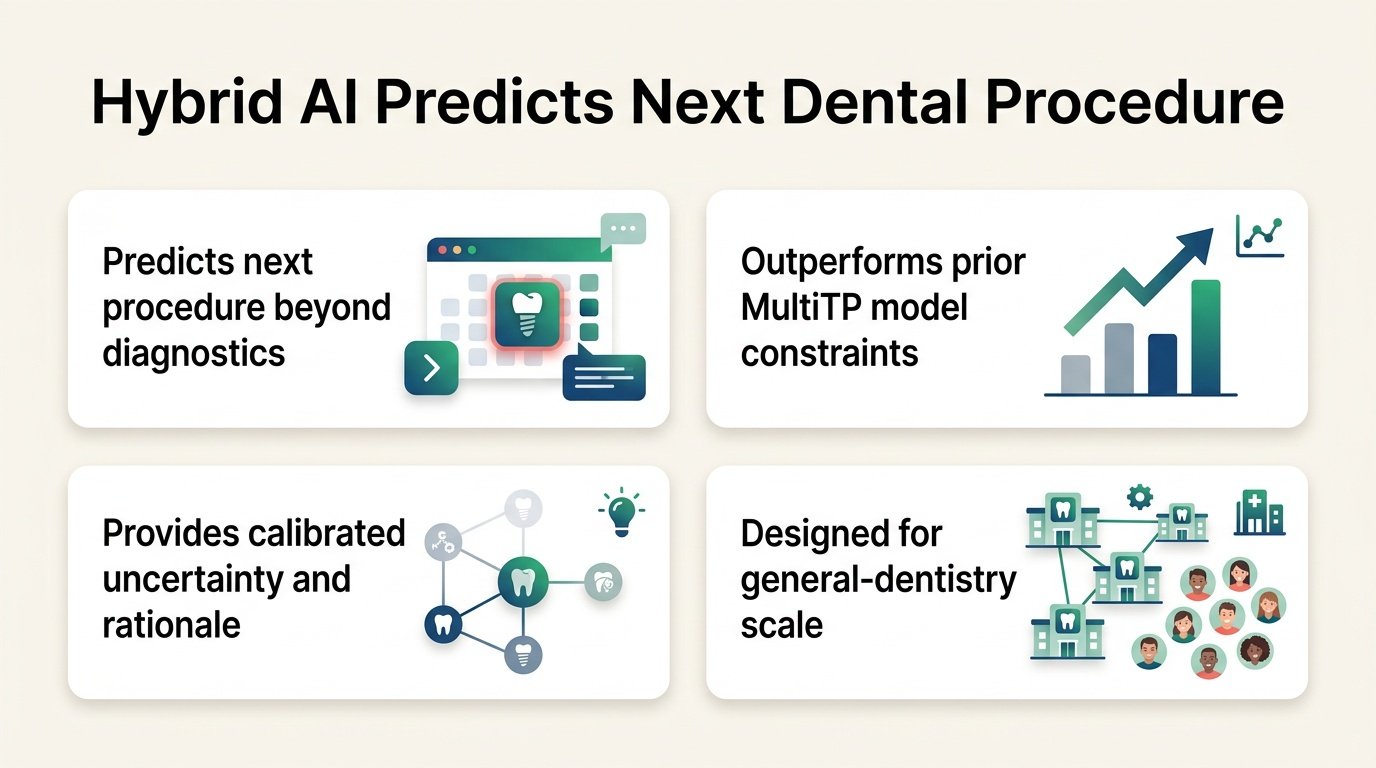
A new study reveals that advanced language models fail at predicting dental treatments unless they are paired with basic, old-school statistics.
Dental AI is excellent at spotting cavities on X-rays. But it has no idea what the dentist should actually do next. For years, developers assumed massive language models would easily map out treatment plans. A new preprint on a tool called DentaCoPilot reveals a different reality. Pure generative AI is surprisingly bad at clinical workflows on its own.
This challenges the current obsession with throwing larger, more expensive models at clinical problems. It turns out that raw reasoning power cannot beat simple, historical probability. To make AI useful at the chairside, we must stop treating large language models as standalone thinkers and start using them as translators for classical algorithms.
The limits of raw scale
The researchers tested DentaCoPilot using a synthetic corpus of 500 patient charts, yielding 1,284 test cases. They pitted traditional statistical models against several configurations of Anthropic’s Claude models. The results expose a massive performance gap.
Simple statistical baselines achieved a 0.567 top-1 accuracy and a 0.967 top-5 accuracy. Meanwhile, pure large language models lagged far behind, scoring between 0.267 and 0.467 on top-1 accuracy. Even upgrading from Claude Sonnet to the more expensive Claude Opus yielded no accuracy gains. This struggle aligns with broader findings in dental informatics. For instance, research on how ChatGPT performs in Oral Medicine highlights that while generative models show promise, they struggle with highly specialized clinical reasoning. Similarly, studies comparing dental students versus ChatGPT-4o in endodontics show that AI still lacks the structured precision required for complex cases.
A hybrid path forward
The breakthrough came from combining the two approaches. By feeding the top-10 candidates from the classical statistical model into Claude Sonnet, the hybrid system bridged the gap.
- Pure Sonnet with chain-of-thought reached only 0.733 top-5 accuracy.
- Conditioning Sonnet on classical priors boosted top-5 accuracy to 0.933.
- The hybrid model preserved critical clinical features, including structured rationales and explicit flags to abstain when data is insufficient.
Why this matters
This finding matters because it redefines the economics of clinical AI. Instead of burning expensive computing power on massive models, developers can use smaller, cheaper models primed with basic math. This hybrid architecture delivers the accuracy of traditional statistics alongside the readable explanations human dentists need to trust the system.
However, the study has a major catch. The model was trained and tested on synthetic data, not real patients. While plans are underway to test DentaCoPilot on the BigMouth repository and at the KLE Vishwanath Katti Institute, the tool remains unproven in messy, real-world clinics.
Read the full study on medRxiv.