
⚡ Quick Summary
This study explored the impact of Deep Neural Network (DNN) technology on speech intelligibility for older adults with mild to moderately severe hearing loss. The findings revealed that DNN, particularly when combined with beamforming, significantly enhanced listening experiences in challenging auditory environments.
🔍 Key Details
- 👥 Participants: 20 adults with mild to moderately severe sensorineural hearing loss
- 🎧 Technology: Hearing aids programmed with four settings (omnidirectional, directional beamforming, noise reduction off, traditional, and DNN)
- 📊 Noise Types: Speech-shaped noise (SSN) and multitalker babble (MTB)
- 📝 Metrics Assessed: Clarity, total impression, listening effort, and background noise awareness
🔑 Key Takeaways
- 📈 DNN technology significantly improved speech intelligibility in noisy environments.
- 🔊 Beamforming was particularly effective when the target speech was from the front.
- 💡 DNN outperformed traditional noise reduction methods across all assessed metrics.
- 🌪️ Listening effort was reduced when using DNN combined with beamforming.
- 🔍 Outcomes varied based on the type of background noise present.
- 🗣️ DNN was more effective in SSN compared to MTB.
- 📊 Improved signal-to-noise ratio contributed to the effectiveness of DNN.
📚 Background
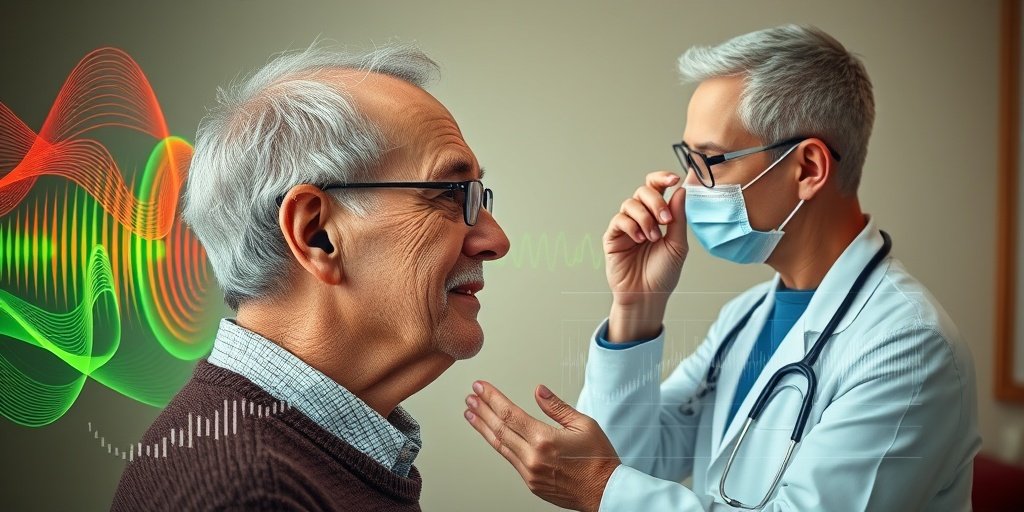
Hearing loss is a prevalent issue among older adults, often leading to difficulties in understanding speech, especially in noisy environments. Traditional hearing aids have limitations in processing complex sounds, which can hinder communication. The introduction of Deep Neural Networks (DNN) in hearing aid technology represents a significant advancement, aiming to enhance speech recognition and overall listening quality for individuals with hearing impairments.
🗒️ Study
The study involved 20 adult participants with mild to moderately severe sensorineural hearing loss. Each participant was fitted with hearing aids programmed with various settings, allowing researchers to assess the effectiveness of DNN in improving speech intelligibility in different noise conditions. The study focused on subjective ratings of clarity, total impression, listening effort, and background noise awareness.
📈 Results
The results indicated that the combination of DNN and beamforming consistently outperformed other settings across all metrics. Participants reported enhanced clarity and reduced listening effort when using the DNN setting, particularly in environments with speech-shaped noise. The effectiveness of DNN was notably higher in SSN compared to multitalker babble, highlighting the importance of noise type and spatial configuration in auditory processing.
🌍 Impact and Implications
The findings from this study have significant implications for the development of hearing aids and auditory processing technologies. By integrating DNN with advanced beamforming techniques, manufacturers can create hearing aids that provide a more natural listening experience, ultimately improving communication and quality of life for older adults with hearing loss. This research paves the way for further innovations in auditory technology, emphasizing the need for continued exploration in this field.
🔮 Conclusion
This study highlights the transformative potential of Deep Neural Networks in enhancing speech recognition and listening quality for older adults with hearing loss. The combination of DNN and beamforming not only improves clarity but also reduces listening effort, making conversations more accessible in challenging environments. As technology continues to evolve, we anticipate further advancements that will enhance the auditory experiences of individuals with hearing impairments.
💬 Your comments
What are your thoughts on the integration of DNN technology in hearing aids? We would love to hear your insights! 💬 Share your comments below or connect with us on social media:
The Effect of Deep Neural Network Implementation on Speech Recognition, Listening Effort, and Sound Quality in Older Adults With Mild to Moderately Severe Hearing Loss.
Abstract
Deep neural network (DNN)-based noise reduction has emerged as a promising advancement in hearing aid signal processing as a means to improve speech intelligibility in noisy environments for hearing aid wearers. The aim of this study was to investigate the impact of the DNN on speech intelligibility in speech-shaped noise (SSN) and multitalker babble (MTB) when the target speech was coming from the front and from the side. Subjective ratings of clarity, total impression, listening effort, and background noise awareness were also collected. Twenty adult participants with mild to moderately severe sensorineural hearing loss were fitted with hearing aids from a single manufacturer, programmed with four different settings that varied across combinations of microphone directionality (omnidirectional and directional beamforming) and noise reduction (off, traditional, DNN). Results showed that DNN, when combined with beamforming, consistently outperformed the other programs across all metrics. Outcomes were influenced by both noise type and spatial configuration. DNN was more effective in SSN than MTB. Beamforming was especially beneficial when the target speech came from the front. Listening in programs that included both DNN and beamforming together resulted in additional benefits shown in the outcome measures, most likely due to the beamforming improving the signal-to-noise ratio and providing a cleaner signal for the DNN to work with.
Author: [‘Folkeard P’, ‘Ashkanichenarlogh V’, ‘Rahme M’, ‘Parsa V’, ‘Kühnel V’, ‘Sheikh B’, ‘Qian J’, ‘Sung YY’, ‘Scollie S’]
Journal: Trends Hear
Citation: Folkeard P, et al. The Effect of Deep Neural Network Implementation on Speech Recognition, Listening Effort, and Sound Quality in Older Adults With Mild to Moderately Severe Hearing Loss. The Effect of Deep Neural Network Implementation on Speech Recognition, Listening Effort, and Sound Quality in Older Adults With Mild to Moderately Severe Hearing Loss. 2026; 30:23312165261449983. doi: 10.1177/23312165261449983