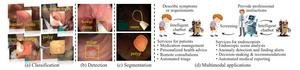
Overview of Recent Developments
A recent study explores the rapidly advancing domain of intelligent colonoscopy. The researchers emphasize that significant progress will stem from generalized multimodal systems rather than just isolated-task modeling. These systems are designed to perceive, describe, locate, and discuss findings using clinically relevant language.
Key Findings from the Study
To advance the field, the researchers conducted a comprehensive review of:
- 63 datasets
- 137 deep-learning models
These models encompass various tasks including:
- Classification
- Detection
- Segmentation
- Vision-language tasks
New Initiatives Introduced
The study led to the creation of three foundational resources:
- ColonINST: A large multimodal colonoscopy dataset
- ColonGPT: A lightweight, colonoscopy-specific multimodal model
- A benchmark for evaluating conversational medical image understanding
Challenges in Colonoscopy Imaging
Colonoscopy remains a critical tool for colorectal cancer screening. However, the complexity of colonoscopy imagery presents challenges for algorithms due to:
- Unpredictable camera movements
- Limited field of view due to the colon’s anatomy
- Inconsistent lighting conditions
- Instruments frequently entering the frame
- Subtle lesions blending into surrounding tissue
The study highlights the need for further research to address issues such as scarce vision-language data, inconsistent labeling, and limited coverage of rare conditions.
Research Collaboration
The research was conducted by a team from:
- Nankai University
- The Australian National University
- Tsinghua University
- Mohamed bin Zayed University of Artificial Intelligence
Their findings were published in Machine Intelligence Research on January 7, 2026 (DOI: 10.1007/s11633-025-1597-6).
Conclusion
The study presents a vision for intelligent colonoscopy that extends beyond mere visual perception. Future systems should not only identify lesions but also provide explanations, respond to prompts, and assist in reporting and decision-making. Addressing existing gaps in data and model performance could lead to a more integrated clinical assistant, enhancing the speed and accuracy of care for patients.