⚡ Quick Summary
This study introduces T-sDTW-CIIL, a transformer-based framework that enhances regression-based myoelectric control through context-informed incremental learning. The results demonstrate significant improvements in success rates and efficiency, achieving up to 3.7 times higher throughput compared to traditional methods.
🔍 Key Details
- 📊 Participants: 12 individuals
- ⚙️ Technology: Transformer models with soft dynamic time warping (sDTW)
- 🏆 Performance Metrics: Success rates, throughputs, efficiencies, and simultaneity gains
- 📈 Environment: High precision ISO-Fitts’ task
🔑 Key Takeaways
- 🚀 T-sDTW-CIIL significantly outperformed static models in myoelectric control tasks.
- 📈 Achieved throughputs of 2.0x, 2.4x, and 3.7x for large, medium, and small targets, respectively.
- 🎯 Maintained a success rate of 98.4% for small targets, compared to only 23.4% for static MLP.
- 💡 Reduced overall contraction intensities by approximately 10% during tasks.
- 🌐 Integrates temporal modeling with closed-loop learning for improved user intent alignment.
- 🤖 Overcomes limitations of existing regression-based myoelectric controllers.
- 🔄 Enables robust, low-intensity human-computer interaction for users.
📚 Background
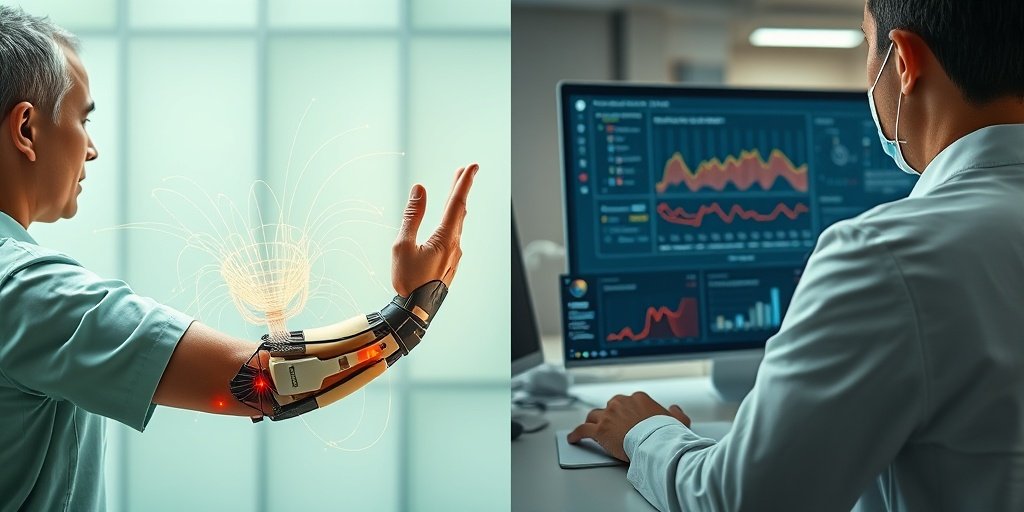
Regression-based myoelectric interfaces have the potential to provide intuitive control for prosthetic devices, yet they face challenges such as calibration sensitivity and unpredictable user behaviors. The integration of temporal neural architectures could enhance these systems by better capturing the dynamics of user interactions, paving the way for more effective and user-friendly solutions.
🗒️ Study
The study involved twelve participants who engaged in an adaptive regression-based cursor-control task. Researchers compared four different pipelines, including both static and context-informed incremental learning (CIIL) variants of multi-layer perceptron (MLP) and transformer models. The goal was to assess the effectiveness of T-sDTW-CIIL in real-time applications.
📈 Results
The T-sDTW-CIIL framework demonstrated remarkable performance, achieving significantly higher success rates and efficiencies compared to traditional MLP models. Specifically, it maintained a success rate of 98.4% for small targets, while the static MLP model’s success rate plummeted to 23.4%. Additionally, T-sDTW-CIIL achieved throughputs that were up to 3.7 times greater than those of conventional training methods.
🌍 Impact and Implications
The findings from this study could revolutionize the field of myoelectric control, enabling more intuitive and efficient interactions between users and prosthetic devices. By leveraging advanced machine learning techniques, we can enhance the usability and effectiveness of these systems, ultimately improving the quality of life for individuals relying on assistive technologies.
🔮 Conclusion
This research highlights the transformative potential of context-informed incremental learning in myoelectric control systems. The T-sDTW-CIIL framework not only addresses existing limitations but also sets a new standard for performance in human-computer interaction. As we continue to explore these innovative technologies, the future looks promising for enhanced user experiences in assistive devices.
💬 Your comments
What are your thoughts on the advancements in myoelectric control technologies? We would love to hear your insights! 💬 Join the conversation in the comments below or connect with us on social media:
Transformer-Based Context-Informed Incremental Learning With sDTW Alignment Unlocks Fast and Precise Regression-Based Myoelectric Control.
Abstract
Regression-based myoelectric interfaces hold the promise of enabling intuitive proportional and simultaneous control but remain limited by calibration sensitivity, unpredictable dynamics, and inconsistent user behaviours. Temporal neural architectures have the potential to substantially improve these controllers by capturing the temporal structure of user behaviours, provided they are trained using dynamics that are sufficiently representative of closed-loop use. Context-informed incremental learning (CIIL) offers a mechanism for acquiring such data online; however, its reliance on environment-derived pseudo-labels makes it vulnerable to temporal deviations between assumed and true user intent. This study introduces T-sDTW-CIIL, a transformer-based incremental learning framework that integrates temporal modelling, closed-loop learning, and soft dynamic time warping (sDTW) to enable tolerant label alignment. Twelve participants completed an adaptive regression-based cursor-control task using four pipelines: static and CIIL variants of both MLP and transformer models. T-sDTW-CIIL achieved significantly higher success rates, throughputs, efficiencies, and simultaneity gains when evaluated in a high precision ISO-Fitts’ environment. T-sDTW-CIIL achieved throughputs of $2.0\times $ , $2.4\times $ , and $3.7\times $ those of an MLP trained using conventional screen-guided training when acquiring large, medium, and small targets, respectively. Perhaps more importantly, it maintained success rates of 98.4% for small targets, whereas the static MLP degraded to only 23.4% success. T-sDTW-CIIL-based adaptation also reduced overall contraction intensities by ~10%. These results demonstrate the powerful combination of temporal learning with context-informed co-adaptation. T-sDTW-CIIL overcomes key limitations of existing regression-based myoelectric controllers, enabling robust, low-intensity human-computer interaction.
Author: [‘Campbell E’, ‘Eddy E’, ‘Scheme E’]
Journal: IEEE Trans Neural Syst Rehabil Eng
Citation: Campbell E, et al. Transformer-Based Context-Informed Incremental Learning With sDTW Alignment Unlocks Fast and Precise Regression-Based Myoelectric Control. Transformer-Based Context-Informed Incremental Learning With sDTW Alignment Unlocks Fast and Precise Regression-Based Myoelectric Control. 2026; 34:2118-2129. doi: 10.1109/TNSRE.2026.3685074