⚡ Quick Summary
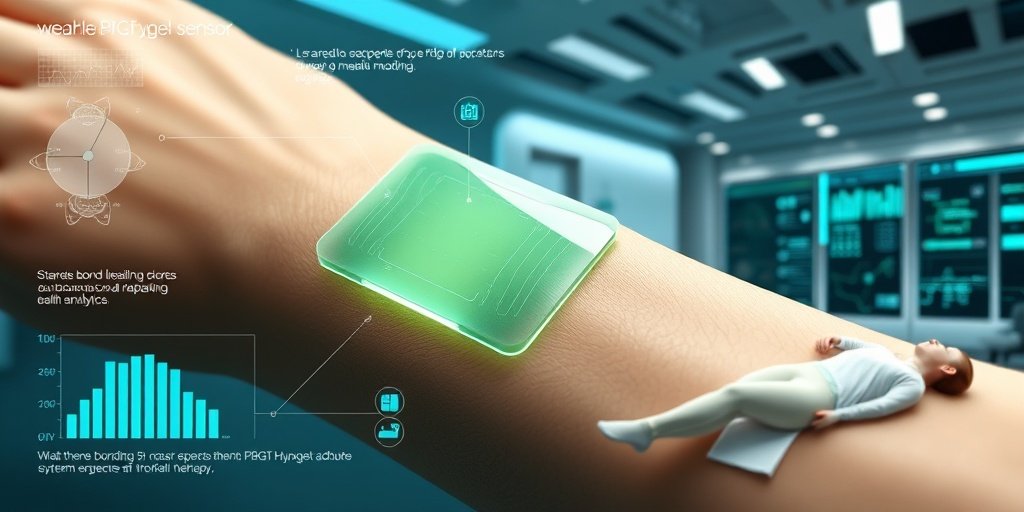
This study presents a novel approach to wearable sensors by utilizing dynamically cross-linked PVA hydrogels reinforced with poly(γ-glutamic acid). The resulting hydrogels demonstrate exceptional elasticity of over 500% and rapid self-healing capabilities, making them ideal for monitoring human movements and touch interactions.
🔍 Key Details
- 📊 Materials Used: Poly(vinyl alcohol), borax, poly(γ-glutamic acid), and tannic acid
- ⚙️ Properties: Elasticity >500%, rapid self-recovery, stable adhesion
- 📏 Gauge Factors: 1.31 (10-100% deformation), 0.61 (200-1000% deformation)
- ⚡ Voltage Output: 0.437 V from a single-electrode triboelectric nanogenerator (TENG)
🔑 Key Takeaways
- 💧 Innovative Hydrogels: The study introduces a new class of hydrogels that are both stretchable and self-healing.
- 🔬 High Elasticity: The PBGT hydrogels exhibit remarkable elasticity, making them suitable for wearable applications.
- ⚡ Self-Healing: Rapid recovery from damage enhances the durability of these materials.
- 📈 High Sensitivity: The hydrogels show significant sensitivity to strain, crucial for accurate movement monitoring.
- 🌍 Versatile Applications: Potential uses include human movement monitoring and touch panel technology.
- 🔋 Self-Powered: Integration with TENG technology allows for self-powered sensor applications.
- 🧪 Multifunctional: The combination of materials provides multifunctionality, enhancing the utility of the hydrogels.
📚 Background
The rapid advancement of technology, particularly in the realms of big data, the Internet of Things (IoT), and artificial intelligence (AI), has led to an increased demand for portable and efficient devices. Wearable sensors, which can monitor various physical movements and interactions, are at the forefront of this technological evolution. Hydrogel-based materials, known for their unique properties, are being actively researched to meet these demands.
🗒️ Study
The research conducted by Lee et al. focused on synthesizing multifunctional conductive hydrogels using a combination of poly(vinyl alcohol), borax, poly(γ-glutamic acid), and tannic acid. The aim was to create a hydrogel that not only exhibits high elasticity and self-healing properties but also maintains stable adhesion to various surfaces, including biological tissues and synthetic materials.
📈 Results
The synthesized PBGT hydrogels demonstrated an impressive elasticity of over 500% and rapid self-recovery from external damage. The gauge factors of 1.31 and 0.61 at different deformation ranges indicate their high sensitivity, making them suitable for precise strain sensing. Additionally, the integration with a TENG resulted in a voltage output of 0.437 V, showcasing their potential as self-powered devices.
🌍 Impact and Implications
The findings from this study have significant implications for the future of wearable technology. The ability to create hydrogels that are not only stretchable and self-healing but also sensitive and self-powered opens up new avenues for applications in health monitoring, sports science, and interactive devices. As we continue to explore the integration of such materials into everyday technology, the potential for enhanced user experiences and improved health outcomes becomes increasingly promising.
🔮 Conclusion
This research highlights the transformative potential of dynamically cross-linked PVA hydrogels in the field of wearable sensors. With their remarkable properties, these hydrogels could redefine how we monitor human movements and interactions. As we look to the future, further exploration and development of such materials will undoubtedly lead to innovative solutions in various technological domains.
💬 Your comments
What are your thoughts on the advancements in wearable sensor technology? We would love to hear your insights! 💬 Share your comments below or connect with us on social media:
Dynamically cross-linked PVA hydrogel reinforced with poly(γ-glutamic acid) for highly Stretchable and rapidly self-healing wearable sensors.
Abstract
The convergence of big data, the Internet of Things (IoT), and artificial intelligence (AI) has spurred an escalating demand for portable devices, thereby driving active research into hydrogel-type strain sensors that are capable of versatile attachment and movement monitoring. Among such strain-sensing materials, poly(vinyl alcohol) and borax are prominent due to their dynamic reversible bonding, which facilitates rapid gel formation and self-healing. In the present study, multifunctional conductive hydrogels are synthesized based on poly(vinyl alcohol), borax, poly(γ-glutamic acid), and tannic acid. The resulting PBGT hydrogels exhibit remarkable elasticity of >500%, along with swift self-recovery from external damage and stable adhesion to diverse interfaces such as pig skin and polyethylene terephthalate (PET) film. Moreover, they display high sensitivity, with gauge factors of 1.31 and 0.61 at deformations of 10-100% and 200-1000%, respectively. Due to these properties, the PBGT hydrogels hold promise for application as strain sensors for monitoring human movements across various scales or as touch panels. Furthermore, integration into a single-electrode triboelectric nanogenerator (TENG) yields a voltage output of 0.437 V, thereby underscoring the potential of these hydrogels as self-powered, intelligent, and flexible electronic materials.
Author: [‘Lee SJ’, ‘In Kim T’, ‘Park YW’, ‘Kang BS’, ‘Kang SM’, ‘Kim MH’, ‘Park WH’]
Journal: Int J Biol Macromol
Citation: Lee SJ, et al. Dynamically cross-linked PVA hydrogel reinforced with poly(γ-glutamic acid) for highly Stretchable and rapidly self-healing wearable sensors. Dynamically cross-linked PVA hydrogel reinforced with poly(γ-glutamic acid) for highly Stretchable and rapidly self-healing wearable sensors. 2026; (unknown volume):152141. doi: 10.1016/j.ijbiomac.2026.152141