

⚡ Quick Summary
This study explored the use of convolutional neural networks (CNNs) for the segmentation of chronic wounds and classification of wound tissues using real-world images. The model achieved a remarkable Dice Similarity Coefficient (DSC) of 0.927 for wound area segmentation, indicating its potential in enhancing wound care diagnostics.
🔍 Key Details
- 📊 Dataset: 362 images of various chronic wounds including venous, arterial, vasculitis, and pyoderma gangrenosum.
- 🧩 Technology: U-Net architecture for convolutional neural networks.
- ⚙️ Learning Method: Fully supervised learning.
- 🏆 Performance Metrics: DSC of 0.927 and IoU of 0.868 for wound area.
🔑 Key Takeaways
- 🤖 AI in Wound Care: The study demonstrates the feasibility of using AI for chronic wound assessment.
- 📈 High Performance: The model achieved a DSC of 0.927 for wound area segmentation.
- 🩹 Tissue Classification: Fibrinous exudate and granulation tissues showed DSC values of 0.750 and 0.696, respectively.
- ⚠️ Challenges: Necrosis classification was less effective, with a DSC of only 0.503.
- 📸 Real-World Application: The model was trained on images taken for clinical purposes, enhancing its practical relevance.
- 🔍 Structure Identification: Performance varied based on the number of images available for each wound structure.
- 🌟 Future Potential: This approach could lead to improved diagnostic tools in wound care.
📚 Background
Chronic wounds pose a significant challenge in healthcare, affecting patient quality of life and placing a burden on healthcare systems. Traditional methods of diagnosing and monitoring these wounds can be subjective and inconsistent. The integration of artificial intelligence into wound care offers a promising avenue for developing more effective and objective diagnostic tools.
🗒️ Study
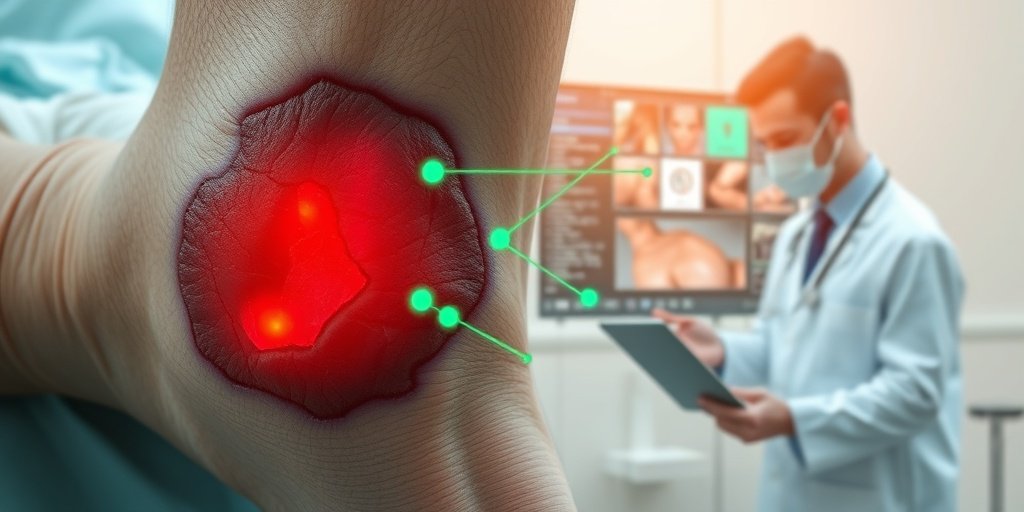
The study utilized a dataset of 362 real-world images of chronic wounds to train a convolutional neural network based on the U-Net architecture. The aim was to automate the segmentation of wound areas and classify various wound tissues, thereby providing a more efficient and accurate diagnostic method.
📈 Results
The convolutional neural network demonstrated impressive performance, achieving a Dice Similarity Coefficient (DSC) of 0.927 and an Intersection over Union (IoU) of 0.868 for the segmentation of wound areas. While fibrinous exudate and granulation tissues were classified with reasonable accuracy, necrosis showed lower performance metrics, highlighting areas for future improvement.
🌍 Impact and Implications
The findings of this study could significantly impact the field of wound care by providing healthcare professionals with a powerful tool for objective assessment of chronic wounds. By leveraging AI technologies, we can enhance diagnostic accuracy, leading to better patient outcomes and more efficient treatment strategies. This could ultimately reduce the burden on healthcare systems and improve the quality of life for patients suffering from chronic wounds.
🔮 Conclusion
This study illustrates the transformative potential of convolutional neural networks in chronic wound care. With high performance in segmenting wound areas and classifying tissues, AI can play a crucial role in advancing diagnostic methods. Continued research and development in this area are essential to refine these technologies and expand their applications in clinical settings.
💬 Your comments
What are your thoughts on the use of AI in wound care? Do you see potential for further advancements in this field? 💬 Share your insights in the comments below or connect with us on social media:
Convolutional Neural Networks in Chronic Wound Segmentation and Tissue Classification Using Real-World Images.
Abstract
Chronic wounds cause a significant burden to affected patients and to society. Effective and objective diagnostic and monitoring methods are needed in wound care, and artificial intelligence offers one promising alternative. In this study, real-world wound images were used to train a convolutional neural network to automatically segment wound area and wound tissues on an image. The study included altogether 362 images of venous, arterial, vasculitis and pyoderma gangrenosum wounds. The model was based on a convolutional neural network architecture U-Net, and fully supervised learning was utilised during the training phase. Wound area reached a Dice Similarity Coefficient (DSC) of 0.927 and Intersection over Union (IoU) of 0.868 using an augmented dataset with pretraining. Fibrinous exudate and granulation performed fairly well with DSC 0.750 and 0.696, and with IoU 0.659 and 0.601, respectively. Necrosis present in only 56 images achieved lower performance with DSC 0.503 and IoU 0.502. In conclusion, this study suggested that it is possible to train a neural network to perform well with images taken for purely clinical purposes. Besides wound area, several wound structures can be identified, but wound structure identification performance is dependent on the number of images featuring the structure.
Author: [‘Huttunen E’, ‘Kimpimäki T’, ‘Salenius JE’, ‘Pölönen I’, ‘Yambasu T’, ‘Huttunen M’, ‘Salmi T’]
Journal: Int Wound J
Citation: Huttunen E, et al. Convolutional Neural Networks in Chronic Wound Segmentation and Tissue Classification Using Real-World Images. Convolutional Neural Networks in Chronic Wound Segmentation and Tissue Classification Using Real-World Images. 2026; 23:e70912. doi: 10.1111/iwj.70912