
⚡ Quick Summary
This study introduces TFFBN-HDLF, a hybrid deep learning framework designed for the detection of epileptic seizures in elderly patients using electroencephalogram (EEG) data. The framework achieved impressive results, with an accuracy of 98.09% on the CHB-MIT dataset and 92.49% on the Siena dataset, showcasing its potential for enhancing clinical decision-making.
🔍 Key Details
- 📊 Datasets: CHB-MIT and Siena
- 🧩 Features used: EEG data processed through time-frequency functional brain networks
- ⚙️ Technology: Hybrid deep learning architecture combining CNNs and Transformer modules
- 🏆 Performance: Accuracy of 98.09% (AUC 99.45%) on CHB-MIT; 92.49% (AUC 95.64%) on Siena
🔑 Key Takeaways
- 🧠 TFFBN-HDLF enhances the reliability of seizure detection in elderly patients.
- 🔍 Time-frequency functional brain networks provide a comprehensive analysis of EEG signals.
- 🤖 The hybrid architecture integrates CNNs with Transformer modules for improved feature extraction.
- 📈 High accuracy indicates the framework’s potential for clinical applications in epilepsy monitoring.
- 🌐 Collaborative integration of attention-based networks significantly boosts diagnostic performance.
- 👵 Focus on elderly patients addresses a critical gap in current seizure detection methodologies.
- 📊 Extensive evaluations confirm the effectiveness of the proposed framework.
📚 Background
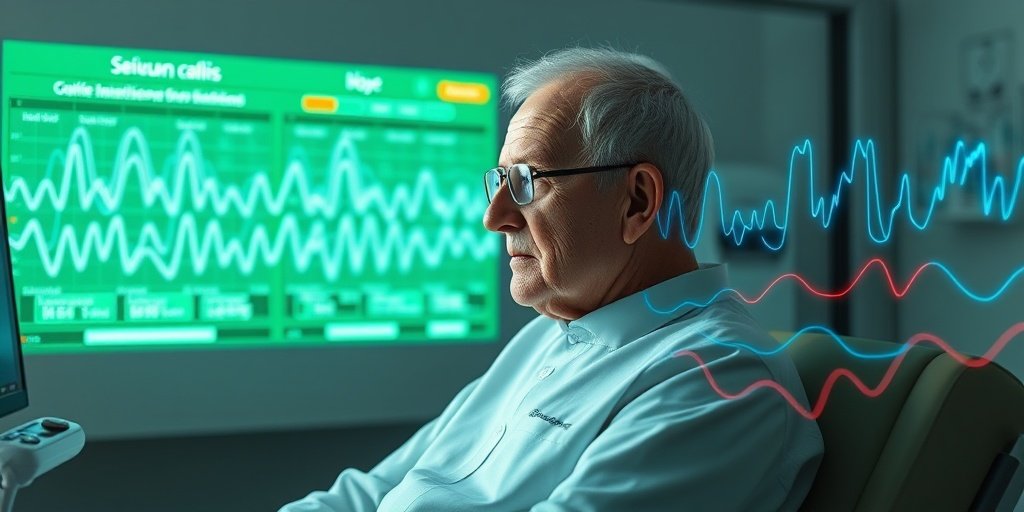
The detection of epileptic seizures is crucial for effective management and treatment, especially in elderly patients who often exhibit complex brain signal patterns. Traditional methods have struggled to accurately identify seizures due to the non-stationary dynamics of EEG signals in this demographic. This study aims to bridge that gap by leveraging advanced deep learning techniques to enhance diagnostic accuracy.
🗒️ Study
The research team developed the time-frequency functional brain network construction method (TFFBNC), which utilizes the Pearson correlation coefficient (PCC) and phase lag index (PLV) to create a two-dimensional time-frequency fused functional brain network (TFPPNet). This innovative approach allows for a more nuanced understanding of neural interactions in elderly patients, transforming raw EEG data into actionable clinical insights.
📈 Results
The TFFBN-HDLF framework demonstrated remarkable performance, achieving an accuracy of 98.09% with an AUC of 99.45% on the CHB-MIT dataset, and an accuracy of 92.49% with an AUC of 95.64% on the Siena dataset. These results highlight the framework’s capability to accurately infer seizure states, even amidst the variability of EEG patterns associated with aging.
🌍 Impact and Implications
The findings from this study have significant implications for clinical practice. By improving the accuracy of seizure detection in elderly patients, the TFFBN-HDLF framework could lead to better patient outcomes and more effective management of epilepsy. This advancement not only enhances the quality of care but also paves the way for further research into AI-assisted monitoring systems in neurology.
🔮 Conclusion
The TFFBN-HDLF framework represents a significant step forward in the field of epilepsy monitoring. By harnessing the power of deep learning and time-frequency analysis, this study showcases the potential for AI to transform clinical decision-making in neurology. Continued exploration and development in this area could lead to even more breakthroughs in the management of epilepsy and other neurological disorders.
💬 Your comments
What are your thoughts on the integration of AI in epilepsy monitoring? We would love to hear your insights! 💬 Share your comments below or connect with us on social media:
TFFBN-HDLF: a hybrid deep learning framework based on time-frequency functional brain networks for epileptic seizure detection.
Abstract
INTRODUCTION: The detection of epilepsy seizures in the elderly based on electroencephalogram (EEG) is the foundation of an intelligent clinical decision support system. However, due to the often slow background activity and complex non-stationary dynamic characteristics of the brain signals in elderly patients, existing methods often struggle to extract robust discriminative features across different individuals. To address this deficiency, this study proposes a hybrid deep learning framework named TFFBN-HDLF, aiming to enhance the reliability and diagnostic accuracy of artificial intelligence-assisted monitoring of epilepsy seizures in the elderly.
METHODS: Firstly, this paper presents a time-frequency functional brain network construction method (TFFBNC). By combining the Pearson correlation coefficient (PCC) and phase lag index (PLV), we construct a two-dimensional time-frequency fused functional brain network (TFPPNet). This method can comprehensively simulate the synchronous neural interactions in the time and frequency domains of the elderly brain, converting the complex raw EEG data into high-quality neurophysiological evidence, thereby providing a basis for clinical decision-making. Additionally, we have developed a hybrid deep learning architecture-SeizureTransNet, which combines convolutional neural networks (CNNs) with enhanced Transformer modules. This architecture can dynamically select and integrate multi-scale spatiotemporal features, ensuring accurate inference of the seizure state in the elderly while maintaining high adaptability to the different EEG pattern differences caused by aging.
RESULTS: Extensive evaluations on publicly available CHB-MIT and Siena datasets have confirmed the effectiveness of this framework. The accuracy of TFFBN-HDLF on the CHB-MIT dataset reached 98.09% (AUC of 99.45%), and on the Siena dataset, it was 92.49% (AUC of 95.64%).
DISCUSSION: These results indicate that the collaborative integration of attention-based time-frequency network fusion and feature learning significantly improves diagnostic performance, demonstrating its potential application in clinical care for epilepsy in the elderly.
Author: [‘Gu P’, ‘Wang R’, ‘Lin Y’, ‘Zhang M’, ‘Liu F’, ‘Guo J’, ‘Jiang B’]
Journal: Front Med (Lausanne)
Citation: Gu P, et al. TFFBN-HDLF: a hybrid deep learning framework based on time-frequency functional brain networks for epileptic seizure detection. TFFBN-HDLF: a hybrid deep learning framework based on time-frequency functional brain networks for epileptic seizure detection. 2026; 13:1788516. doi: 10.3389/fmed.2026.1788516