⚡ Quick Summary
A recent study utilized an artificial intelligence (AI)-based system to screen for osteoporosis in Vietnamese adults, revealing a concerning 43.9% prevalence among the analyzed population. This innovative approach demonstrates the potential of AI in enhancing osteoporosis detection, particularly in resource-limited settings.
🔍 Key Details
- 📊 Dataset: 1987 pelvic and hip radiographs from patients aged ≥ 40 years
- 🧩 Features used: AI software estimating bone mineral density (BMD)
- ⚙️ Technology: AI-based analysis for deriving T-scores
- 🏆 Definition of osteoporosis: T-score ≤ -2.5
🔑 Key Takeaways
- 📈 High prevalence: 43.9% of patients screened were diagnosed with osteoporosis.
- 👩⚕️ Gender disparity: Osteoporosis was more prevalent in women (58.7%) compared to men (22.8%).
- 🔺 Age factor: The prevalence of osteoporosis increased with age.
- ⚠️ Fracture risk: Osteoporosis was significantly associated with femoral neck and intertrochanteric fractures.
- 📉 Lower T-scores: Patients with T-scores ≤ -3.0 had an 11.5 times higher risk of hip fractures.
- 🌍 Feasibility: AI-assisted screening is a viable method for osteoporosis detection in Vietnam.
- 💡 Implications: This approach could improve early detection strategies in resource-limited healthcare settings.
📚 Background
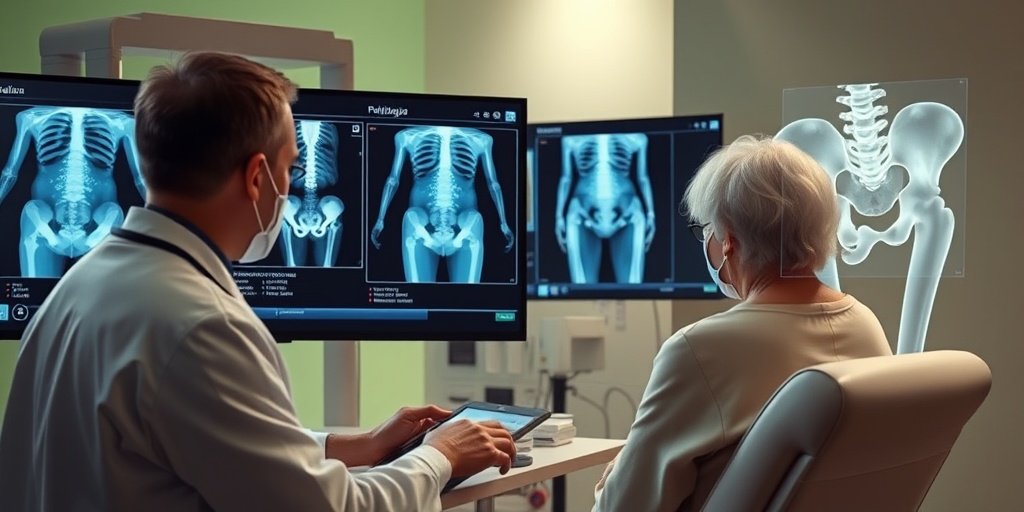
Osteoporosis is often referred to as a silent disease due to its asymptomatic nature until fractures occur. In many developing countries, including Vietnam, the screening rates for osteoporosis remain low, leading to undiagnosed cases and increased morbidity. The integration of artificial intelligence in medical imaging presents a promising solution to enhance screening efforts and improve patient outcomes.
🗒️ Study
Conducted in 2023 at a tertiary medical center in Central Vietnam, this cross-sectional study analyzed 1987 pelvic and hip radiographs from patients aged 40 years and older. The AI-based software used in the study was designed to estimate bone mineral density (BMD) and derive T-scores, facilitating the identification of osteoporosis among the participants.
📈 Results
The findings revealed that among the 1987 patients, a significant 43.9% were diagnosed with osteoporosis. The prevalence was notably higher in women (58.7%) compared to men (22.8%), with a clear correlation between age and osteoporosis rates. Furthermore, patients with lower T-scores exhibited a markedly increased risk of hip fractures, particularly those with T-scores ≤ -3.0, who faced an 11.5-fold increase in risk.
🌍 Impact and Implications
The results of this study underscore the potential of AI-assisted screening as a transformative tool for osteoporosis detection in Vietnam. By providing a feasible and effective method for early diagnosis, this approach could significantly reduce the burden of osteoporosis-related fractures, particularly among vulnerable populations such as elderly women. The implications extend beyond Vietnam, suggesting that similar AI technologies could be adapted for use in other resource-limited settings globally.
🔮 Conclusion
This study highlights the remarkable potential of AI in enhancing osteoporosis screening in developing countries. By leveraging advanced technologies, healthcare providers can achieve earlier detection and intervention, ultimately improving patient outcomes. As we move forward, further research and implementation of AI-assisted screening methods could pave the way for a healthier future for populations at risk of osteoporosis.
💬 Your comments
What are your thoughts on the use of AI for osteoporosis screening? We would love to hear your insights! 💬 Join the conversation in the comments below or connect with us on social media:
Artificial intelligence-assisted screening reveals high prevalence of osteoporosis in Vietnamese adults using pelvic and hip radiographs.
Abstract
OBJECTIVES: Osteoporosis is a silent disease with low screening rates in many developing countries. This study aimed to evaluate the feasibility of using an artificial intelligence (AI)-based system to screen osteoporosis from pelvic and hip radiographs in Vietnam.
METHODS: We conducted a cross-sectional study at a tertiary medical center in Central Vietnam in 2023. A total of 2000 consecutive pelvic and hip radiographs from patients aged ≥ 40 years were collected. After excluding poor-quality images, 1987 radiographs were analyzed using an AI-based software designed to estimate bone mineral density (BMD) from plain radiographs and derive T-scores. Osteoporosis was defined as a T-score ≤ -2.5. Patient characteristics, radiographic findings, and risk factors for osteoporosis were analyzed.
RESULTS: Among 1987 patients (mean age 66.4 ± 15.1 years; 41.3% men), osteoporosis was identified in 872 patients (43.9%). The prevalence increased with age and was higher in women than in men (58.7% vs 22.8%, P < 0.001). Osteoporosis was associated with femoral neck (OR = 3.8, 95% CI: 2.7-5.2) and intertrochanteric fractures (OR = 7.0, 95% CI: 4.5-11.0). Patients with lower T-scores had a higher risk of hip fractures, especially those with T-scores ≤ -3.0 (OR = 11.5, 95% CI: 5.5-24.5).
CONCLUSIONS: AI-based analysis of pelvic and hip radiographs is a feasible and effective tool for osteoporosis screening in Vietnam. The prevalence of osteoporosis in this hospital-based setting was high, particularly among elderly women. AI-assisted screening may offer an accessible strategy for early detection of osteoporosis in resource-limited settings.
Author: [‘Nguyen DM’, ‘Wu CH’, ‘Nguyen TV’, ‘Ho-Pham LT’, ‘Dang KTH’, ‘Nguyen HV’, ‘Lin SY’, ‘Chen CH’, ‘Tai TW’]
Journal: Osteoporos Sarcopenia
Citation: Nguyen DM, et al. Artificial intelligence-assisted screening reveals high prevalence of osteoporosis in Vietnamese adults using pelvic and hip radiographs. Artificial intelligence-assisted screening reveals high prevalence of osteoporosis in Vietnamese adults using pelvic and hip radiographs. 2026; 12:18-25. doi: 10.1016/j.afos.2026.01.002