⚡ Quick Summary
This study explores the use of artificial intelligence for perioperative risk assessment in elderly patients undergoing inguinal hernia repair, particularly in resource-limited settings. The findings suggest that AI can significantly enhance patient safety and surgical outcomes.
🔍 Key Details
- 📊 Focus Group: Elderly patients undergoing inguinal hernia repair
- ⚙️ Technology: Artificial Intelligence-based risk assessment
- 🌍 Setting: Resource-limited environments
- 📝 Authors: Asafa OQ, Asafa AO, Folami EO, et al.
- 📅 Publication Year: 2026
🔑 Key Takeaways
- 🤖 AI technology can improve perioperative risk assessments for elderly patients.
- 🏥 Inguinal hernia repair is a common procedure among the elderly, necessitating careful risk evaluation.
- 🌍 Resource-limited settings face unique challenges in patient care, making AI solutions particularly valuable.
- 📈 Enhanced patient safety is a primary goal of implementing AI in surgical assessments.
- 💡 Future research is needed to validate AI models in diverse clinical environments.
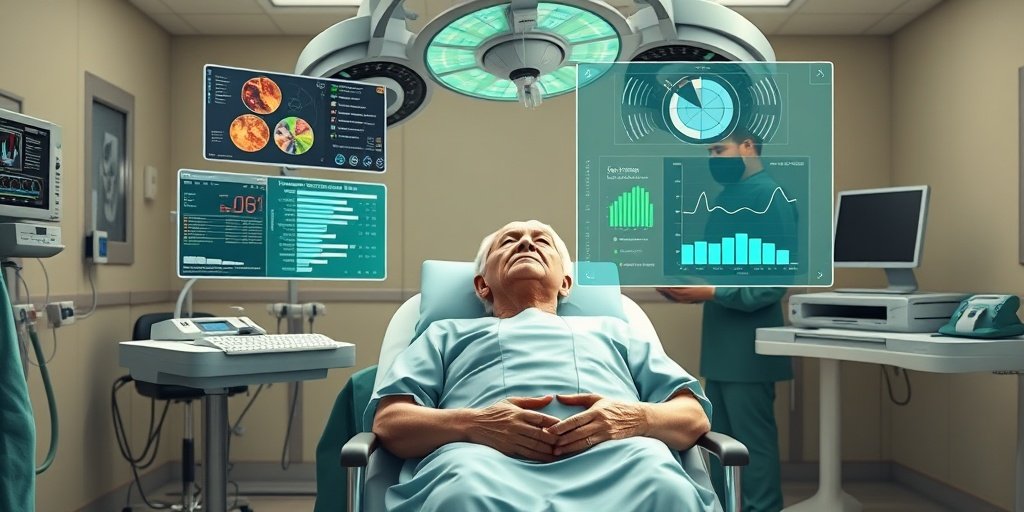
📚 Background
The surgical landscape for elderly patients is fraught with challenges, particularly in resource-limited settings where access to advanced medical technologies may be restricted. Inguinal hernia repair is a frequently performed procedure, yet the risks associated with surgery in older adults can be significant. Traditional risk assessment methods often fall short, highlighting the need for innovative solutions such as artificial intelligence.
🗒️ Study
This study aimed to evaluate the effectiveness of an AI-based approach for assessing perioperative risks in elderly patients undergoing inguinal hernia repair. The researchers focused on developing a model that could accurately predict surgical outcomes and complications, thereby aiding healthcare providers in making informed decisions.
📈 Results
The implementation of AI in perioperative risk assessment demonstrated promising results, indicating a potential for improved accuracy in predicting complications. The study highlighted that AI models could analyze various patient data points, leading to more tailored and effective surgical strategies.
🌍 Impact and Implications
The findings from this study could have a transformative impact on surgical practices, especially in resource-limited settings. By integrating AI into perioperative assessments, healthcare providers can enhance patient safety and optimize surgical outcomes. This approach not only addresses immediate clinical needs but also paves the way for broader applications of AI in healthcare.
🔮 Conclusion
This research underscores the potential of artificial intelligence in revolutionizing perioperative care for elderly patients. By improving risk assessment processes, AI can lead to better surgical outcomes and enhanced patient safety. Continued exploration and validation of these technologies are essential for their successful integration into clinical practice.
💬 Your comments
What are your thoughts on the use of AI in surgical risk assessments? We would love to hear your insights! 💬 Share your comments below or connect with us on social media:
Artificial Intelligence-Based Perioperative Risk Assessment for Elderly Patients Undergoing Inguinal Hernia Repair in a Resource-Limited Setting.
Abstract
None
Author: [‘Asafa OQ’, ‘Asafa AO’, ‘Folami EO’, ‘Alatishe KA’, ‘Ajayeoba OT’, ‘Awodele K’, ‘Uthman II’, ‘Kehinde ON’, ‘Babatunde M’, ‘Adebukola OG’]
Journal: World J Surg
Citation: Asafa OQ, et al. Artificial Intelligence-Based Perioperative Risk Assessment for Elderly Patients Undergoing Inguinal Hernia Repair in a Resource-Limited Setting. Artificial Intelligence-Based Perioperative Risk Assessment for Elderly Patients Undergoing Inguinal Hernia Repair in a Resource-Limited Setting. 2026; (unknown volume):(unknown pages). doi: 10.1002/wjs.70354