
⚡ Quick Summary
This scoping review evaluates the impact of robotic rehabilitation and AI-driven technologies on stroke patients, focusing on improvements in hand strength, dexterity, and range of motion (ROM). The findings highlight significant advancements while also identifying critical gaps that need further exploration.
🔍 Key Details
- 📊 Study Period: 2014-2024
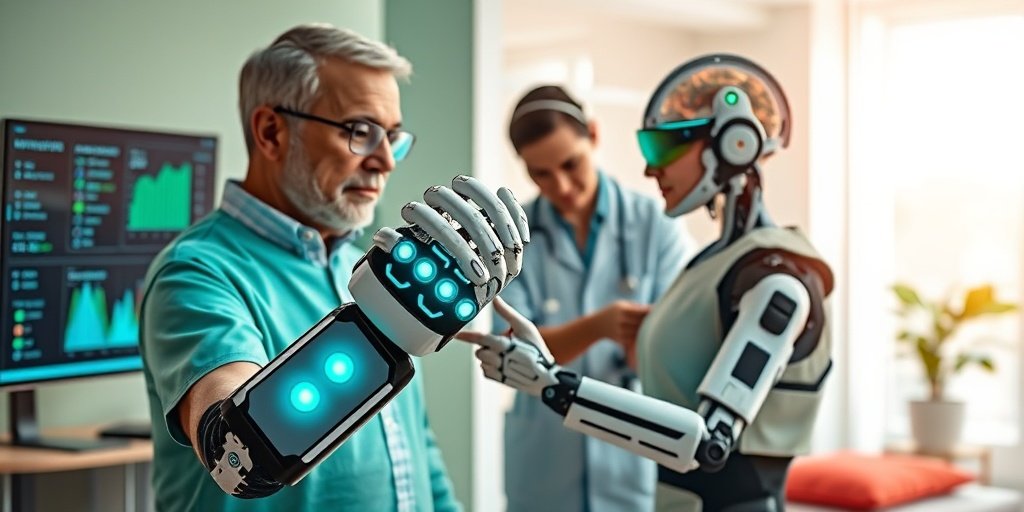
- 🧩 Technologies Reviewed: Robotic-assisted technologies (RATs), including end-effector robots, exoskeletons, soft robotic gloves (SRGs), brain-computer interfaces (BCIs), and AI-enhanced virtual reality (AIVR)
- ⚙️ Focus: Upper limb rehabilitation for stroke survivors
- 📈 Outcome Measures: Hand strength, dexterity, ROM, cost-effectiveness, and patient satisfaction
🔑 Key Takeaways
- 🤖 Robotic devices significantly enhance motion and grip strength in stroke patients.
- 💡 AI algorithms optimize therapy by balancing challenge and engagement, reducing therapist workload.
- 🏠 Home-based models improve adherence to rehabilitation protocols.
- 💰 Cost and accessibility remain significant barriers to widespread adoption of robotic rehabilitation.
- 🔍 Long-term efficacy of these technologies requires further research.
- 🧠 Cognitive-emotional outcomes are an area needing more attention in robotic rehabilitation studies.
- 📉 Setup challenges can hinder participant independence during rehabilitation.
📚 Background
Stroke is a leading cause of long-term disability, often resulting in significant impairments in motor function. Traditional rehabilitation methods can be limited in their effectiveness, prompting the exploration of robotic rehabilitation and artificial intelligence (AI) as innovative solutions. These technologies aim to enhance recovery by providing tailored interventions that can adapt to individual patient needs.
🗒️ Study
This scoping review systematically analyzed studies published between 2014 and 2024 that focused on robotic-assisted technologies for upper limb rehabilitation in stroke survivors. The review aimed to assess the effectiveness of these interventions in improving hand function and to provide clinicians with updated guidance on their application.
📈 Results
The review found that robotic rehabilitation significantly impacts motor function among stroke patients, particularly in enhancing grip strength and functional independence. The integration of AI algorithms allows for personalized therapy adjustments, making rehabilitation more engaging and effective. However, challenges such as cost, accessibility, and the need for further research on long-term outcomes were also identified.
🌍 Impact and Implications
The findings from this review suggest that robotic rehabilitation has the potential to transform stroke recovery processes. By leveraging advanced technologies, healthcare providers can offer more effective and personalized rehabilitation strategies. However, addressing the barriers of cost and accessibility is crucial for these innovations to reach a broader patient population, ultimately improving quality of life for stroke survivors.
🔮 Conclusion
This scoping review underscores the significant advancements in robotic rehabilitation and AI integration for stroke recovery. While the results are promising, further research is essential to overcome existing challenges and optimize therapy delivery. The future of stroke rehabilitation looks bright, with the potential for enhanced patient outcomes through continued innovation in this field.
💬 Your comments
What are your thoughts on the role of robotics and AI in stroke rehabilitation? We would love to hear your insights! 💬 Join the conversation in the comments below or connect with us on social media:
Robotic rehabilitation and intelligent algorithms improving the performance skills of stroke patients: a scoping review.
Abstract
BACKGROUND: This scoping review highlights major advances and persisting gaps in robotic and AI-driven rehabilitation for stroke, evaluating their impact on hand strength, dexterity, and ROM, and offering clinicians practical, updated guidance.
METHODS: Studies that focused on robotic-assisted technologies (RATs) in upper limb rehabilitation for stroke survivors (2014-2024) were included. Study designs unrelated to stroke, animal studies, and conference abstracts were excluded. Systematic searching in PubMed, Web of Science, Scopus, and Google Scholar employed robotic rehabilitation, AI, hand function, and stroke recovery-related terms. Data extraction encompassed intervention type, duration of treatment, dosage of therapy, outcome measures, cost-effectiveness, and patient satisfaction. Types of robotic rehabilitation: end-effector robots, exoskeletons, soft robotic gloves (SRGs), brain-computer interfaces (BCIs), and AI-enhanced virtual reality (AIVR).
RESULTS: These devices can augment motion, grip strength, and functional independence, especially in chronic and subacute stroke patients. Therapies are made fine-grained by algorithms to balance challenge and engagement, thus lightning therapists’ burdens. Conventional energy sources may offer a more attractive option at shorter timelines and with reasonably predictable availability. Models that can be done at home enhance adherence at that higher level, though usability appears high for most models. Still, challenges with setup and independence for participants remain.
CONCLUSION: Robotic rehabilitation has a significant impact on motor function (MF) among stroke patients. Despite this, obstacles such as cost, accessibility, and long-term efficacy need even more research. Therapy dose optimization, adaptive AI integration, and cognitive-emotional outcome assessment are all areas of gaps in robotic rehabilitation that still need to be addressed.
Author: [‘Rustamzadeh O’, ‘Hosseini SA’, ‘Tanha RR’, ‘Akbarfahimi N’]
Journal: J Bodyw Mov Ther
Citation: Rustamzadeh O, et al. Robotic rehabilitation and intelligent algorithms improving the performance skills of stroke patients: a scoping review. Robotic rehabilitation and intelligent algorithms improving the performance skills of stroke patients: a scoping review. 2026; 46:308-331. doi: 10.1016/j.jbmt.2025.09.037