⚡ Quick Summary
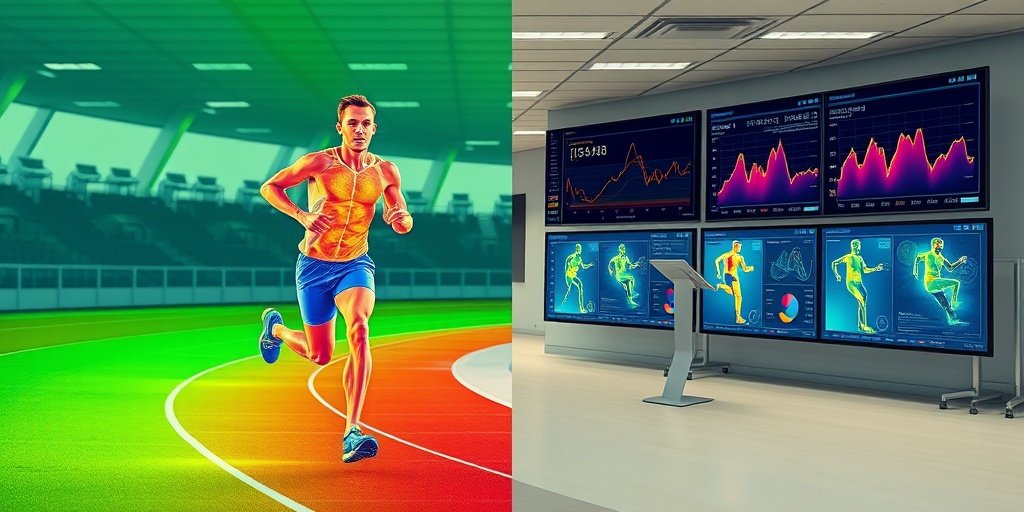
This study utilized deep learning-assisted infrared thermography (IRT) to analyze thermoregulatory responses during running in eleven endurance-trained individuals. The findings revealed that specific skin temperature metrics are both reproducible and physiologically relevant, providing insights into individual and uniform thermoregulatory responses.
🔍 Key Details
- 📊 Participants: 11 endurance-trained individuals
- ⏳ Sessions: Three 46-minute running sessions over 2 days
- ⚙️ Technology: Deep learning-assisted infrared thermography (IRT)
- 📈 Metrics measured: Oxygen consumption (VO2), core temperature (TCORE), heart rate (HR), and various skin temperature metrics (TSK)
🔑 Key Takeaways
- 📊 Consistent temporal dynamics were observed in all TSK metrics aligned with external load.
- 💡 TP showed robust correlations with HR and VO2 during exercise (r = -0.63 to -0.9, p < 0.001).
- 📉 TNV correlations with TCORE varied based on individual exercise capacity.
- 🔄 High reproducibility of ∆TNV was confirmed with ICC(3,1) values of 0.89 for recovery and 0.76 for warm-up.
- 🏃♂️ Variability in peripheral temperature regulation is more closely linked to running velocity at the individual anaerobic threshold than to maximal cardiorespiratory fitness.
📚 Background
The field of exercise physiology has seen a growing interest in non-invasive monitoring techniques that can provide real-time insights into physiological responses during physical activity. Infrared thermography (IRT) stands out as a promising tool, allowing researchers to observe thermoregulatory and cardiopulmonary responses without the need for invasive procedures. However, questions regarding the reproducibility of measurements and the standardization of region-of-interest selection have persisted.
🗒️ Study
Conducted by a team of researchers, this study aimed to address the gaps in understanding the reproducibility and physiological relevance of skin temperature metrics during running. Eleven endurance-trained individuals participated in three running sessions, each lasting 46 minutes, with the same average external load but varying intensity distributions. The study employed deep learning-assisted IRT to analyze skin temperature metrics alongside cardiopulmonary parameters.
📈 Results
The results indicated that all TSK metrics exhibited consistent temporal dynamics in response to external load. Notably, TP demonstrated strong correlations with heart rate and oxygen consumption, while TNV showed heterogeneous correlations with core temperature based on individual exercise capacity. The reproducibility of ∆TNV was confirmed, with high intra-individual consistency across sessions.
🌍 Impact and Implications
The findings from this study have significant implications for the field of exercise physiology and sports science. By leveraging deep learning-assisted IRT, researchers can obtain reliable and reproducible metrics that reflect both uniform and individual-specific thermoregulatory responses. This technology could enhance our understanding of how different individuals respond to exercise, potentially informing training regimens and recovery strategies.
🔮 Conclusion
This study highlights the transformative potential of deep learning-assisted infrared thermography in monitoring thermoregulatory responses during exercise. The ability to capture both uniform and individual-specific responses opens new avenues for research and application in sports science. As we continue to explore these technologies, we anticipate further advancements that will improve athletic performance and recovery strategies.
💬 Your comments
What are your thoughts on the use of infrared thermography in exercise physiology? We would love to hear your insights! 💬 Join the conversation in the comments below or connect with us on social media:
Deep learning-based infrared thermography reveals reproducible uniform and individual thermoregulatory responses during running.
Abstract
Infrared thermography (IRT) has recently gained attention in the field of exercise physiology, due to its ability to monitor thermoregulatory and cardiopulmonary responses non-invasively and in real time during physical exercise. However, the reproducibility of intra-individual measurement and standardization of region-of-interest selection in relation to the acute exercise response remain inconclusive. This study aimed to examine the reproducibility and physiological relevance of specific skin temperature (TSK) metrics processed automatically using deep learning-assisted IRT during running, and to synchronize these metrics with cardiopulmonary and thermoregulatory parameters. Eleven endurance-trained individuals performed three 46-min running sessions over 2 days, with the same average external load but different intensity distributions. Individual anaerobic threshold velocity (vIAT), previously determined by cardiopulmonary exercise testing, was used to prescribe running intensity. During exercise, oxygen consumption (VO2), core temperature (TCORE), heart rate (HR) and different TSK metrics, including non-vessel (TNV), cutaneous arterial perforator (TP), and superficial vein patterns, were continuously measured. All TSK metrics displayed consistent temporal dynamics aligned with external load, but their absolute temperature levels differed systematically. During intermittent running and recovery, TP exhibited robust correlations with HR and VO2 (r = - 0.63 to - 0.9, p < 0.001), and TP entropy showed consistent associations with TCORE during the warm-up (r = 0.59-0.83, p < 0.001). This indicates uniform response patterns across the cohort. In contrast, TNV demonstrated heterogeneous correlations with TCORE, depending on individual exercise capacity. A strong inverse correlation was identified between ∆TNV and vIAT (r = - 0.74 to - 0.88, p ≤ 0.009) and individuals with higher vIAT demonstrated greater TCORE-TNV gradients during running. Measurements of ∆TNV demonstrated high reproducibility, with intra-individual ICC(3,1) values of 0.89 for recovery and 0.76 for warm-up, and no statistically significant differences between the three sessions. Deep learning-assisted IRT provides reproducible, physiologically consistent metrics across repeated exercise sessions, regardless of the day or prior load. Distinct TSK metrics capture both uniform and individual-specific thermoregulatory responses. Variability in peripheral temperature regulation is more strongly associated with running velocity at the individual anaerobic threshold than with maximal cardiorespiratory fitness.
Author: [‘Weber V’, ‘López DA’, ‘Ochmann DT’, ‘Zentgraf S’, ‘Nägele M’, ‘Neuberger EWI’, ‘Schömer E’, ‘Simon P’, ‘Hillen B’]
Journal: Sci Rep
Citation: Weber V, et al. Deep learning-based infrared thermography reveals reproducible uniform and individual thermoregulatory responses during running. Deep learning-based infrared thermography reveals reproducible uniform and individual thermoregulatory responses during running. 2026; 16:(unknown pages). doi: 10.1038/s41598-026-44102-6