⚡ Quick Summary
This study explores the application of YOLOv4, a real-time object detection system, to classify osteoporosis and detect compression fractures from medical radiographs. The model achieved a prediction accuracy of 78.1% for osteoporosis and 68.3% for compression fractures, highlighting its potential as a screening tool in settings lacking advanced diagnostic facilities.
🔍 Key Details
- 📊 Dataset: Clinical radiographs from a collaborated teaching hospital
- 🧩 Features used: Trabecular characteristics from caput femoris and lateral spine images
- ⚙️ Technology: YOLOv4 for real-time object detection
- 🏆 Performance: Osteoporosis classification accuracy: 78.1%, Compression fracture detection accuracy: 68.3%
🔑 Key Takeaways
- 🤖 AI and machine learning are increasingly utilized in medical image diagnosis.
- 💡 YOLOv4 demonstrates significant promise in detecting osteoporosis and compression fractures.
- 🏥 X-ray imaging can serve as a preliminary screening tool for osteoporosis.
- 🌍 The study emphasizes the importance of accessible diagnostic tools in healthcare settings.
- 📈 The model’s accuracy is close to 80%, indicating its reliability for initial assessments.
- 🧑⚕️ This approach could streamline patient selection for further testing, such as DXA scans.
- 🔬 The research underscores the potential of deep learning in enhancing medical diagnostics.
📚 Background
Osteoporosis is a prevalent condition characterized by reduced bone density, leading to an increased risk of fractures. Traditional diagnostic methods, such as Dual-energy X-ray Absorptiometry (DXA), are effective but may not be readily available in all healthcare settings. The integration of artificial intelligence and machine learning into medical imaging offers a promising alternative for early detection and classification of osteoporosis and related fractures.
🗒️ Study
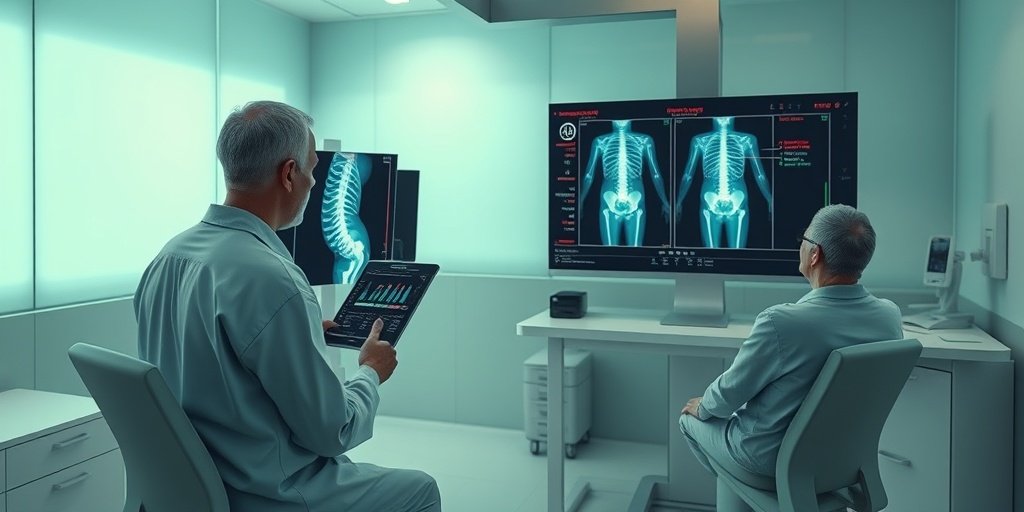
The study implemented the YOLOv4 technique to develop a model capable of classifying osteoporosis and detecting compression fractures from X-ray images. By extracting trabecular characteristics from the caput femoris and analyzing lateral spine images, the researchers aimed to create a robust inference model that could operate effectively in real-time clinical settings.
📈 Results
The YOLOv4 model achieved a commendable prediction accuracy of 78.1% for osteoporosis classification and 68.3% for compression fracture detection. These results suggest that X-ray imaging can be effectively utilized as a screening tool, particularly in environments where DXA facilities are not available, thereby enhancing patient care and diagnostic efficiency.
🌍 Impact and Implications
The findings of this study have significant implications for the future of medical diagnostics. By leveraging deep learning technologies like YOLOv4, healthcare providers can improve the accuracy and accessibility of osteoporosis screening. This approach not only facilitates early detection but also optimizes patient management by identifying individuals who may require further evaluation and treatment.
🔮 Conclusion
This research highlights the transformative potential of artificial intelligence in the field of medical diagnostics. With a prediction accuracy nearing 80%, the YOLOv4 model represents a significant advancement in the classification of osteoporosis and detection of compression fractures. Continued exploration and development of such technologies could lead to improved healthcare outcomes and more efficient use of resources in clinical settings.
💬 Your comments
What are your thoughts on the integration of AI in medical diagnostics? We would love to hear your insights! 💬 Share your comments below or connect with us on social media:
Classification of Osteoporosis and Detection of Compression Fractures by Implementing Real-Time Object Detection System Upon Medical Radiographs.
Abstract
AIM: Artificial intelligence and machine learning have been increasingly employed in medical image diagnosis, but face the challenge of database acquisition. Hence, this study applies the You Only Look Once (YOLO) technique, a real-time object detection system, to construct the inference model, including the image preprocessing and labeling, model training, and the prediction of unknown data to detect objects.
METHODS: We implement the YOLOv4 technique to classify osteoporosis and detect compression fractures. Trabecular characteristics of osteoporosis are extracted from caput femoris in X-ray images, and compression fractures are observed in lateral spine images. All the datasets are derived from the clinical practice of the collaborated teaching hospital.
RESULTS: We construct the YOLOv4 model to classify osteoporosis and detect compression fractures with prediction accuracy of 78.1% and 68.3%, respectively. X-ray could be a screening tool to predict osteoporosis and select patients for DXA, especially in settings where the DXA facility is unavailable.
CONCLUSION: We find it promising to apply the developed approach to medical diagnosis with an accuracy of near 80%, and this deep learning model could preliminarily help to screen possible positives from abundant radiographs.
Author: [‘Chen AC’, ‘Weng JH’, ‘Chen CW’, ‘Yang CC’, ‘Wei JC’]
Journal: Int J Rheum Dis
Citation: Chen AC, et al. Classification of Osteoporosis and Detection of Compression Fractures by Implementing Real-Time Object Detection System Upon Medical Radiographs. Classification of Osteoporosis and Detection of Compression Fractures by Implementing Real-Time Object Detection System Upon Medical Radiographs. 2026; 29:e70592. doi: 10.1111/1756-185x.70592