
⚡ Quick Summary
This study introduces the TRACT-NET, a novel deep learning model designed to classify stroke severity using diffusion-weighted imaging (DWI) and the National Institutes of Health Stroke Scale (NIHSS). The model demonstrated impressive performance, achieving a 0.8137 accuracy on the AMC dataset and a 0.7094 AUC on the SOOP dataset, indicating its potential utility in emergency stroke assessment.
🔍 Key Details
- 📊 Dataset: 273 patients from Asan Medical Center (AMC) and 1,106 patients from the Stroke Outcome Optimization Project (SOOP)
- 🧩 Features used: Diffusion-weighted imaging (DWI) scans and NIHSS scores
- ⚙️ Technology: Mixture-of-skip-connection deep learning model (TRACT-NET)
- 🏆 Performance: AMC dataset: 0.8137 accuracy, 0.9645 specificity; SOOP dataset: 0.6896 accuracy, 0.7881 specificity
🔑 Key Takeaways
- 🧠 TRACT-NET utilizes a mixture-residual block for enhanced feature representation.
- 🔍 3D coordinate-attentive and self-attentive modules improve the model’s ability to capture long-range dependencies.
- 📈 High performance in predicting binary stroke severity, outperforming traditional classification models.
- 💡 Sensitivity and specificity metrics indicate robust discriminative performance in stroke assessment.
- 🌟 Clinical relevance highlighted through gradient-weighted class activation mapping focusing on critical DWI regions.
- 🚑 Potential application in emergency settings for rapid stroke severity assessment.
- 📅 Study conducted at Asan Medical Center and validated on the SOOP dataset.
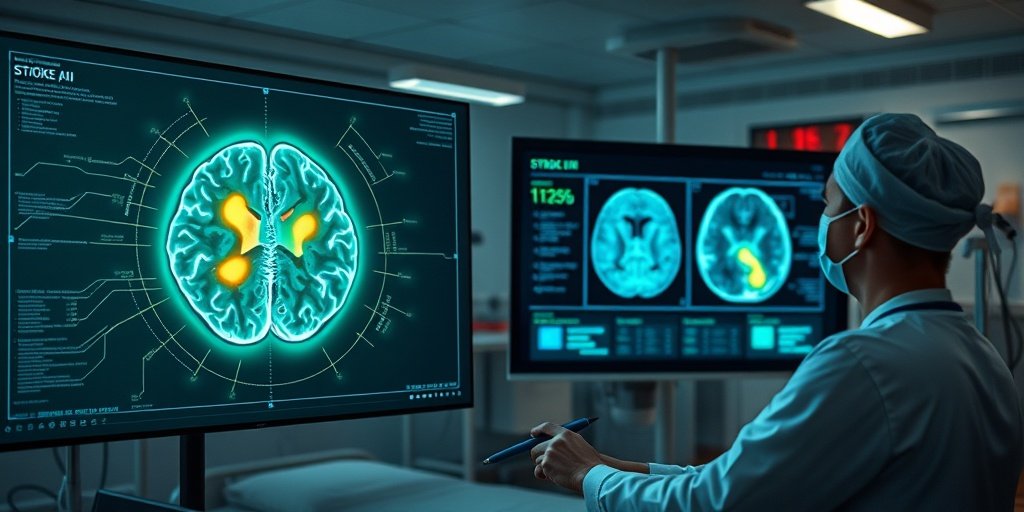
📚 Background
Stroke assessment is crucial for effective management and treatment decisions. The NIHSS is a widely used tool for grading neurological deficits; however, it is often criticized for being labor-intensive and subject to interrater variability. The integration of advanced technologies such as deep learning can potentially streamline this process, providing more consistent and accurate assessments.
🗒️ Study
The study aimed to develop a deep learning model, TRACT-NET, to classify stroke severity based on DWI scans and NIHSS scores. Researchers utilized data from 273 patients at Asan Medical Center and validated their findings on an external dataset comprising 1,106 patients from the Stroke Outcome Optimization Project (SOOP).
📈 Results
TRACT-NET demonstrated remarkable performance, achieving a 0.8137 accuracy and 0.9645 specificity on the AMC dataset. In the SOOP dataset, it achieved a 0.6896 accuracy and 0.7881 specificity. These results underscore the model’s ability to effectively predict stroke severity, making it a promising tool for clinical use.
🌍 Impact and Implications
The findings from this study suggest that TRACT-NET could significantly enhance stroke severity assessment in emergency situations. By providing rapid and accurate predictions, this model could facilitate timely treatment decisions, ultimately improving patient outcomes. The integration of such advanced technologies in clinical practice could revolutionize how strokes are managed.
🔮 Conclusion
The development of TRACT-NET highlights the potential of deep learning in the realm of stroke assessment. With its impressive performance metrics, this model could serve as a valuable tool for healthcare professionals, aiding in the swift evaluation of stroke severity. Continued research and validation are essential to fully realize its capabilities and integrate it into clinical workflows.
💬 Your comments
What are your thoughts on the use of deep learning for stroke assessment? We would love to hear your insights! 💬 Leave your comments below or connect with us on social media:
Mixture-of-Skip-Connection Deep Learning Model to Classify Stroke Severity from Diffusion Weighted Imaging Based on NIHSS.
Abstract
The National Institutes of Health Stroke Scale (NIHSS) is a quantitative tool, grading neurological deficits and guiding acute stroke management; however, bedside scoring is labor-intensive, time-consuming, and subject to interrater variability. This study proposes the TRansformer And Coordinate-aTtention NETwork (TRACT-NET), which includes a mixture-residual block, to predict stroke severity based on NIHSS score and diffusion-weighted imaging (DWI) scans. A 3D coordinate-attentive module and a 3D efficient self-attentive module were embedded into the mixture block for skip connection, enhancing feature representation by capturing axis awareness and long-range dependency. In the bottleneck stage, Mamba, a selective state-space model, was used to refine feature maps capturing relevant information from long sequences. TRACT-NET was evaluated with three-fold cross-validation of DWI and NIHSS data from 273 patients at Asan Medical Center (AMC) and externally validated on Stroke Outcome Optimization Project (SOOP) dataset, which includes 1106 patients. Patients were divided into binary groups: minor and non-minor strokes. TRACT-NET outperformed other classification models in predicting binary stroke severity. On the AMC dataset, it achieved 0.81 sensitivity, 0.9645 specificity, 0.8188 positive predictive value (PPV), 0.8054 negative predictive value (NPV), 0.7946 F1-score, 0.8137 accuracy, and 0.8137 area under the curve (AUC). On the SOOP dataset, the model achieved 0.6896 sensitivity, 0.7881 specificity, 0.7054 PPV, 0.6360 NPV, 0.6875 F1-score, 0.6896 accuracy, and 0.7094 AUC. Receiver operating characteristic curves demonstrated robust discriminative performance, whereas gradient-weighted class activation mapping results highlighted that TRACT-NET focused on clinically relevant DWI regions. These findings suggest TRACT-NET could assist stroke severity assessment in emergency situations, facilitating effective treatment decisions.
Author: [‘Oh S’, ‘Jeong H’, ‘Cho Y’, ‘Kim K’, ‘Kim C’, ‘Jeong DY’, ‘Kim BJ’]
Journal: J Imaging Inform Med
Citation: Oh S, et al. Mixture-of-Skip-Connection Deep Learning Model to Classify Stroke Severity from Diffusion Weighted Imaging Based on NIHSS. Mixture-of-Skip-Connection Deep Learning Model to Classify Stroke Severity from Diffusion Weighted Imaging Based on NIHSS. 2026; (unknown volume):(unknown pages). doi: 10.1007/s10278-026-01892-5