
⚡ Quick Summary
This study explored the use of Denoising Diffusion Probabilistic Models (DDPM) to generate synthetic MRI images, enhancing brain tumor classification across diverse datasets. The incorporation of mutual information (MI) regularization significantly improved classification accuracy, achieving up to 89% accuracy in cross-dataset evaluations.
🔍 Key Details
- 📊 Dataset: 559 patients with low and high-grade brain tumors from BraTS (n=335) and TASMC (n=224)
- ⚙️ Technology: Denoising Diffusion Probabilistic Models (DDPM) with and without mutual information (MI)
- 🏆 Performance Metrics: FID = 31.47, IS = 1.50 for DDPM with MI
- 🔍 Classification Model: 2D ResNet-152 trained under various setups
🔑 Key Takeaways
- 🧠 DDPM models generated high-quality synthetic MRI images, enhancing data diversity.
- 💡 Mutual Information (MI) regularization improved both image quality and variability.
- 📈 Cross-dataset evaluation showed superior generalization performance with accuracies of 0.89 and 0.85.
- 🏅 Results outperformed baseline models and traditional data augmentation techniques.
- 🌍 This approach offers a robust solution for clinical applications across institutions.
- 📉 Lower FID and higher IS indicate enhanced realism in generated images.
- 🔄 Ensemble learning further strengthened the model’s performance.
📚 Background
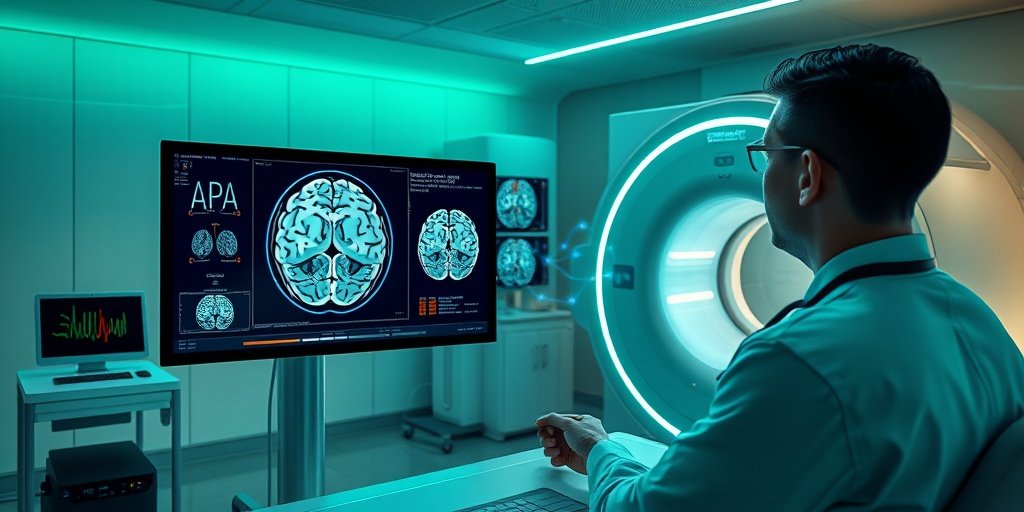
The classification of brain tumors is a critical aspect of medical imaging, yet the limited availability of high-quality training data poses significant challenges. Deep generative models like DDPM can address this issue by creating realistic synthetic images, thereby enriching training datasets and improving the generalization of deep learning models in medical imaging.
🗒️ Study
This retrospective study included a total of 559 patients diagnosed with low-grade glioma (LGG) and high-grade glioma (HGG). The researchers trained DDPM models to generate synthetic MRI images, assessing their quality through various metrics. The classification performance was evaluated using a 2D ResNet-152 model under four different setups, including the use of MI regularization.
📈 Results
The results demonstrated that DDPM models, particularly those incorporating MI, produced synthetic images with a FID of 31.47 and an Inception Score (IS) of 1.50. The cross-dataset evaluations revealed that the models with MI achieved accuracies of 0.89 and 0.85 for BraTS-to-TASMC and TASMC-to-BraTS evaluations, respectively, outperforming traditional methods and the baseline model.
🌍 Impact and Implications
The findings from this study have significant implications for the field of medical imaging and brain tumor classification. By leveraging DDPM and MI, healthcare professionals can enhance diagnostic accuracy and improve patient outcomes. This innovative approach not only addresses the challenge of limited training data but also paves the way for more robust and generalizable models in clinical settings.
🔮 Conclusion
This study highlights the transformative potential of combining DDPM with mutual information regularization in enhancing brain tumor classification. The significant improvements in accuracy and generalization across diverse datasets suggest a promising future for the integration of advanced generative models in medical imaging. Continued research in this area could lead to even more breakthroughs in diagnostic technologies.
💬 Your comments
What are your thoughts on the use of synthetic images in medical imaging? We would love to hear your insights! 💬 Leave your comments below or connect with us on social media:
Enhancing Brain Tumor Classification and Generalization Using DDPM-Generated MRI, Mutual Information and Ensemble Learning.
Abstract
BackgroundDeep generative models can improve the generalization of deep learning in medical imaging by enriching limited training data with diverse, realistic synthetic images.PurposeTo assess whether Denoising Diffusion Probabilistic Models (DDPM) generated synthetic MRI, with and without mutual information (MI) regularization, enhances brain tumor classification across heterogeneous datasets.Study TypeRetrospective.PopulationA total of 559 patients with low and high grade brain tumors (LGG, HGG) were included from two datasets: public dataset (BraTS, n = 335) and clinical dataset (TASMC, n = 224), used exclusively to evaluate model generalization.Field Strength/Sequence1.5 T/3.0T-MR / T1WI, T1WI + C, T2WI, and FLAIR images.AssessmentDDPM models were trained to generate synthetic MR images of low grade glioma (LGG) and high grade glioma (HGG), with a variant incorporating MI. Image quality was assessed using Pearson-correlation, Frechet-Inception-Distance (FID) and Inception-Score (IS). For classification purposes. For classification, a 2D ResNet-152 was trained under four setups: (1) real images (baseline), (2) +augmentation, (3) +DDPM, and (4) +DDPM + MI. Performance was assessed by accuracy and F1-score. Robustness was tested through cross-dataset evaluation using a 5-fold ensemble.ResultsThe DDPM models, with and without MI, generated high-quality synthetic images, achieving FID = 31.47, 45.00, and IS = 1.50, 1.25, respectively. Lower FID and higher IS indicate enhanced realism and diversity, suggesting that MI improved both the quality and variability of the generated images. Cross-dataset evaluation demonstrated that DDPMs with MI achieved superior generalization performance in brain tumor classification task, with accuracies of 0.89 and 0.85 for BraTS-to-TAMSC and TAMSC-to-BraTS evaluations, respectively. These results outperform the baseline model (0.87, 0.80), traditional data augmentation (0.85, 0.78), and the standard DDPM without MI (0.82, 0.83).Data ConclusionDDPM + MI with ensemble learning significantly improves brain tumor generalization across diverse datasets, consistently outperforming baseline, traditional augmentation, and standard DDPM. This combination offers a robust solution for cross-institutional clinical applications.
Author: [‘Moshe YH’, ‘Teicher M’, ‘Artzi M’]
Journal: Technol Cancer Res Treat
Citation: Moshe YH, et al. Enhancing Brain Tumor Classification and Generalization Using DDPM-Generated MRI, Mutual Information and Ensemble Learning. Enhancing Brain Tumor Classification and Generalization Using DDPM-Generated MRI, Mutual Information and Ensemble Learning. 2026; 25:15330338251405180. doi: 10.1177/15330338251405180