⚡ Quick Summary
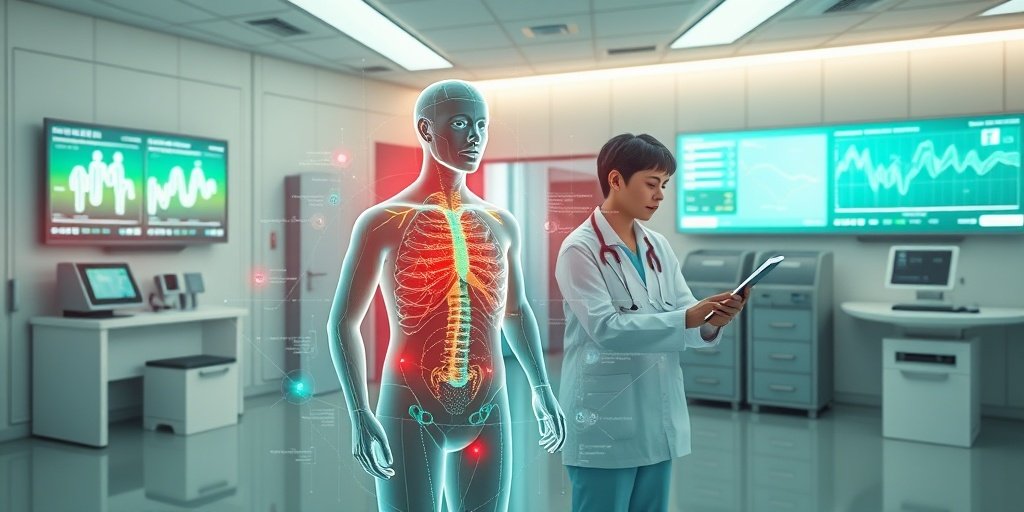
The article discusses the innovative concept of digital twins (DTs) in healthcare, which utilize continuous data from sensors and wearables, combined with artificial intelligence (AI), to enhance early disease detection and personalized treatment. This transformative approach promises to reshape clinical practice by enabling preventive care before symptoms manifest.
🔍 Key Details
- 📊 Technology: Digital twins integrating data from sensors and wearables
- 🔍 Applications: Early disease detection, personalized treatment simulations
- 🔗 Security: Blockchain for secure data exchange and patient consent
- 🏥 Fields of Impact: Cardiology, oncology, metabolic health
🔑 Key Takeaways
- 🌐 Digital twins represent a new paradigm in healthcare, merging real-time data with AI.
- 💡 Preventive interventions can be initiated before symptoms appear, enhancing patient outcomes.
- 🔒 Blockchain technology ensures secure data handling and patient privacy.
- 📈 Multimodal data streams provide actionable insights for healthcare professionals.
- 👩⚕️ Personalized care is made possible through simulations of treatment responses.
- ⚖️ Ethical considerations regarding privacy and interoperability are crucial in this evolving field.
- 🌍 The integration of DTs could revolutionize clinical practices across various medical specialties.
📚 Background
The healthcare landscape is rapidly evolving, with technology playing a pivotal role in enhancing patient care. The concept of digital twins—virtual replicas of patients—has emerged as a groundbreaking approach that leverages continuous data collection from various sources. This innovation aims to provide healthcare professionals with the tools necessary for early detection and personalized treatment, ultimately leading to improved patient outcomes.
🗒️ Study
The article by Padliya T. explores the transformative potential of digital twins in healthcare. It highlights how these virtual patient replicas can evolve in real time by integrating data from sensors and wearables, coupled with the predictive capabilities of AI. The study emphasizes the importance of this technology in fields such as cardiology, oncology, and metabolic health, showcasing its ability to generate actionable foresight for healthcare providers.
📈 Results
The integration of digital twins in healthcare has shown promising results, particularly in the areas of early disease detection and personalized treatment simulations. By utilizing multimodal data streams, healthcare professionals can gain insights that were previously unattainable, allowing for timely interventions and improved patient management strategies.
🌍 Impact and Implications
The implications of digital twins in healthcare are profound. By enabling preventive care and personalized treatment plans, this technology has the potential to significantly enhance patient outcomes. Furthermore, the incorporation of blockchain technology ensures that patient data is handled securely, addressing privacy concerns that are increasingly relevant in today’s digital age. As digital twins continue to evolve, they may redefine the standards of clinical practice and patient care.
🔮 Conclusion
The exploration of digital twins in healthcare reveals an exciting frontier that combines technology with patient care. This innovative approach not only facilitates early disease detection and personalized treatment but also emphasizes the importance of ethical considerations in data handling. As we look to the future, the integration of digital twins could lead to a more precise and effective healthcare system, ultimately benefiting patients and providers alike.
💬 Your comments
What are your thoughts on the potential of digital twins in healthcare? We would love to hear your insights! 💬 Share your comments below or connect with us on social media:
One Patient, Two Worlds: Digital Twins for Everyday Prevention and Care.
Abstract
Digital twins (DTs) are emerging as a transformative paradigm in health care, combining continuous data from sensors, real-world insights from wearables, and predictive power from artificial intelligence (AI). These virtual patient replicas evolve in real time, enabling early disease detection, personalized simulation of treatment responses, and preventive interventions before symptoms appear. Recent advances in cardiology, oncology, and metabolic health illustrate how digital twins integrate multimodal data streams to generate actionable foresight. Coupled with blockchain for secure data exchange and patient consent, digital twins stand at the intersection of precision medicine and ethical innovation. This article explores the evolving role of digital twins in health care detection and preventive care, highlighting how sensors, wearables, and AI converge to reshape the future of clinical practice. This article also discusses privacy, interoperability, and regulatory guardrails.
Author: [‘Padliya T’]
Journal: IEEE Pulse
Citation: Padliya T. One Patient, Two Worlds: Digital Twins for Everyday Prevention and Care. One Patient, Two Worlds: Digital Twins for Everyday Prevention and Care. 2025; 16:22-26. doi: 10.1109/MPULS.2025.3618425