⚡ Quick Summary
This study evaluated the performance of two fully automated AI-based CAD software programs in designing 3-unit fixed dental prostheses (FDPs). The results indicated that while both systems improved design efficiency, human oversight remains crucial for optimal outcomes, particularly in anterior FDPs.
🔍 Key Details
- 📊 Sample Size: 30 FDPs (12 anterior and 18 posterior)
- 🧩 Participants: Certified Dental Technician (CDT), dentbird (DB), and Atomica AI (AA)
- ⚙️ Evaluation Criteria: 11-criteria acceptability score and root mean square (RMS) deviation analysis
- 🏆 Success Rates: DB 100%, AA 93% (83% anterior, 100% posterior)
🔑 Key Takeaways
- 🤖 AI Systems: Both CAD programs demonstrated variable performance in FDP design.
- 🏆 Acceptability Scores: AA’s scores were comparable to CDT, especially in posterior FDPs.
- 📉 Performance Issues: DB underperformed in anterior FDPs, particularly in esthetic and functional areas.
- ⏱️ Efficiency: Both AI systems significantly reduced design time, with AA being faster in anterior FDPs.
- 🔍 Areas for Improvement: Both AI programs scored lower than CDT in occlusal and proximal contact areas.
- 📈 RMS Deviation: AA showed lower RMS deviation than DB in anterior FDPs.
- 👨⚕️ Human Oversight: Essential for ensuring optimal design in critical areas.
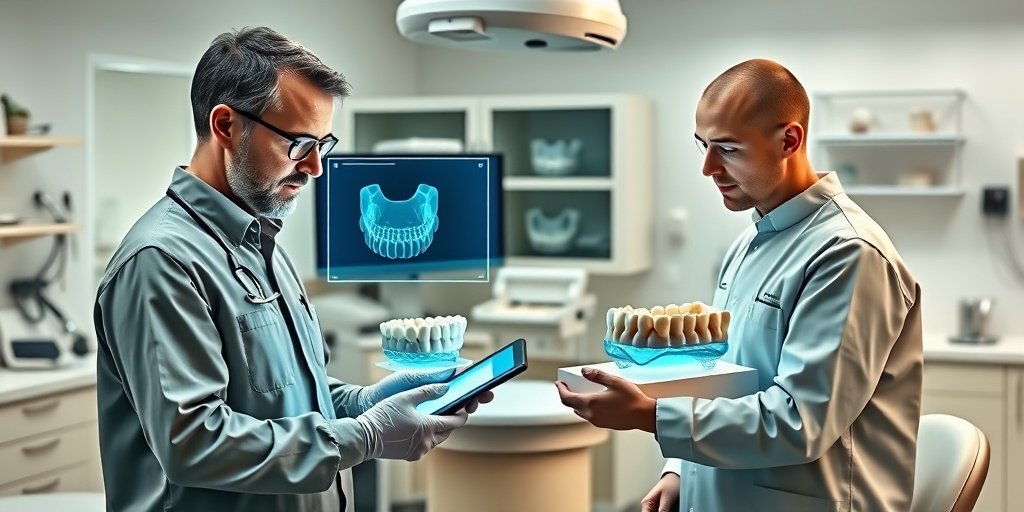
📚 Background
The advent of artificial intelligence (AI) in dentistry has opened new avenues for enhancing the design of dental prostheses. While previous studies have shown promise for single-unit crown designs, the effectiveness of AI in creating multi-unit fixed dental prostheses remains largely unexplored. This study aims to fill that gap by comparing the performance of two fully automated CAD software programs against traditional methods employed by dental technicians.
🗒️ Study
Conducted in vitro, this study involved the design of 30 fixed dental prostheses using digital scans of natural abutments. The designs were created by a Certified Dental Technician (CDT) and two AI systems: dentbird (DB) and Atomica AI (AA). The evaluation was performed by three calibrated prosthodontists who assessed the designs based on an 11-criteria acceptability score and conducted RMS deviation analysis to quantify accuracy.
📈 Results
The findings revealed that DB successfully generated all designs (100%), while AA achieved a 93% overall success rate. Notably, AA’s acceptability scores were comparable to those of CDT, particularly in posterior FDPs. However, both AI systems scored lower than CDT in critical areas such as occlusal and proximal contacts, highlighting the need for human intervention in these aspects. Furthermore, AA demonstrated a lower RMS deviation than DB in anterior FDPs, indicating a higher level of accuracy.
🌍 Impact and Implications
The implications of this study are significant for the field of dentistry. The integration of AI-based CAD systems can enhance the efficiency of prosthetic design, potentially reducing turnaround times and improving patient outcomes. However, the findings also underscore the importance of human oversight in ensuring that critical design elements meet the necessary esthetic and functional standards. As technology continues to evolve, a collaborative approach between AI and dental professionals may yield the best results.
🔮 Conclusion
This study highlights the potential of AI in revolutionizing dental prosthesis design. While both automated systems demonstrated improvements in efficiency, the variability in performance suggests that human expertise remains indispensable, particularly in complex cases. Future research should focus on refining these technologies and exploring their integration into everyday dental practice to maximize their benefits.
💬 Your comments
What are your thoughts on the use of AI in dental prosthesis design? Do you believe that technology can fully replace human expertise, or is a collaborative approach the way forward? 💬 Share your insights in the comments below or connect with us on social media:
Acceptability, deviation, and efficiency of 2 fully automated CAD software programs in designing 3-unit fixed dental prostheses: A comparative study.
Abstract
STATEMENT OF PROBLEM: Fully automated artificial intelligence (AI)-based computer-aided design (CAD) software programs have shown promise for single-unit crown design, but their accuracy, acceptability, and efficiency in designing multi-unit fixed dental prostheses (FDPs) remain unclear.
PURPOSE: This in vitro study evaluated the design acceptability, trueness, and efficiency of 2 commercially available fully automated AI -based CAD software programs in designing anterior and posterior 3-unit FDPs compared with those designed by dental laboratory technicians.
MATERIAL AND METHODS: Digital scans of natural abutments prepared for 3-unit fixed dental prostheses (12 anterior and 18 posterior FDPs) were replicated into 3 sets and allocated for restoration design by Certified Dental Technician (CDT), dentbird (DB), and Atomica AI (AA). Restoration designs were evaluated qualitatively using an 11-criteria acceptability score by 3 calibrated prosthodontists and quantitatively using root mean square (RMS) deviation analysis. CAD times were recorded for each group. Statistical analyses included the Kruskal-Wallis test followed by the Dunn post hoc test, paired t test, and repeated-measure ANOVA followed by the paired t test to evaluate intergroup differences (α=.05).
RESULTS: DB successfully generated all designs (100%), while AA achieved a 93% overall success rate (83% for anterior and 100% posterior FDPs). AA obtained acceptability scores comparable with those of CDT, particularly in posterior FDPs, while DB exhibited significantly lower scores, especially in anterior FPDs. Both AI programs scored lower than CDT in occlusal and proximal contact areas and connector size (P<.001). AA demonstrated lower RMS deviation than DB in anterior FDPs (P<.05). Both AI systems significantly reduced design time, with AA completing design faster than DB in anterior FDPs (P<.05).
CONCLUSIONS: Fully automated AI-based CAD systems demonstrated variable performance in 3-unit FDP design. AA achieved acceptable trueness and morphology, particularly in posterior regions, while DB underperformed in esthetic and functional areas. Although both systems improved design efficiency, human oversight remains essential for occlusal and proximal contact, connector design, and anterior FDPs.
Author: [‘Sawangsri K’, ‘Bekkali M’, ‘Hsieh YL’, ‘Lai YC’, ‘Ucar Y’, ‘Hammoudeh HS’]
Journal: J Prosthet Dent
Citation: Sawangsri K, et al. Acceptability, deviation, and efficiency of 2 fully automated CAD software programs in designing 3-unit fixed dental prostheses: A comparative study. Acceptability, deviation, and efficiency of 2 fully automated CAD software programs in designing 3-unit fixed dental prostheses: A comparative study. 2025; (unknown volume):(unknown pages). doi: 10.1016/j.prosdent.2025.11.034